
SBA Preferred Lenders List: 12 Top PLP Banks By State 2026
Not all SBA lenders operate at the same speed. Banks with Preferred Lender Program (PLP) status have the authority to approve loans internally, which means your application doesn't sit in an SBA queue for weeks. If you're searching for an SBA preferred lenders list, that distinction alone can shave weeks, sometimes months, off your timeline to funding.
The problem? The SBA doesn't exactly make it easy to find these lenders. There's no clean, public-facing directory sorted by state or loan type. You're left digging through FOIA data, outdated PDFs, and vague referral pages. Having helped business owners secure SBA 7(a) and 504 loans through our commercial financing services at David Roa, I've seen firsthand how choosing the wrong lender stalls deals that should have closed months ago. The lender you pick matters as much as the loan program itself.
So I did the legwork. This article breaks down 12 top PLP banks by state for 2026, based on actual lending volume, program participation, and approval authority. Whether you need working capital, commercial real estate financing, or equipment funding, this list gives you a concrete starting point, not a generic bank directory. I'll also cover how the Preferred Lender Program works, what makes these banks different, and how to match the right lender to your specific situation.
1. David Roa
Before you spend hours contacting banks on any SBA preferred lenders list, talking to a broker who already has established relationships with PLP lenders saves you time and prevents costly mismatches. With over 25 years of experience and more than $150 million funded, David Roa works directly with borrowers to identify which preferred lender fits their situation, then guides the application through to close.
Where David can place your loan by state
David is licensed to work with lending partners across multiple states, with particular strength in the Chicago metropolitan area and the broader Midwest. Beyond Illinois, David connects borrowers with PLP lenders active in California, Texas, Florida, and several other markets depending on loan type and borrower profile. If your business operates in a specific state, the first conversation will clarify which preferred lenders in that geography are realistically accessible for your deal.
SBA programs and deal types David focuses on
David specializes in SBA 7(a) loans for working capital, business acquisition, and owner-occupied commercial real estate. He also facilitates SBA 504 transactions for fixed-asset purchases where long-term, below-market rates make more sense than a 7(a) structure. Beyond standard SBA programs, David works on DSCR loans, hard money, and fix-and-flip financing, so if your deal doesn't fit a traditional SBA box, there are other paths worth discussing.
The right lender for your SBA loan depends on your industry, revenue structure, and how quickly you need to close, not just which bank has the highest approval volume.
What to prepare before your first call
You'll move faster if you bring two to three years of business tax returns, recent bank statements, and a clear picture of how you plan to use the loan proceeds. For acquisitions, a purchase agreement or letter of intent helps David identify which lenders will move quickly on your specific transaction rather than asking you to start over later in the process.
Questions David will help you ask PLP lenders
David will help you press lenders on approval timelines, collateral requirements, and whether they'll hold the loan in-house or sell it on the secondary market. Knowing those answers upfront prevents surprises at closing. You can reach David directly at davidroa.net to start that conversation.
2. Newtek Bank
Newtek Bank holds SBA Preferred Lender Program status and operates as a technology-forward lender that processes applications entirely online, making it one of the more straightforward names on any SBA preferred lenders list. Their digital infrastructure means you aren't dependent on branch availability or a local relationship manager to move your deal forward.
States where Newtek lends and how they operate
Newtek lends nationwide, so geography is rarely a limiting factor for borrowers. The entire process runs through their online platform, from initial application to final approval. You submit documents digitally, communicate with a dedicated loan officer remotely, and track progress through their portal rather than waiting on branch callbacks.

What Newtek tends to fund with SBA 7(a) loans
Newtek focuses primarily on SBA 7(a) loans for business acquisitions, working capital, debt refinancing, and commercial real estate purchases. They handle both standard 7(a) loans up to $5 million and smaller amounts, which gives you flexibility depending on where your deal falls in size.
If your primary goal is speed and you're comfortable with an all-digital process, Newtek's structure removes several friction points that slow down traditional bank timelines.
Borrower profile Newtek usually prefers
Newtek typically works with established businesses showing at least two years of operating history and consistent revenue. Strong personal credit, generally above 680, improves your approval odds considerably with their underwriting team.
Questions to ask Newtek before you apply
Ask Newtek about their current approval timelines and whether they retain the loan in-house or sell it on the secondary market. Also confirm which collateral types they accept for your specific loan size before you commit time to gathering paperwork.
3. Huntington National Bank
Huntington National Bank consistently ranks as one of the highest-volume SBA 7(a) lenders in the country, making it a reliable name on any SBA preferred lenders list. Their dedicated small business lending team and established PLP status mean your application gets reviewed and approved internally, without waiting on the SBA for a green light.
States where Huntington is most active
Huntington operates primarily across the Midwest and Mid-Atlantic, with strong SBA lending presence in Ohio, Michigan, Illinois, Indiana, Kentucky, Pennsylvania, and West Virginia. If your business is located in one of these states, Huntington likely has a local SBA specialist who handles deals in your market regularly.
What Huntington does well for SBA borrowers
Their team excels at SBA 7(a) loans for owner-occupied commercial real estate and business acquisitions. Volume and experience with these transaction types means the underwriting team moves efficiently on deals that fit their standard criteria, which reduces back-and-forth during review.
Huntington's SBA loan volume has placed them among the top five 7(a) lenders nationally in recent years, which signals that their process is built to close deals, not just originate applications.
What Huntington looks for in owners and businesses
Expect Huntington to review at least two years of business tax returns and a minimum personal credit score around 680. They place real weight on cash flow consistency and your demonstrated ability to cover debt service from operating revenue rather than projected income.
Questions to ask Huntington before you apply
Ask your Huntington loan officer about their current timeline from application to approval and what collateral they require for your specific loan amount. Confirm whether they service the loan in-house after closing, since that affects your relationship once you're in repayment.
4. Live Oak Banking Company
Live Oak Banking Company holds SBA Preferred Lender Program status and built its entire model around SBA lending, making it one of the most specialized names on any SBA preferred lenders list. Unlike traditional banks that treat SBA loans as one product among dozens, Live Oak treats SBA lending as its core business, which shows in their underwriting depth and turnaround times.
States served and how the process works remotely
Live Oak lends nationwide and operates without a branch network, handling the full process remotely through a digital platform and dedicated loan officers. This setup works well if you're in a market without strong local SBA lender options or if you simply prefer a streamlined, document-focused process over in-person meetings.
Best-fit SBA loan uses and industries at Live Oak
Live Oak built its reputation around industry-specific SBA lending, with deep underwriting expertise in veterinary practices, dental offices, pharmacies, funeral homes, self-storage facilities, and financial advisory firms. They use SBA 7(a) and SBA 504 loans for acquisitions, real estate, and working capital within those sectors, giving you an evaluator who genuinely understands your industry's financials.

If your business falls into one of Live Oak's target industries, their sector-specific experience often translates into faster approvals and fewer documentation surprises.
Minimums and underwriting focus to expect
Live Oak typically works with loan amounts starting around $500,000, so smaller requests may not fit their model. Their underwriting team prioritizes industry-specific cash flow analysis over generic financial ratios, which benefits borrowers in sectors with non-standard revenue patterns.
Questions to ask Live Oak before you apply
Ask whether your industry falls within their active focus areas and what their current timeline looks like from application to approval. Confirm whether they require collateral beyond business assets for your loan size, since their requirements vary depending on deal structure and industry type.
5. U.S. Bank
U.S. Bank carries SBA Preferred Lender Program status and brings a national branch footprint that gives borrowers access to in-person support alongside digital application tools. As one of the largest banks in the country, U.S. Bank processes SBA approvals internally, keeping your application out of the SBA review queue and on a faster path to funding. For borrowers who want a nationally recognized institution on this SBA preferred lenders list, U.S. Bank is worth a direct conversation.
Where U.S. Bank has branches and lends SBA
U.S. Bank operates branches across 26 states, with the heaviest concentration in the Midwest, West, and Pacific Northwest. States like Minnesota, Ohio, California, Colorado, and Washington represent particularly strong markets where their SBA teams close deals regularly. Their physical branch network means you can work with a local loan officer face-to-face rather than managing everything remotely.
Best-fit SBA loan uses at U.S. Bank
U.S. Bank handles SBA 7(a) loans for working capital, equipment purchases, business acquisitions, and owner-occupied commercial real estate. They also participate in the SBA 504 program for fixed-asset financing, giving you options if long-term, fixed-rate funding fits your project better than a standard 7(a) structure.
U.S. Bank's combination of branch access and PLP authority makes it a realistic option for borrowers who want a familiar institution with internal approval speed.
What U.S. Bank typically requires to qualify
Expect U.S. Bank to review two to three years of business tax returns and personal financial statements from all owners holding 20% or more. They typically want a personal credit score of 680 or higher and clear evidence that your business generates enough cash flow to cover the proposed debt service comfortably.
Questions to ask U.S. Bank before you apply
Ask your U.S. Bank loan officer about current processing timelines and whether your business type falls within their active SBA lending focus. Confirm what collateral they require for your specific loan amount, and find out whether they service the loan in-house after closing so you know who to contact if issues arise during repayment.
6. TD Bank
TD Bank holds SBA Preferred Lender Program status and runs one of the stronger regional SBA programs on the East Coast. Their PLP authority means your application moves through internal approval rather than waiting on an SBA queue, making them a practical name to know on any SBA preferred lenders list if your business operates in the eastern United States.
States where TD Bank is a strong PLP option
Their SBA lending activity concentrates heavily along the East Coast, with strong presence in states including Maine, New Hampshire, Vermont, Massachusetts, Connecticut, Rhode Island, New York, New Jersey, Pennsylvania, Delaware, Maryland, Virginia, North Carolina, South Carolina, Florida, and Washington D.C. If your business operates in any of these markets, TD Bank has established SBA teams with direct knowledge of local conditions.
For East Coast borrowers, TD Bank's regional concentration often translates into faster local decisions compared to purely national lenders operating without branch presence in your market.
SBA loan types TD commonly closes
TD Bank primarily closes SBA 7(a) loans for working capital, business acquisitions, and commercial real estate. They also handle equipment financing through SBA structures for businesses that need asset-specific funding with favorable repayment terms.
What TD expects from documentation and cash flow
Expect TD Bank to review two to three years of business tax returns along with personal financial statements from all owners holding 20% or more. Their underwriters focus closely on consistent revenue trends and your ability to cover proposed debt obligations from operating cash flow rather than projections.
Questions to ask TD before you apply
Ask TD whether your industry qualifies under their current SBA lending priorities and what their timeline from application to closing looks like right now. Also confirm whether they retain the loan after closing or sell it on the secondary market, since that affects your servicing relationship going forward.
7. M&T Bank
M&T Bank holds SBA Preferred Lender Program status and focuses its SBA activity on regional markets where it maintains deep community banking relationships. Their internal approval authority keeps your application moving without an SBA queue, and their loan officers tend to work closely with borrowers throughout the process rather than handing files off between departments.
States where M&T is available for SBA lending
M&T Bank operates primarily across the Mid-Atlantic and Northeast, with active SBA lending in New York, New Jersey, Pennsylvania, Maryland, Delaware, Virginia, West Virginia, Connecticut, and parts of New England. If your business sits within this footprint, M&T belongs on your SBA preferred lenders list as a realistic regional option worth contacting early.
When M&T makes sense for smaller SBA requests
M&T works well for borrowers pursuing loan amounts in the lower to mid range of the 7(a) program, particularly for working capital, equipment financing, and owner-occupied commercial real estate. Their regional focus means you get a loan officer familiar with your local market rather than someone evaluating your deal from a national template.
Borrowers who already have a deposit or checking relationship with M&T often find the underwriting process moves faster because the bank already holds visibility into your cash flow patterns.
What M&T looks for in credit and capacity
M&T typically expects a personal credit score of at least 680 and two to three years of business tax returns demonstrating consistent revenue. Their underwriters weigh debt service coverage closely, so you'll want to show clear operating income above your projected loan payments before you apply.
Questions to ask M&T before you apply
Ask your M&T loan officer about current timelines from application to approval and whether your business type and loan size fall within their active SBA focus. Confirm what collateral requirements apply at your requested loan amount and whether they service the loan internally after closing.
8. Celtic Bank
Celtic Bank holds SBA Preferred Lender Program status and consistently ranks among the top SBA 7(a) lenders nationally by volume. Based in Salt Lake City, Utah, Celtic operates as an online-first institution, which means their process doesn't rely on branch visits or local relationship managers to move your application forward.
Where Celtic lends and when an online-first lender helps
Celtic lends nationwide, making geography a non-issue regardless of where your business operates. Their model works particularly well if you're in a market with limited local SBA lender options or if you simply want a streamlined digital process rather than coordinating in-person meetings. Borrowers in rural areas or smaller metros often find Celtic more accessible than traditional regional banks on any SBA preferred lenders list.
If speed and geographic flexibility matter more than a face-to-face banking relationship, Celtic's fully remote process removes friction that slows down branch-dependent lenders.
Best-fit SBA use cases and industries at Celtic
Celtic handles SBA 7(a) loans for working capital, equipment purchases, debt refinancing, and business acquisitions across a broad range of industries. They don't concentrate exclusively on niche sectors, which makes them a viable option for general business borrowers who might not fit the specialized profile some industry-focused lenders require.
What to expect in eligibility and documentation
Celtic typically expects a personal credit score of 680 or higher and at least two years of operating history backed by business tax returns. Their underwriters review cash flow consistency closely, so clean financials and clear loan purpose documentation improve your approval odds significantly.
Questions to ask Celtic before you apply
Ask Celtic about their current approval timeline from application to funding, since online lenders vary considerably in processing speed depending on deal complexity. Confirm whether they hold the loan in-house after closing or sell it on the secondary market, and clarify what collateral they require at your specific loan size.
9. Ready Capital
Ready Capital holds SBA Preferred Lender Program status and operates as a non-bank specialty finance company, which sets it apart from most other names on this SBA preferred lenders list. Their exclusive focus on commercial real estate and SBA lending gives their underwriters a depth of experience that generalist retail banks often struggle to match on complex or non-standard transactions.
Nationwide availability and what makes Ready Capital different
Ready Capital lends nationwide and works through a distributed network of loan officers rather than a traditional branch system. That structure makes them accessible regardless of where your business operates, particularly in markets where conventional SBA lenders maintain limited local presence.
Ready Capital's non-bank model typically allows more flexibility on collateral evaluation and deal structure compared to most conventionally regulated retail banks.
SBA loans Ready Capital commonly funds
Ready Capital focuses on SBA 7(a) loans for owner-occupied commercial real estate, business acquisitions, and working capital needs. They handle loan amounts across a broad range, from smaller requests up to the $5 million program cap, so your deal size is unlikely to disqualify you outright.
What borrowers should expect in underwriting and timeline
Expect Ready Capital to request two to three years of business tax returns and personal financial statements from all owners holding 20% or more. Their underwriting team places significant weight on debt service coverage and collateral quality, especially for commercial real estate transactions where asset value plays a central role in approval decisions.
Questions to ask Ready Capital before you apply
Ask Ready Capital about their current approval timeline from application to closing and whether they service the loan in-house afterward. Clarifying what collateral they require at your specific loan size before you gather documents will prevent delays once your file is in review.
10. Bank of America
Bank of America holds SBA Preferred Lender Program status and brings one of the largest branch networks in the country to any SBA preferred lenders list. Their PLP designation allows internal approval, which keeps your application moving without waiting on the SBA to weigh in separately.
States where Bank of America SBA teams operate
Bank of America operates branches in all 50 states plus Washington D.C., giving you local access to SBA specialists regardless of where your business is headquartered. States with particularly active SBA lending teams include California, Texas, Florida, New York, and Illinois, where high business formation rates drive consistent loan volume through their commercial banking divisions.
SBA loan needs Bank of America tends to prioritize
Bank of America primarily handles SBA 7(a) loans for established businesses seeking working capital, equipment financing, and owner-occupied commercial real estate. They also participate in the SBA 504 program for larger fixed-asset purchases where long-term, fixed-rate financing makes more sense than a standard 7(a) structure.
Bank of America's existing relationship with your business accounts can accelerate underwriting, since their team already has direct visibility into your revenue and cash flow patterns.
What to expect for relationship and financial requirements
Expect Bank of America to favor existing business customers with established deposit accounts. Their underwriters typically require a personal credit score of 700 or higher and two to three years of business tax returns showing consistent, documentable revenue.
Questions to ask Bank of America before you apply
Ask your Bank of America loan officer about minimum time-in-business requirements and whether your industry falls within their current SBA lending focus. Confirm what collateral they require at your loan size before you start gathering documents.
11. JPMorgan Chase
JPMorgan Chase holds SBA Preferred Lender Program status and brings the largest branch network on this SBA preferred lenders list. Their PLP designation means your application gets approved internally without waiting on the SBA separately.
States where Chase is a realistic SBA option
Chase operates in over 48 states, with strong SBA lending activity in California, Texas, New York, Florida, and Illinois. Dedicated SBA specialists serve most major business markets within that footprint consistently.
Their branch network means you can meet a local SBA loan officer in person rather than handling every step remotely through digital channels alone.
SBA loan scenarios Chase often supports
Chase primarily funds SBA 7(a) loans for working capital, equipment purchases, and owner-occupied commercial real estate. They handle requests up to the $5 million program cap, so deal size rarely rules you out outright.
Existing Chase business account holders often move through underwriting faster because their cash flow is already visible to the lending team.
What Chase usually requires from borrowers
Expect Chase to review two to three years of business tax returns and personal financial statements from all owners holding 20% or more. Their underwriters focus on debt service coverage ratios closely, so documented operating income above your projected loan payments carries real weight.
A personal credit score of 700 or higher reflects their typical minimum standard before approving SBA applications at most loan sizes.
Questions to ask Chase before you apply
Ask your loan officer about current approval timelines and whether your industry qualifies under their active SBA programs. Confirm collateral requirements at your specific loan size before you commit time to assembling your full documentation package.
If Chase already holds your business accounts, ask whether that existing banking relationship affects their review timeline or any documentation requirements they apply to your application.
12. Bank of Hope
Bank of Hope holds SBA Preferred Lender Program status and focuses on serving small businesses, immigrant entrepreneurs, and minority-owned enterprises within its core markets. Their PLP designation gives them internal approval authority, which means your application moves without waiting on the SBA separately, just as with every other lender on this SBA preferred lenders list.
Where Bank of Hope lends and common borrower situations
Bank of Hope operates primarily across California, New York, New Jersey, Texas, Illinois, Washington, Georgia, and Virginia, with particularly strong presence in Korean-American business communities. They regularly work with borrowers who carry solid personal credit but lack the long-standing banking relationships that larger national institutions often require during underwriting.

SBA programs Bank of Hope is known for
Bank of Hope primarily closes SBA 7(a) loans for business acquisitions, working capital, and owner-occupied commercial real estate. Their lending team has built notable experience in retail, food service, and service-based small businesses, making them a practical option for restaurant owners and small retailers who need structured financing outside of conventional bank channels.
If your business operates in one of their core markets and larger banks have pushed back on your application, Bank of Hope's community-focused underwriting often works in your favor.
What to expect for credit, collateral, and structure
Expect Bank of Hope to review two to three years of business tax returns alongside personal financial statements from all owners holding 20% or more. Their underwriters weigh collateral quality closely, particularly on commercial real estate transactions where asset value plays a significant role in final approval decisions.
Questions to ask Bank of Hope before you apply
Ask Bank of Hope about current approval timelines and whether your industry qualifies under their active SBA lending programs. Before assembling your full documentation package, confirm what collateral requirements apply at your specific loan size so there are no surprises once your file enters formal review.
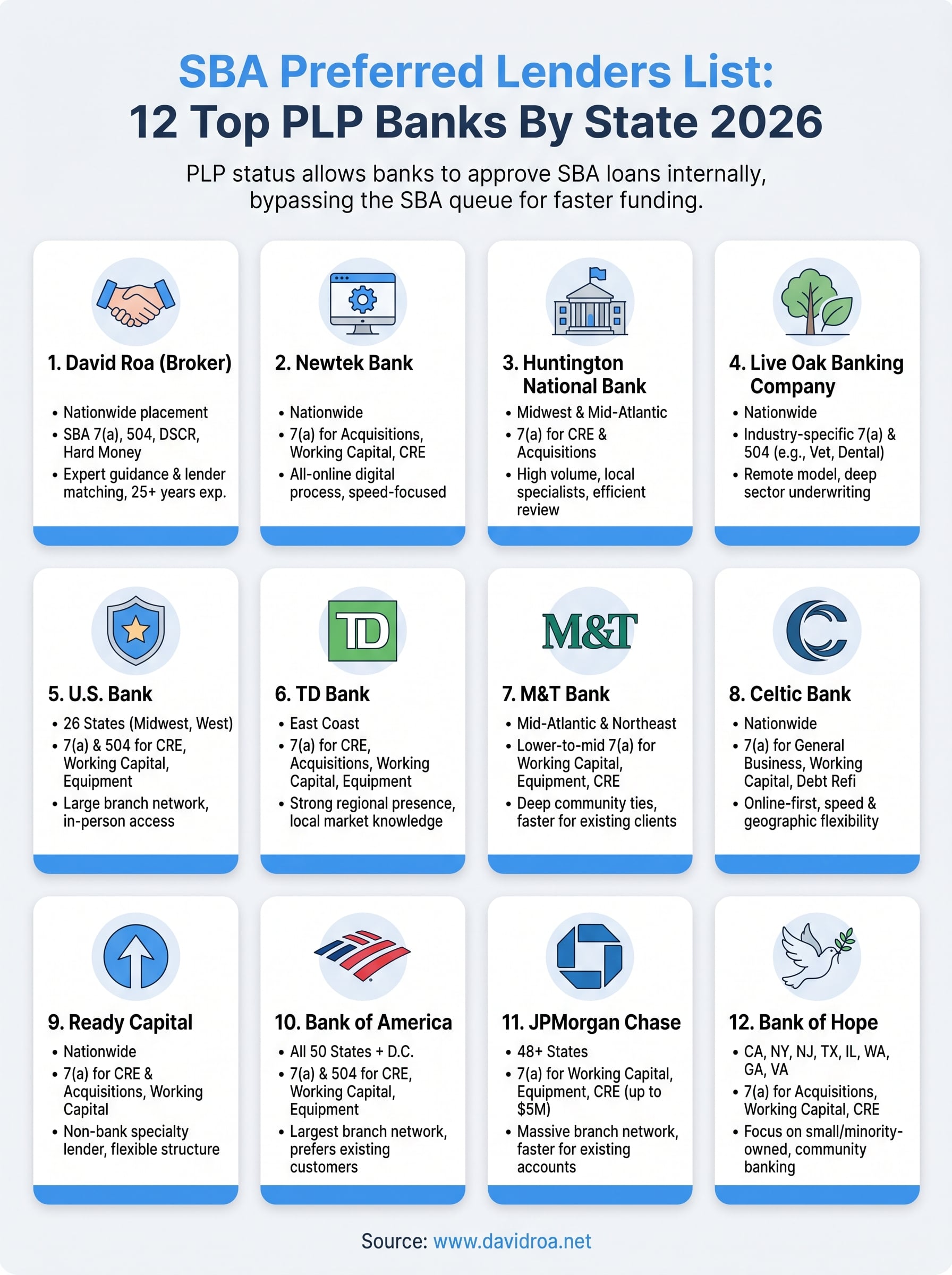
Next Steps
Every lender on this SBA preferred lenders list has internal approval authority, which puts your application on a faster track than working with non-PLP banks. The hard part isn't finding names. It's knowing which lender actually fits your industry, loan size, and financial profile before you invest time in an application that stalls at underwriting.
Start by narrowing your list to two or three lenders based on geography, loan purpose, and borrower requirements. Gather your two to three years of business tax returns, recent bank statements, and a clear explanation of how you plan to use the funds. Having those ready before your first conversation speeds up every lender's initial review.
If you want guidance on which PLP lender makes the most sense for your specific deal, talk to David Roa directly. With 25 years of experience and over $150 million funded, David can match your situation to the right lender and help you avoid costly detours.
