How To Analyze Rental Property Deals: Metrics & Checklist
Most rental property investments don't fail because of bad luck, they fail because someone skipped the math. Knowing how to analyze rental property deals before you commit protects your capital and sets the foundation for real returns. Yet too many investors rely on gut feelings or surface-level numbers, only to discover months later that their "great deal" barely breaks even after expenses.
A proper deal analysis goes beyond listing price and estimated rent. It means running the actual numbers, cash flow, cap rate, cash-on-cash return, operating expenses, and stress-testing them against reality. With over 25 years in mortgage lending and hands-on experience flipping properties and managing a real estate portfolio, I've seen firsthand how the difference between a profitable investment and a money pit often comes down to one or two overlooked line items in the analysis.
This guide walks you through the exact metrics, formulas, and step-by-step process to evaluate any rental property deal with confidence. You'll also get a practical checklist you can use before making an offer, whether you're acquiring your first rental or adding to an existing portfolio. Let's get into the numbers that actually matter.
What you need before you analyze a deal
Before you run a single number, you need the right raw data. Rushing into analysis with incomplete information produces false confidence, which is often worse than no analysis at all. Gathering the correct inputs upfront is the part most investors skip, and it's exactly why their projections miss reality by wide margins.
Garbage in, garbage out: your analysis is only as accurate as the data you feed it.
Property details and physical condition
Start with the basic property profile: address, property type (single-family, duplex, or multi-unit), year built, square footage, and number of units. Beyond that, request the current rent roll if the property is already occupied. A rent roll shows each unit, the current tenant, the monthly rent, and the lease end date. If rents sit below market, that gap is both a risk and an opportunity, and you can't price either one without knowing the baseline.
Physical condition matters just as much as income. A recent inspection report or a detailed seller disclosure will flag deferred maintenance items like roof age, HVAC systems, and plumbing. These repair costs feed directly into your expense projections and can shift your numbers significantly.
Financial records and operating history
For any property with existing tenants, ask for 12 to 24 months of actual operating history: income collected, expenses paid, and any vacancy periods. Sellers often present pro forma numbers based on what the property could earn, not what it actually earned. Real history tells a completely different story.
Pull the property tax bill, get insurance quotes, and request utility bills for any costs the owner currently covers. These three line items alone can move your net operating income by hundreds of dollars per month.
Your financing position
Knowing how to analyze rental property deals accurately means knowing your cost of capital before you start crunching numbers. Get a rate estimate for the loan product you plan to use, whether that's a conventional investment loan or a DSCR loan based on the property's income. Your loan amount, interest rate, and term determine your monthly debt service, which anchors every cash flow calculation you run.
Step 1. Check the market and rent comps
Market research is the first real step in how to analyze rental property deals correctly. Before you trust any income figure the seller provides, verify what similar properties actually rent for in that specific neighborhood. Rent comps anchor every income projection you build downstream, and getting this number right saves you from a chain of compounding errors that inflate your returns on paper.
Find the right comparable rentals
Pull three to five active rental listings for properties that match your subject in unit size, bedroom count, and location (stay within one mile in urban markets, three miles in suburban areas). Look at what similar units are currently renting for, not what they rented for 18 months ago. Log each comp in a simple table like this one:
| Address | Beds/Baths | Sq Ft | Monthly Rent |
|---|---|---|---|
| 123 Maple St | 3/1 | 1,100 | $1,450 |
| 456 Oak Ave | 3/2 | 1,200 | $1,550 |
| 789 Elm Dr | 3/1 | 1,050 | $1,400 |
Use the midpoint of your comps as your baseline rent figure, never the highest number available.
Confirm local vacancy rates
Vacancy rate directly reduces your gross income, so you need a realistic number before you build any projections. A 5% to 8% vacancy assumption covers most U.S. markets, but verify it with a local property manager who actively leases in that zip code. Higher-than-average vacancy in a submarket signals soft rental demand, and that signal should prompt a harder look at the deal before you move forward with an offer.
Step 2. Build a realistic rental pro forma
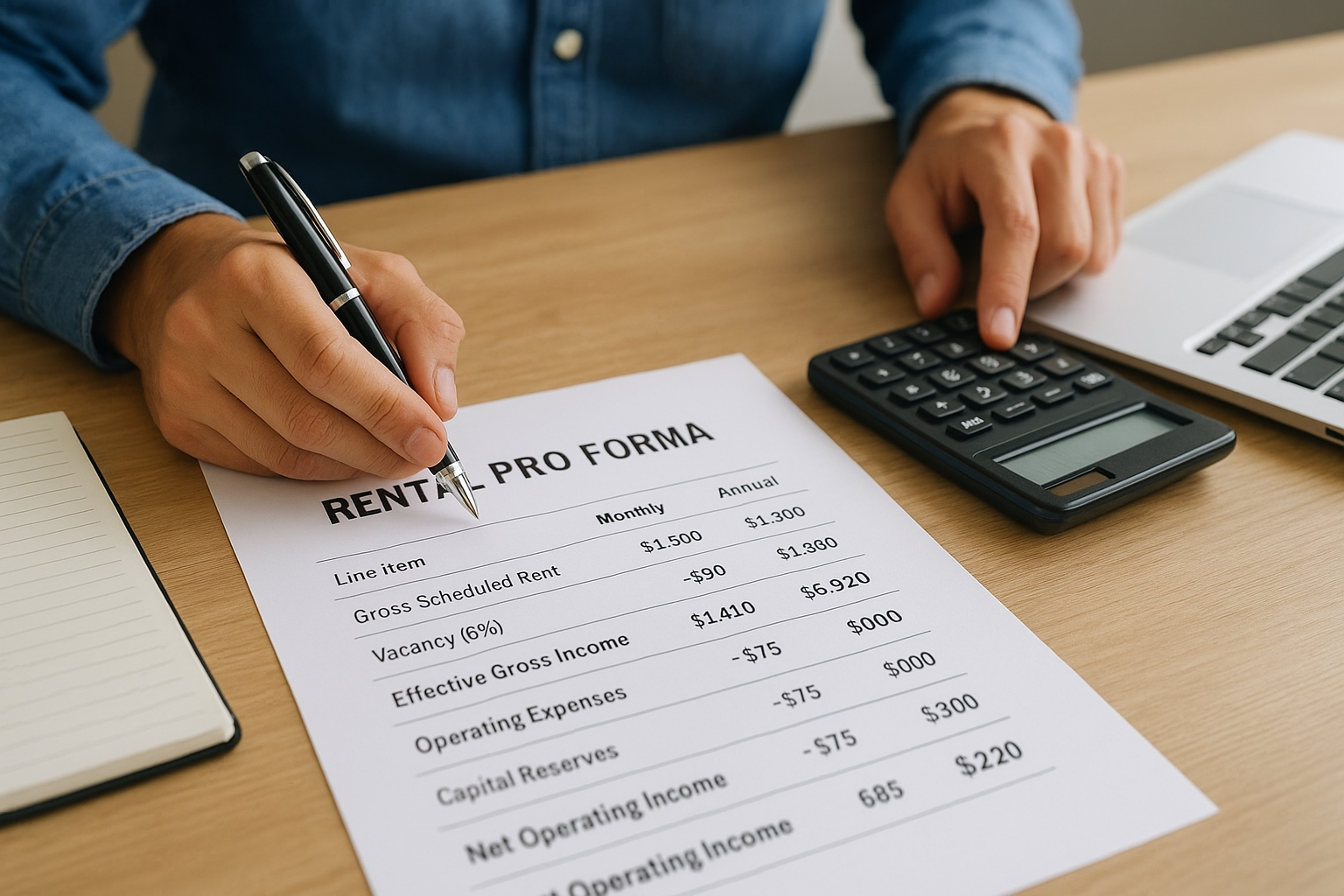
A pro forma is a projected income and expense statement for a rental property over a set time period, typically one year. Building one forces you to account for every cost line before you commit capital. When you understand how to analyze rental property deals at a serious level, the pro forma is the document that separates disciplined investors from hopeful ones.
Structure your income and expense lines
Start with gross scheduled rent at the top, then subtract your vacancy allowance to get effective gross income. From there, list every operating expense below it. A complete pro forma covers these categories:
- Income: Gross scheduled rent, vacancy loss, other income (laundry, parking, late fees)
- Operating expenses: Property taxes, insurance, property management (8-10% of collected rent), repairs and maintenance, utilities (owner-paid), landscaping, and accounting
- Capital reserves: Set aside $50 to $100 per unit per month for major future replacements like roof, HVAC, and appliances
Never skip capital reserves. Ignoring them makes your cash flow look stronger on paper while setting you up for a cash crisis when a major system fails.
Simple pro forma template
Use this table as your baseline structure for any single-family or small multi-unit deal:
| Line Item | Monthly | Annual |
|---|---|---|
| Gross Scheduled Rent | $1,500 | $18,000 |
| Vacancy (6%) | -$90 | -$1,080 |
| Effective Gross Income | $1,410 | $16,920 |
| Operating Expenses | -$650 | -$7,800 |
| Capital Reserves | -$75 | -$900 |
| Net Operating Income | $685 | $8,220 |
Step 3. Calculate the metrics that matter
Once your pro forma is complete, you apply the core financial metrics that tell you whether the deal actually works. Knowing how to analyze rental property deals means moving past gut instinct and letting three specific numbers drive your decision. Each metric answers a different question about the property's performance.
Cap rate
Cap rate measures the property's return independent of financing. Divide your net operating income (NOI) by the purchase price, then multiply by 100. Using the pro forma from the previous step, an $8,220 NOI on a $110,000 purchase price produces a 7.5% cap rate. In most U.S. markets, a cap rate between 6% and 10% indicates a reasonably priced investment. Below 6% usually signals an overpriced asset with thin returns.
Cash-on-cash return
Cash-on-cash return measures what your actual cash invested earns after you pay your mortgage. Subtract annual debt service from NOI to get your annual pre-tax cash flow, then divide by total cash deployed, which includes your down payment and closing costs. A $15,000 investment that generates $1,800 in annual cash flow produces a 12% cash-on-cash return.
Target a minimum cash-on-cash return of 8% before moving forward with any rental property offer.
Quick reference formula table
Use this table to run all three core calculations cleanly on any deal you evaluate:
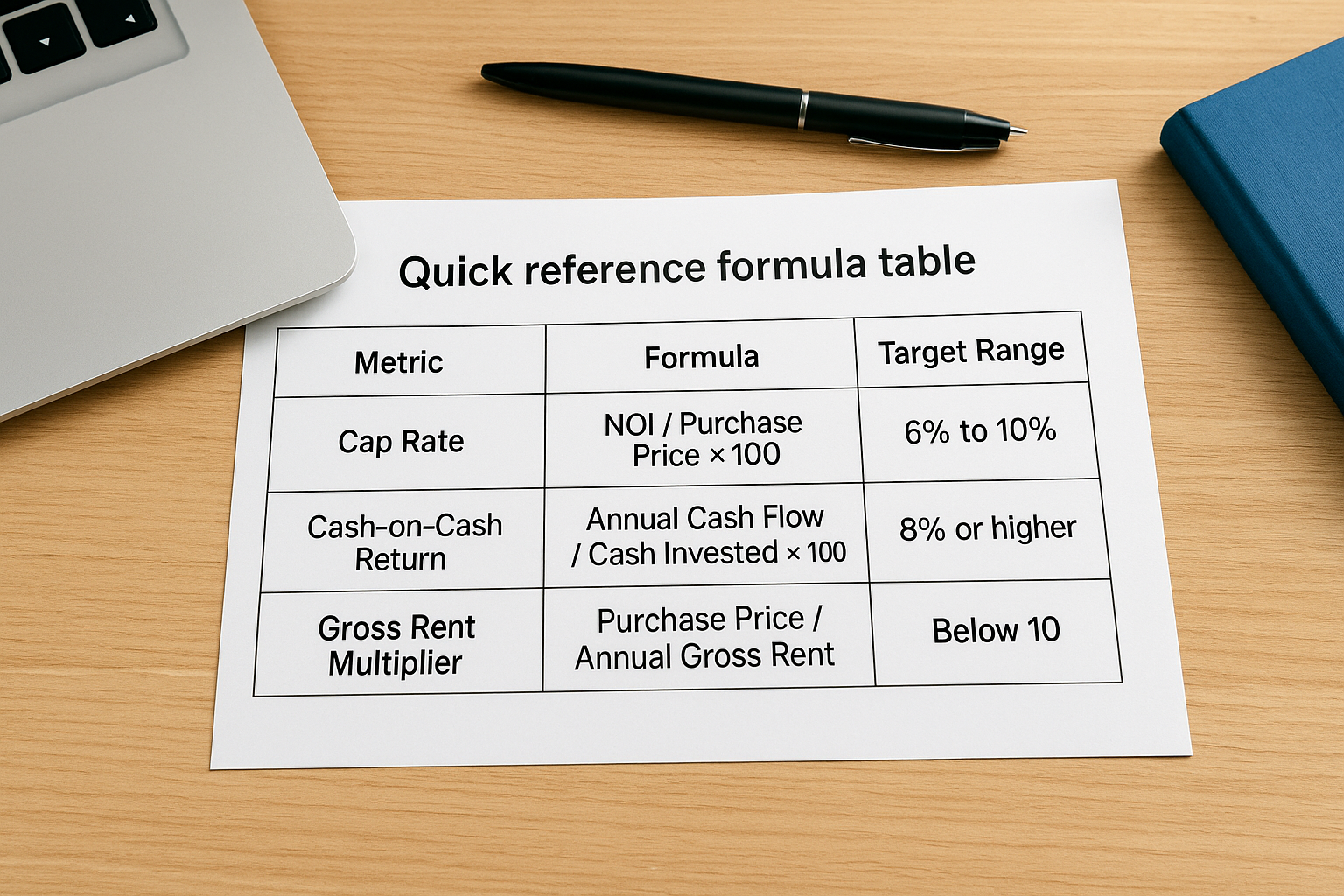
| Metric | Formula | Target Range |
|---|---|---|
| Cap Rate | NOI / Purchase Price × 100 | 6% to 10% |
| Cash-on-Cash Return | Annual Cash Flow / Cash Invested × 100 | 8% or higher |
| Gross Rent Multiplier | Purchase Price / Annual Gross Rent | Below 10 |
Step 4. Stress test and decide to offer
Running the base-case numbers is only half the work. A stress test pushes your pro forma into uncomfortable scenarios to see if the deal still holds up when reality doesn't cooperate. This is a critical step in how to analyze rental property deals like a disciplined investor rather than an optimistic one.
Run your worst-case scenario
Take your baseline assumptions and change three variables at once: raise vacancy to 12%, increase your repair and maintenance budget by 25%, and assume rent stays flat for 24 months. If your cash flow goes negative under all three conditions simultaneously, the deal has thin margins and limited cushion. Use the table below to run both scenarios side by side:
| Scenario | Vacancy | Expenses | Annual Cash Flow |
|---|---|---|---|
| Base case | 6% | Standard | $1,800 |
| Stress case | 12% | +25% | -$200 |
If a moderate stress test wipes out your entire cash flow, the deal depends on everything going right, and that is a speculative bet, not an investment.
Make the offer decision
Once you have both scenarios on paper, the decision framework becomes straightforward. If your stress-case cash flow stays above zero or only dips slightly negative, the deal has real margin. If it collapses under modest pressure, either renegotiate the purchase price to rebuild that cushion or walk away. Discipline at the offer stage protects every dollar you deploy.
Wrap-up and next move
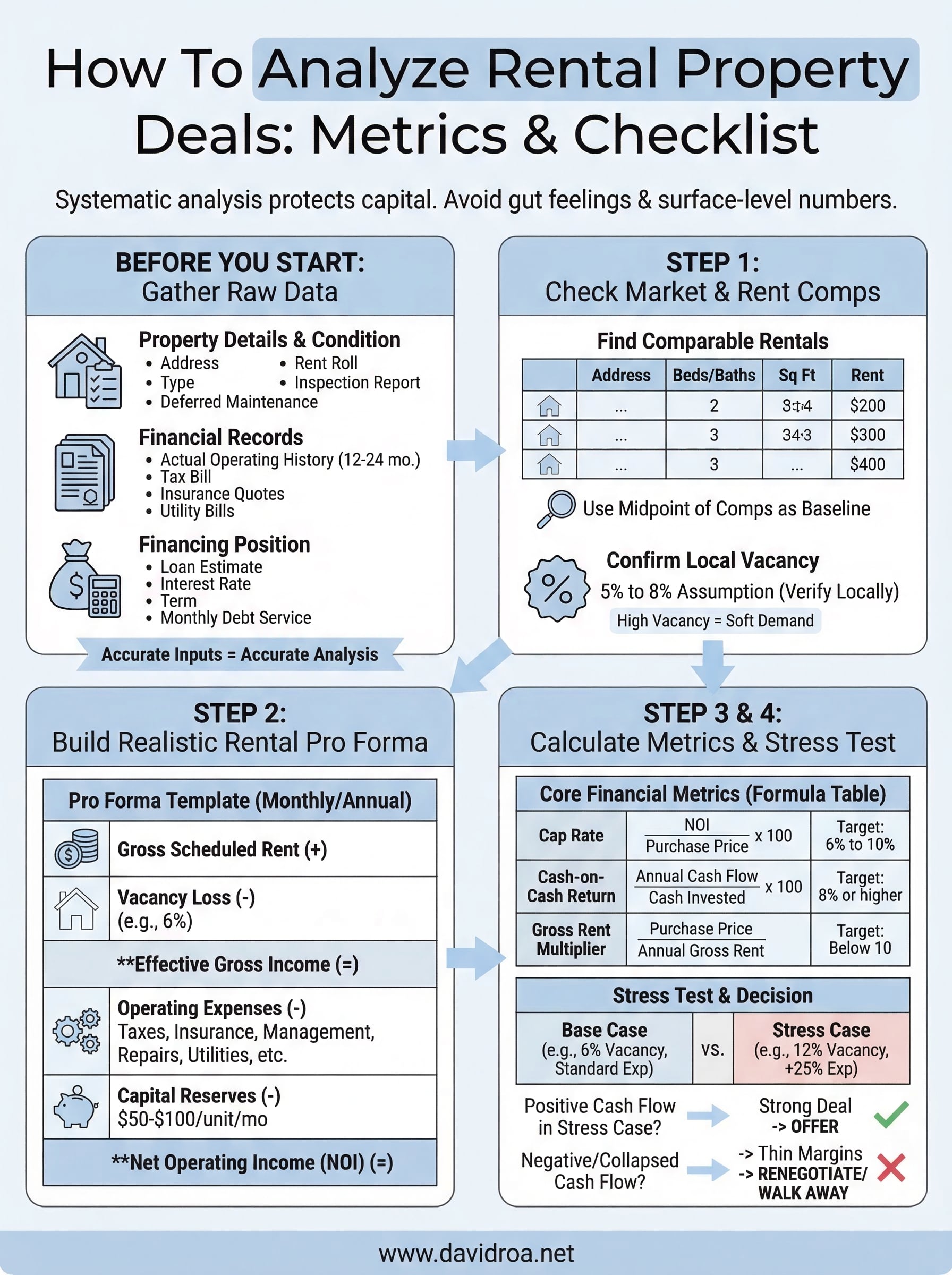
Knowing how to analyze rental property deals gives you a repeatable system instead of a guessing game. You now have the inputs to gather, the pro forma structure to build, the metrics to calculate, and the stress test to apply before you ever make an offer. Every profitable rental in a long-term portfolio started with this exact process run honestly and completely, without skipping the uncomfortable numbers.
Your analysis gets you to the right purchase price. The financing gets you to closing. Your loan structure directly affects cash flow, debt service, and your overall return, so the lender you work with matters as much as the deal itself. If you want to discuss financing options for your next rental property, including DSCR loans and other investment-specific programs, connect with David Roa to get the right capital structure in place before you submit that offer.
