Rocket Mortgage VA Loan: Rates, Eligibility, Fees & Reviews
If you're a veteran or active-duty service member shopping for a home loan, there's a good chance you've come across the Rocket Mortgage VA loan during your research. Rocket Mortgage is one of the largest retail mortgage lenders in the country, and their VA loan program gets a lot of attention. But popularity alone doesn't tell you whether it's the right fit for your situation, rates, fees, eligibility requirements, and actual borrower experiences all matter far more than brand recognition.
As a mortgage broker with over 25 years in the lending industry and more than $150 million funded, I've helped countless veterans and military families navigate their VA loan options. At David Roa, we work with VA loans regularly and understand exactly what to look for, and what to watch out for, when evaluating any lender's VA program. That hands-on experience gives us a practical lens to break down what Rocket Mortgage actually offers versus what you might find elsewhere.
This article covers everything you need to make an informed decision: Rocket Mortgage's current VA loan rates, who qualifies, what you'll pay in closing costs and fees, and what real borrowers are saying in their reviews. Whether you're purchasing your first home or refinancing an existing VA loan, the goal here is straightforward, give you the facts so you can compare confidently and choose the lender that serves your specific needs, not just the one with the biggest ad budget.
What a Rocket Mortgage VA loan is
A Rocket Mortgage VA loan is a home loan backed by the U.S. Department of Veterans Affairs and originated through Rocket Mortgage, the retail lending arm of Rocket Companies. The VA itself does not lend money directly. Instead, it guarantees a portion of the loan, which reduces the lender's risk and allows lenders like Rocket Mortgage to offer qualifying borrowers favorable terms that most conventional loans simply cannot match. When you apply through Rocket Mortgage, you're using their platform and underwriting process to access that government-backed benefit.
The VA loan basics
The VA loan program has been around since 1944 as part of the Servicemen's Readjustment Act, commonly known as the GI Bill. Its core purpose is to help veterans, active-duty service members, and surviving spouses buy or refinance a home without needing a large down payment or private mortgage insurance. These two advantages alone can save you tens of thousands of dollars over the life of a loan compared to a standard conventional mortgage.
VA loans are one of the few mortgage products that allow eligible borrowers to finance 100% of a home's purchase price with no monthly mortgage insurance premium.
There are a few distinct loan types under the VA umbrella. A VA purchase loan helps you buy a primary residence, while a VA Interest Rate Reduction Refinance Loan (IRRRL) lets you refinance an existing VA loan to a lower rate with minimal paperwork. A VA cash-out refinance allows you to tap your home equity for other financial goals. Rocket Mortgage offers all three of these products through their digital platform.
How Rocket Mortgage fits into the VA lending landscape
Rocket Mortgage is a direct lender, meaning they originate, process, underwrite, and fund your loan using their own capital and guidelines, rather than shopping your application across multiple wholesale investors. That structure gives them speed and consistency in processing, which can be important if you're working against a contract deadline. Their Rocket Mortgage mobile app and online portal are central to how they manage the entire application and approval process, from document uploads to closing disclosures.
Because Rocket Mortgage operates at significant scale, they follow VA loan guidelines set by the VA itself, but they also layer on their own internal overlays. Overlays are additional requirements a lender sets beyond the VA's minimum standards. For example, the VA does not set a minimum credit score, but Rocket Mortgage typically requires a minimum credit score of 580 or higher for VA loans, and many loan officers there prefer to see scores in the 620 range for smoother approvals. This is a meaningful distinction if your credit history has gaps or blemishes from your service years.
What this means for you as a borrower
Understanding that Rocket Mortgage is one option among many VA-approved lenders helps you approach the process with the right mindset. The VA's guarantee is constant regardless of which lender you choose. What changes from lender to lender is the interest rate you're offered, the fees you're charged, the credit and income requirements they apply, and the level of personal service you receive. Your eligibility for the VA benefit itself has nothing to do with which company you pick; the benefit belongs to you based on your service record.
Why veterans choose VA loans and where Rocket fits
VA loans exist because standard mortgage products often work against the realities of military life. Frequent relocations, service-related income gaps, and limited time to build conventional credit histories can make it harder for veterans to qualify for competitive financing. The VA loan program removes several of the biggest barriers at once, and that makes it a logical starting point for most eligible borrowers regardless of which lender they eventually choose.
The VA loan benefit is one of the most valuable financial tools available to veterans, and many service members never use it simply because they don't know what it covers.
The financial advantages that set VA loans apart
The benefits of a VA loan are concrete and measurable. No down payment is the headline feature, but the elimination of private mortgage insurance (PMI) is just as significant over the long run. On a $400,000 loan, PMI at a typical rate of 0.5% to 1.5% annually could cost you $2,000 to $6,000 per year on a conventional mortgage. A VA loan wipes that cost out entirely. You also typically access lower interest rates compared to conventional loans because the VA guarantee reduces lender risk, and that reduction gets passed to you as the borrower.
Additional advantages include:
- Limits on closing costs the lender can charge you
- No prepayment penalties if you pay off the loan early
- Flexible debt-to-income ratio guidelines compared to conventional lending
- Access to VA refinance options like the IRRRL if rates drop later
Where Rocket Mortgage's strengths and limitations show up
Rocket Mortgage handles a high volume of VA loans, and their digital-first platform is built for borrowers who want to manage most of the process online. If you're comfortable uploading documents, tracking your loan status through an app, and communicating with a loan team rather than a single dedicated advisor, their system works efficiently. The speed of their pre-approval process can also be useful in competitive housing markets where sellers want to see buyer readiness quickly.
The limitation is that the rocket mortgage va loan process is largely automated, which means complex financial situations, such as self-employment income or non-traditional service records, can run into friction. Borrowers with straightforward W-2 income and clean credit histories tend to move through their pipeline smoothly, while those with nuanced files may benefit from working with a broker who can advocate directly on their behalf.
Rates, APR, and fees to expect with Rocket
The interest rate on a rocket mortgage va loan is not a fixed number you can look up and rely on. Rates change daily based on bond market movement, and the rate you receive depends on your credit score, loan amount, loan term, and whether you pay discount points upfront. Rocket Mortgage publishes sample rates on their website, but those figures typically assume strong credit and specific loan scenarios. The rate you see advertised is often not the rate most borrowers actually receive at closing.
Always request a Loan Estimate, which lenders are legally required to provide within three business days of your application, so you can compare the full APR, not just the interest rate.
How Rocket sets its VA loan rates
Rocket Mortgage prices its rates based on the secondary mortgage market, meaning they sell most loans to investors after closing. That process influences how aggressively they price their rates on any given day. As a direct lender, they do not shop your file across multiple wholesale investors the way a broker would, which means you are comparing one set of pricing rather than a competitive spread. Your final rate will reflect your risk profile as Rocket's underwriters assess it, and borrowers with scores above 700 and stable income tend to see the most competitive offers.
The VA funding fee and other closing costs
One cost that applies to nearly every VA loan regardless of lender is the VA funding fee, a one-time charge paid to the Department of Veterans Affairs. As of current VA guidelines, the fee for a first-time VA loan use with no down payment is 2.15% of the loan amount for regular military, and it rises to 3.3% for subsequent use. Veterans with a service-connected disability rating of 10% or higher are exempt from this fee entirely. On top of the funding fee, Rocket Mortgage charges an origination fee, and you will see standard third-party costs such as title insurance, appraisal, and prepaid homeowners insurance on your Loan Estimate. The VA does limit certain fees lenders can charge veterans, but that protection does not eliminate closing costs altogether, so budget accordingly before you apply.
Eligibility, COE, and underwriting requirements
Your eligibility for a VA loan is determined by federal service requirements, not by any individual lender. Rocket Mortgage acts as the originator, but the VA sets the baseline for who qualifies. Understanding both layers before you apply saves time and prevents surprises during underwriting.
Service requirements and who qualifies
The VA defines eligibility through minimum active duty service periods that vary depending on when and how you served. Generally, veterans who served 90 consecutive days during wartime or 181 days during peacetime qualify. National Guard and Reserve members typically need six years of service or 90 days of active duty under Title 32 orders. Surviving spouses of veterans who died in service or from a service-connected disability may also be eligible for the benefit.
If you are unsure whether your service record qualifies, the VA's official eligibility page at va.gov provides the complete breakdown of service requirements by era and branch.
Getting your Certificate of Eligibility
Your Certificate of Eligibility (COE) is the official document that proves to any lender, including Rocket Mortgage, that you have earned the VA loan benefit. You can request your COE through the VA's online portal, by mail, or directly through your lender. Rocket Mortgage can pull your COE electronically in many cases through the VA's automated system, which speeds up the initial approval process if your records are current in the VA database.

Once the COE is in hand, check whether it shows full entitlement or remaining entitlement. Borrowers with full entitlement can finance above conforming loan limits without a down payment in most counties, while those with remaining entitlement need to calculate how much the VA will guarantee before structuring their purchase.
Rocket's underwriting standards
Beyond federal eligibility, a rocket mortgage va loan application goes through Rocket's internal underwriting review. Their standard for debt-to-income ratio typically sits at 41% or below, though the VA allows exceptions for borrowers with strong compensating factors like significant cash reserves or a high credit score. Rocket also evaluates employment history, residual income, and 12 to 24 months of financial documentation when income falls outside standard W-2 formats. Gaps in employment tied to military service are treated differently than civilian gaps, so document your service dates clearly in your application file.
How to apply with Rocket Mortgage step by step
Applying for a rocket mortgage va loan through Rocket's platform is a structured digital process, and knowing the steps in advance helps you move through it without unnecessary delays. The entire application starts online or through their mobile app, and Rocket's system guides you from initial information input through to closing disclosure. Understanding each stage lets you prepare the right documents at the right time instead of scrambling once an underwriter requests them.
Gather your documents before you start
Before you open the application, pulling your documents together in advance saves you significant time. Rocket's system will ask you to upload these materials during the process, and incomplete submissions are one of the most common reasons loan timelines stretch out longer than they should.
Prepare the following before you begin:
- Government-issued ID such as a driver's license or passport
- DD-214 discharge papers or proof of active duty status
- Certificate of Eligibility (COE) or be ready for Rocket to pull it electronically
- Two years of W-2s and federal tax returns, or profit and loss statements if self-employed
- Recent pay stubs covering the last 30 days
- Two to three months of bank statements showing liquid assets
- Proof of homeowners insurance once you are under contract on a property
Moving through the application and closing
Once your documents are ready, you complete Rocket's online application by entering your personal information, employment history, and income details. The system runs a soft credit pull during pre-approval, which does not affect your credit score. After you formally apply and authorize a hard inquiry, Rocket assigns a loan officer and begins the underwriting review. You track progress through the Rocket app, where you can see outstanding conditions and respond to document requests directly.
After underwriting clears your file, Rocket orders a VA appraisal on the property, which confirms the home meets the VA's minimum property requirements and supports the purchase price. Once the appraisal comes back acceptable and all conditions are satisfied, you receive a Clear to Close, and your closing date gets scheduled. At closing, you sign final documents, pay any remaining closing costs, and receive the keys.
A simple way to decide if it's right for you
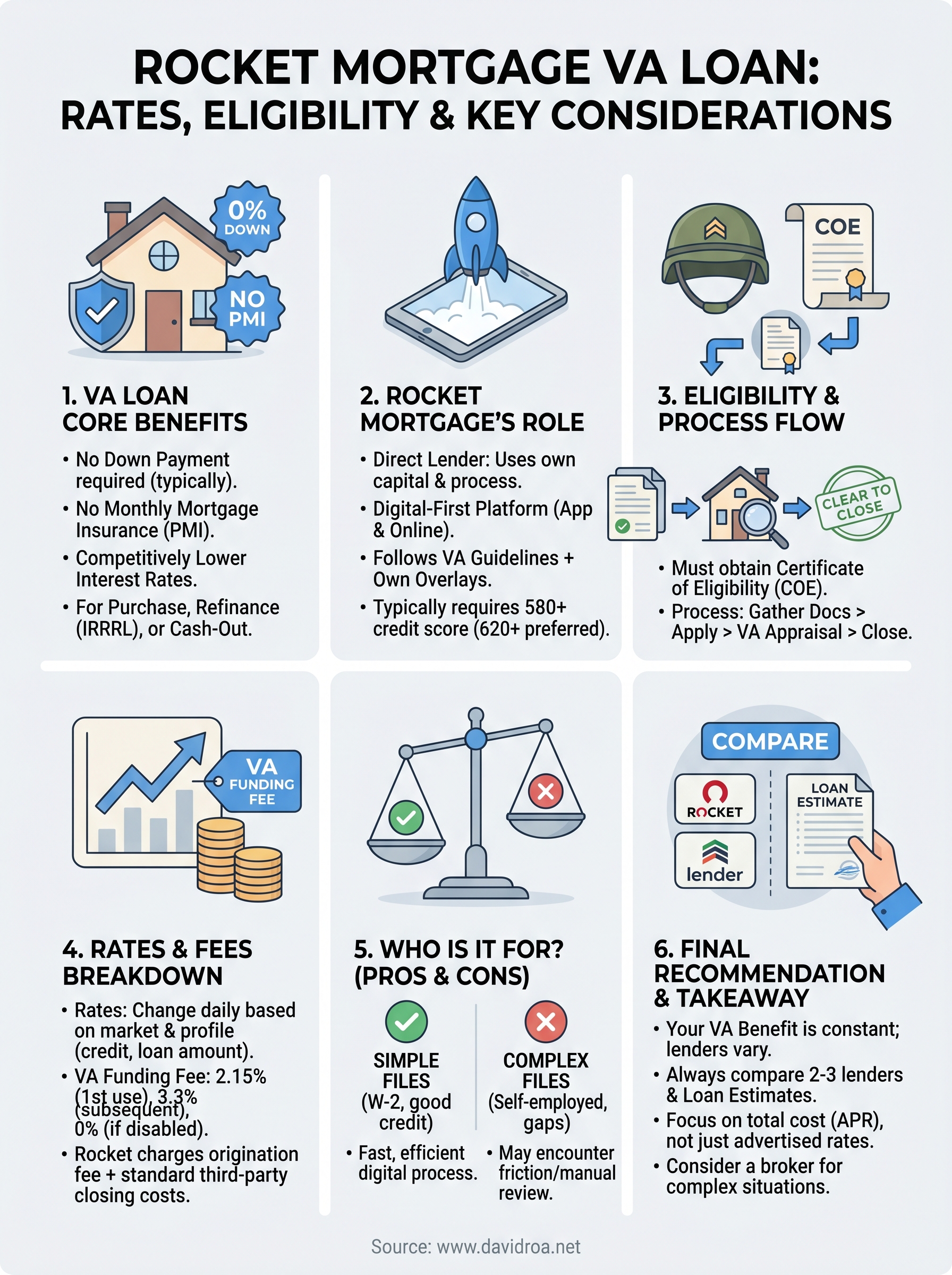
The rocket mortgage va loan works best for borrowers with straightforward finances: stable W-2 income, credit scores above 620, and no complex documentation needs. If that describes your situation, their digital platform and fast pre-approval process can serve you well. If your file involves self-employment income, an alternative credit history, or a service record that requires manual review, you may hit friction with a high-volume lender built around automation.
Your VA benefit belongs to you regardless of which lender you use, so the real question is which lender will work hardest to close your loan on the best possible terms. Comparing at least two or three lenders before committing gives you real data to work with instead of assumptions. If you want a broker who has handled complex VA scenarios for over 25 years, connect with David Roa to talk through your options and get a straight answer on what your situation actually qualifies for.
