What Is a 1031 Exchange? IRS Rules, Timelines, Examples
You sell an investment property for a solid profit, and then the IRS takes a sizable cut in capital gains taxes before you can reinvest. That's the scenario most real estate investors want to avoid, and it's exactly the problem a 1031 exchange solves. Named after Section 1031 of the Internal Revenue Code, this strategy lets you defer those taxes by rolling your proceeds into another qualifying property instead of cashing out.
It sounds straightforward, but the execution involves strict identification windows, qualified intermediaries, and rules that can disqualify your exchange if you miss a single deadline. Whether you're flipping properties, building a rental portfolio, or moving from residential into commercial real estate, understanding the mechanics matters, one misstep and you're stuck with a tax bill you didn't plan for. Over 25 years of funding real estate deals at David Roa, I've walked investors through dozens of exchange-financed transactions, helping them line up the right loan product so the timing actually works.
This guide breaks down exactly how a 1031 exchange works, the IRS rules and timelines you need to follow, the types of properties that qualify, and real examples showing the strategy in action. By the end, you'll have a clear, practical understanding of whether a 1031 exchange fits your next investment move.
Why 1031 exchanges matter for real estate investors
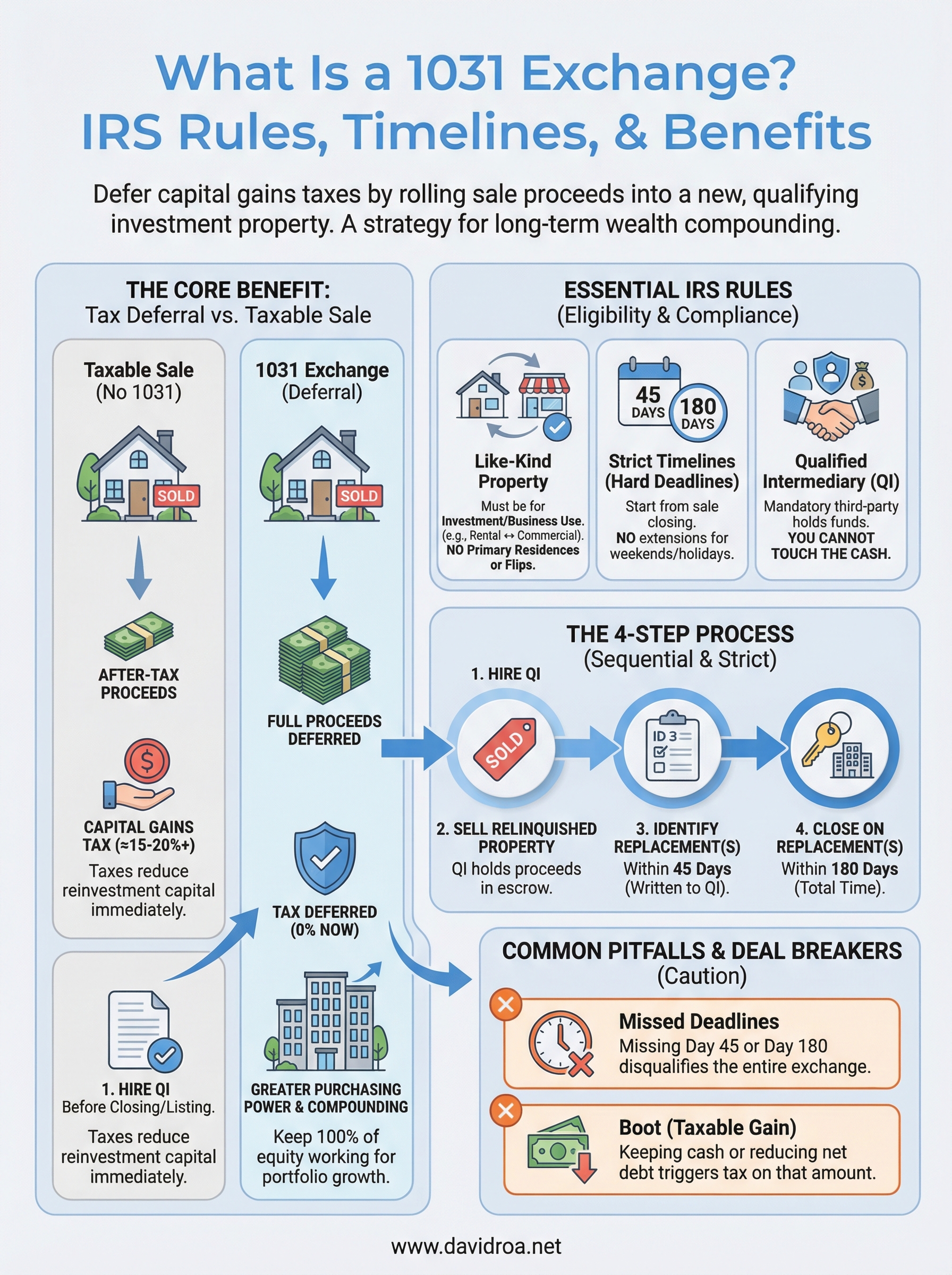
When you sell an investment property, the IRS typically wants its share right away. Depending on your income bracket, federal capital gains tax on real estate can run anywhere from 15% to 20%, and many states add their own rate on top of that. If you've held a property for several years and built significant equity, that combined tax burden can consume a large portion of the profit you planned to reinvest. Understanding what is a 1031 exchange means recognizing a legal mechanism that lets you keep that capital fully deployed, rather than writing a check to the government before your next deal even closes.
The tax deferral advantage
Tax deferral is not the same as tax elimination, but the difference in long-term wealth accumulation is substantial. Every dollar you defer stays invested in your replacement property, generating rental income, appreciating in value, or both. Over multiple exchanges, you can compound equity gains across a growing portfolio without triggering a taxable event at each sale, provided you keep rolling proceeds into qualifying replacement properties.
The longer you defer taxes through successive exchanges, the larger your investable base becomes, which directly accelerates portfolio growth.
Here's a direct comparison of what deferral means in practice:
| Scenario | Sale Price | Capital Gains Tax (20%) | Capital Available to Reinvest |
|---|---|---|---|
| No 1031 exchange | $500,000 | $80,000 | $420,000 |
| 1031 exchange | $500,000 | $0 (deferred) | $500,000 |
That $80,000 difference goes straight into your next property's purchase price, boosting your buying power immediately and compounding forward with each subsequent deal you close.
Building wealth through compounding equity
Real estate investors who use 1031 exchanges treat them as a portfolio scaling tool, not just a tax workaround. You can start with a single-family rental, exchange into a small multi-family building, and eventually move into commercial or mixed-use properties, all while deferring taxes at each step. Each exchange lets you upgrade the quality, size, or projected cash flow of your holdings without surrendering equity to a tax bill you weren't ready to absorb.
Your long-term exit strategy benefits too. Many investors hold a final property until death, at which point heirs receive a stepped-up cost basis, meaning the accumulated deferred gains may never face taxation at all. Across a lifetime of active investing, that single planning move can represent hundreds of thousands of dollars kept inside the portfolio rather than paid out.
1031 exchange rules that determine eligibility
Not every real estate sale qualifies, and when investors ask what is a 1031 exchange in practical terms, the answer always starts with eligibility rules. The IRS sets specific conditions that both the property you sell (the relinquished property) and the property you buy (the replacement property) must meet. Miss any one of these conditions, and you lose your deferral entirely.
Like-kind property requirement
The term "like-kind" is broader than most investors expect. You don't need to swap a single-family rental for another single-family rental. Any real property held for investment or business use qualifies, so you can exchange a duplex for a commercial building, vacant land for an apartment complex, or a retail strip for a warehouse. What you cannot exchange are primary residences or personal vacation homes used primarily for personal enjoyment, or inventory properties that a dealer holds for sale rather than investment.
Both the relinquished property and the replacement property must be held for investment or productive use in a trade or business, not for personal use.
Timeline rules you must follow
Your financing timeline is just as critical as the property requirements. The IRS enforces two hard deadlines that run from the date you close on your relinquished property. First, you have 45 calendar days to formally identify up to three potential replacement properties in writing. Second, you must close on one or more of those identified properties within 180 calendar days of your original sale. These deadlines do not extend for weekends, holidays, or personal circumstances, so you need your financing arranged well before the clock starts.

How to complete a 1031 exchange step by step
Executing a 1031 exchange is a sequential process where each step feeds directly into the next. You can't rearrange the order, and you can't skip steps because the IRS treats any deviation as a disqualifying event. Here's how the process works from the moment you decide to sell.
Find a qualified intermediary before you list
A qualified intermediary (QI) is a third party who holds your sale proceeds so you never take constructive receipt of the funds. The moment you receive the money yourself, the IRS considers the exchange complete and the full gain becomes taxable. Hire your QI before you list the property, because the exchange agreement must be in place prior to closing on the relinquished property. Your QI will prepare the required documentation, hold the funds in escrow, and coordinate the transfer to your replacement property.
Selecting your qualified intermediary early is the single most important logistical step in understanding what is a 1031 exchange in practice.
Identify replacement properties within 45 days
Once you close on the sale, the 45-day identification clock starts immediately. You must submit a written, signed identification to your QI listing your potential replacement properties. The standard rule allows you to identify up to three properties regardless of value. Be specific with legal addresses or property descriptions, because vague identifications get rejected.
Close on your replacement property within 180 days
After identifying your replacement properties, you must close on at least one of them within 180 calendar days of your original sale. Your financing needs to be locked and your lender coordinated in advance, since the 180-day window includes time spent on loan processing and title work.
Common pitfalls, tax traps, and deal breakers
Even investors who understand what is a 1031 exchange conceptually can lose their deferral by mishandling the execution. The IRS doesn't grant exceptions for honest mistakes, so knowing where deals fall apart protects you from an unexpected tax bill at the worst possible moment.
Missing the identification or closing deadline
The 45-day identification window and 180-day closing window are absolute. You can't request an extension because a deal fell through or financing took longer than expected. If you identify three properties and all three fall out of contract, you're out of options unless you identified backups under the alternative rules. Lock in your financing early and maintain a short list of backup properties from day one so you're never scrambling at day 44.
Treat the 45-day deadline like a closing date with no grace period, because that's exactly what it is.
Boot and partial exchanges
Boot is the term for any cash or non-like-kind property you receive as part of the exchange that you don't roll into the replacement property. The IRS taxes boot in the year of the exchange, so a partial reinvestment still triggers a partial tax liability. Mortgage boot works the same way: if your replacement property carries less debt than your relinquished property, the debt reduction counts as boot unless you compensate with additional cash.
Related-party transactions
Selling to or buying from a related party (a family member, business partner, or entity you control) triggers additional IRS scrutiny under Section 1031(f). Related-party exchanges require both parties to hold their respective properties for at least two years after the transaction, or the deferral collapses retroactively.
Examples and strategy tips for real scenarios
Knowing what is a 1031 exchange in theory is one thing; seeing how real investors apply it is another. The following examples show how the rules work in practice and where smart strategy decisions separate investors who maximize their deferral from those who leave money on the table.
Trading up from a single-family rental to a multi-family building
Suppose you purchased a single-family rental in Chicago for $250,000 several years ago, and you now sell it for $450,000. After accounting for depreciation recapture and capital gains, your federal tax exposure could easily reach $60,000 or more. By executing a 1031 exchange, you roll the full $450,000 into a four-unit apartment building worth $600,000, financing the gap with a standard investment property loan. You keep every dollar working, upgrade your monthly cash flow, and push your tax liability forward to a future date you control.

Pairing a 1031 exchange with the right investment property loan lets you acquire a replacement asset larger than your sale proceeds alone could cover.
Strategy tip: Identify backup properties from day one
Many investors focus only on their preferred replacement property and ignore the IRS rule that allows you to identify up to three options simultaneously. If your first choice falls through on day 40, you have no recourse unless you listed backups from the start. Always identify two or three qualifying properties on day one, even if you're confident about your primary target. Treat your identification list as insurance rather than a formality, because the 45-day window gives you no room to pivot once it expires.
Conclusion
Understanding what is a 1031 exchange gives you a concrete tool for building long-term wealth without surrendering equity to taxes at every transaction. The strategy works because every deferred dollar stays invested, compounding through your next property and the one after that, as long as you follow the IRS rules on timing, like-kind requirements, and qualified intermediaries.
Your execution matters as much as your understanding. Missed deadlines, boot, and related-party missteps can eliminate your deferral entirely, which is why smart investors line up their financing, their QI, and their backup properties before the 45-day clock ever starts. The planning you do before the sale closes determines whether the exchange succeeds or fails.
If you're ready to structure your next real estate transaction and need financing that fits the 180-day window, connect with David Roa to find the right loan product for your replacement property.
