FHA Affordability Calculator: Estimate Your Home Budget
Figuring out how much house you can actually afford on an FHA loan starts with running real numbers, not guessing. An FHA affordability calculator takes your income, monthly debts, and down payment to estimate a realistic home budget based on FHA-specific guidelines like mortgage insurance premiums and debt-to-income limits.
The problem is, most online calculators give you a rough ballpark without explaining what's behind the math. That leaves you either overestimating your budget or second-guessing every listing you click on. With over 25 years in mortgage lending and more than $150 million funded, I've walked thousands of buyers, including first-time homeowners and ITIN holders, through this exact process at David Roa.
This guide breaks down how FHA affordability is calculated step by step, what factors move the needle, and how to use these numbers to shop for a home with confidence.
What an FHA affordability calculator measures
A standard mortgage calculator spits out a payment based on loan amount and interest rate. An FHA affordability calculator does more than that. It layers in FHA-specific costs and qualification rules that change your real budget significantly, including mortgage insurance premiums, minimum down payment thresholds, and debt-to-income limits set by FHA guidelines.
The two debt-to-income ratios FHA uses
FHA measures affordability through two separate debt-to-income (DTI) ratios, and both have to pass. The first is your front-end ratio, which compares your projected monthly housing payment to your gross monthly income. FHA typically caps this at 31%. The second is your back-end ratio, which adds all your monthly debt obligations (credit cards, car loans, student loans) to that housing payment and divides the total by your gross income. FHA generally caps this at 43%, though some lenders will go higher with compensating factors like strong credit or cash reserves.
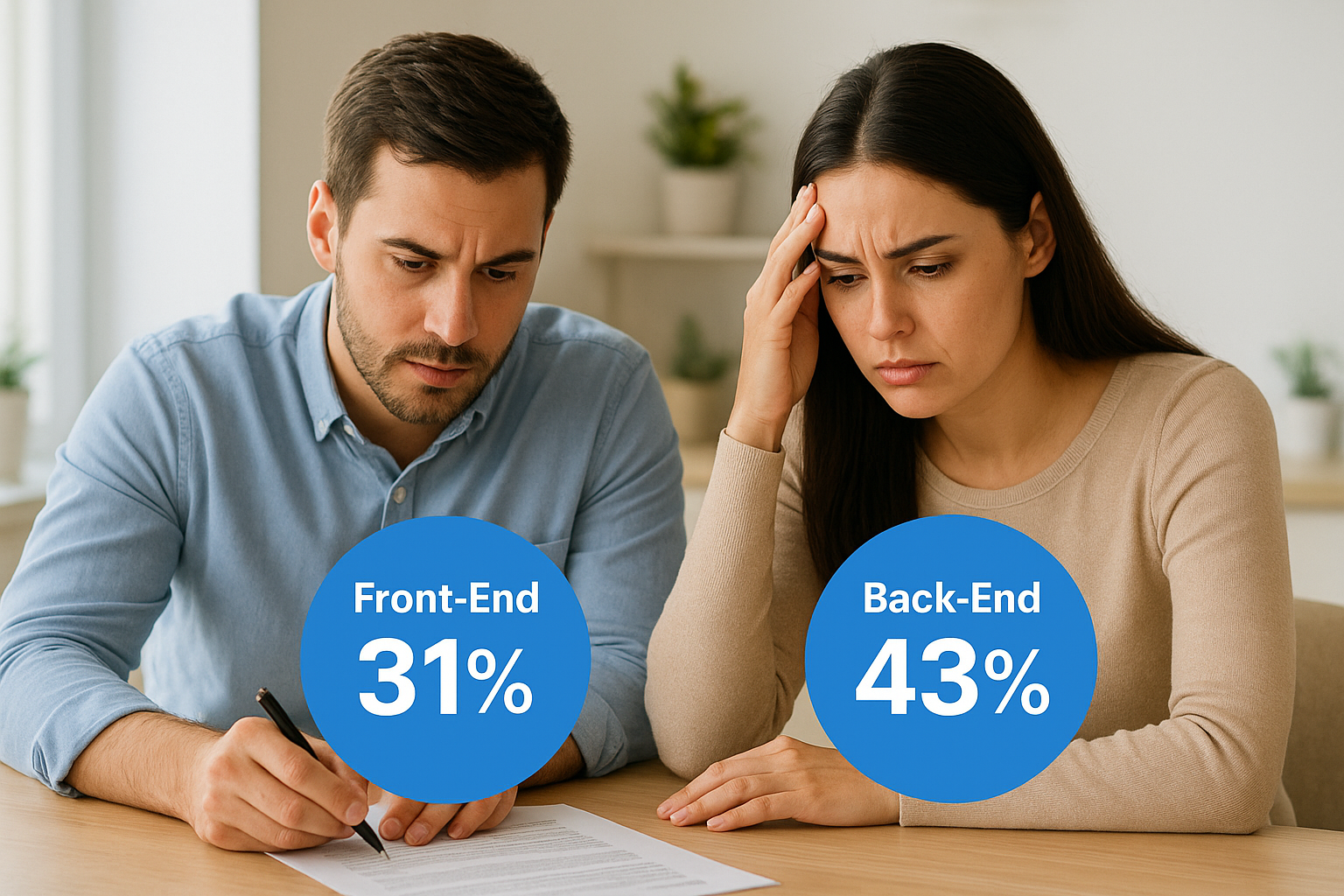
If your back-end DTI pushes past 43%, a lender may still approve the loan, but you will need to show clear compensating factors to make it work.
What gets added to your base mortgage payment
This is where FHA loans differ most from conventional loans. Your monthly payment includes principal and interest, but FHA also requires two layers of mortgage insurance. The upfront mortgage insurance premium (UFMIP) is 1.75% of the loan amount, typically rolled into the loan balance. On top of that, you pay an annual MIP ranging from 0.45% to 1.05% of the loan balance, split across 12 monthly payments. Property taxes and homeowners insurance also factor into your total payment, and those numbers vary by county and coverage level.
| Cost Component | How It Works |
|---|---|
| Principal + Interest | Based on loan amount and rate |
| Upfront MIP | 1.75% of loan, added to balance |
| Annual MIP | 0.45%-1.05%, paid monthly |
| Property Taxes | Varies by county |
| Homeowners Insurance | Based on coverage and location |
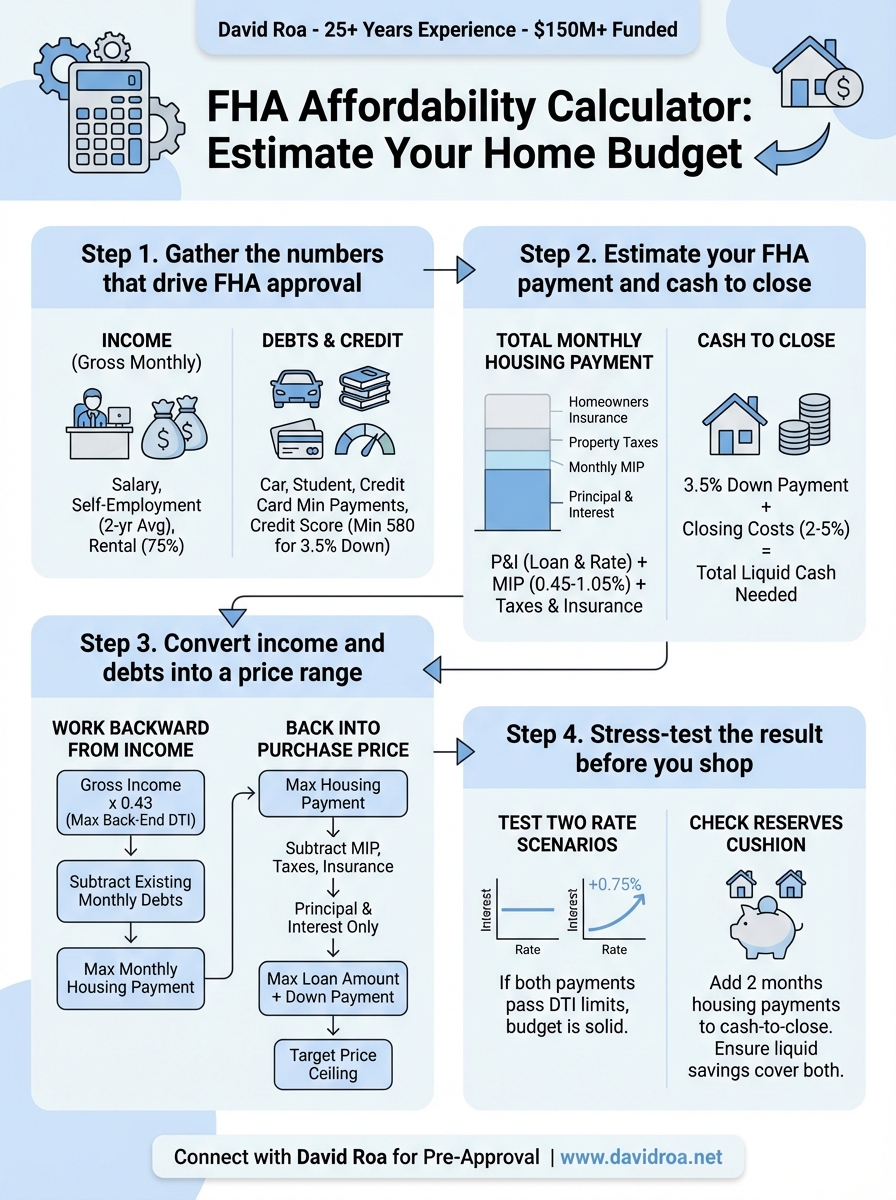
Step 1. Gather the numbers that drive FHA approval
Before you plug anything into an fha affordability calculator, you need four specific numbers ready. Pulling accurate figures upfront keeps your estimate close to what a lender will actually approve, instead of giving you a number that falls apart at pre-qualification.
Income figures to pull
Your calculator needs your gross monthly income, which is your pay before taxes and deductions. If you're salaried, divide your annual salary by 12. If you're self-employed or have variable income, use a two-year average from your tax returns, since that's what FHA underwriters look at.
Use your documented, verifiable income here, not what you expect to earn next year.
Pull these numbers before you start:
- Gross monthly salary or wages
- Self-employment income (2-year average from tax returns)
- Rental income (75% of gross rent is the standard FHA calculation)
Debt obligations and credit score
Every monthly minimum debt payment goes directly into your DTI ratio calculations. List all recurring obligations: car loans, student loans, credit card minimums, and any existing mortgage payments. Your credit score matters here too because FHA requires a minimum 580 to qualify for the 3.5% down payment, and scores below that push you to 10% down.
Step 2. Estimate your FHA payment and cash to close
Once you have your income and debt numbers ready, you can run the FHA affordability calculator estimate for your actual monthly payment and the cash you need to close. These two figures tell you whether a target price works for your budget before you contact any lender.
Break down your estimated monthly payment
Your total monthly housing payment combines principal and interest, annual MIP divided by 12, property taxes, and homeowners insurance. Use this template as your starting calculation:
| Payment Component | Calculation Method |
|---|---|
| Principal + Interest | Use a standard amortization formula at current FHA rates |
| Monthly MIP | (Loan amount x 0.55%) / 12 for most 30-year FHA loans |
| Property Taxes | Annual county tax estimate / 12 |
| Homeowners Insurance | Annual premium / 12 |
Running this breakdown line by line prevents surprises when your lender delivers the official Loan Estimate.
Estimate your cash to close
Your cash to close includes the 3.5% down payment on the purchase price plus estimated closing costs, which typically run 2% to 5% of the loan amount. On a $300,000 home, that means $10,500 down and roughly $6,000 to $15,000 in closing costs, totaling $16,500 to $25,500 you need liquid before closing day.
Step 3. Convert income and debts into a price range
With your payment estimate in hand, you can work backward using the FHA affordability calculator logic to find the maximum home price your income and debts support. This step turns your DTI ratios into an actual dollar figure you can take into a home search.
Work backward from your gross monthly income
Multiply your gross monthly income by 0.43 to get your maximum total monthly debt allowed under FHA's back-end limit. Then subtract every recurring monthly debt payment you listed in Step 1. What remains is the maximum monthly housing payment your income can carry.
If your remaining number is lower than the payment you estimated in Step 2, you need to either lower your target price or reduce existing debts before applying.
| Step | Calculation |
|---|---|
| Max total debt | Gross monthly income x 0.43 |
| Subtract existing debts | Car, student loans, credit card minimums |
| Max housing payment | Remaining balance |
Back into a purchase price
Once you have your maximum housing payment, subtract your estimated monthly MIP, taxes, and insurance. The leftover amount covers principal and interest only. Run that figure through a standard amortization at the current FHA rate to find your maximum loan amount, then add your 3.5% down payment to reach your target price ceiling.
Step 4. Stress-test the result before you shop
Your fha affordability calculator result reflects today's conditions, but conditions shift. Before you start touring homes, run your numbers through two scenarios that can push your payment beyond what you planned for. This step takes five minutes and protects you from committing to a price range that only works under perfect circumstances.
Test two rate scenarios
Interest rates move, and even a 0.5% increase on a $280,000 loan adds roughly $80 to $90 per month to your payment. Run your Step 2 payment calculation twice: once at the current rate you were quoted and once at that rate plus 0.75%. If the higher payment still clears both DTI limits, your budget is solid. If it doesn't, lower your target price by $15,000 to $20,000 and rerun the numbers.
If both scenarios pass, you have a buffer that keeps you qualified even if rates tick up between pre-approval and closing.
Check your cash reserves cushion
After closing, most FHA lenders want to see at least two months of housing payments remaining in your bank account. Add that reserve requirement to your cash-to-close total from Step 2. If your liquid savings don't cover both figures, adjust your target purchase price down until they do.
Next Steps
You now have a repeatable process for running your own FHA affordability calculator estimate from scratch. You gathered your income and debt numbers, broke down the full monthly payment components, worked backward to a purchase price, and stress-tested that number against rate changes and reserve requirements.
The next move is to take those figures to a lender who knows FHA guidelines inside and out. Your estimate gives you a realistic price range to shop within, but a formal pre-approval locks in your rate and confirms the numbers with verified documentation. That step moves you from budgeting on paper to making real offers on homes.
For situations involving ITIN financing, self-employment income, or a complex debt picture, those factors need an experienced loan officer who has handled similar files before. Connect with David Roa to review your numbers and get pre-approved for an FHA loan backed by 25 years of hands-on lending experience.
