
FHA Student Loan Guidelines: How Payments Affect DTI in 2026
Student loan debt doesn't have to derail your homeownership plans. Understanding FHA student loan guidelines is essential if you're carrying education debt and want to qualify for a mortgage, these rules determine exactly how lenders calculate your monthly payment obligation for debt-to-income (DTI) purposes, even when your loans are deferred or on an income-driven repayment plan.
The calculation method has changed several times over the years, and getting it wrong can cost you thousands or disqualify you entirely. Whether your servicer shows a $0 payment or you're enrolled in an IDR plan, FHA has specific requirements that lenders must follow under current HUD guidelines.
With over 25 years in mortgage lending and more than $150 million funded in residential and commercial loans, I've helped hundreds of borrowers, including many with significant student debt, work through these requirements successfully. This guide breaks down the current FHA student loan calculation rules, how different repayment plans are treated, and what you can do to strengthen your approval odds.
What FHA student loan guidelines mean in 2026
FHA student loan guidelines are the official rules HUD requires lenders to follow when calculating your student loan payment for DTI purposes. These guidelines changed significantly in 2021, and they remain in effect today with one clear goal: accurately reflect your actual payment obligation rather than using arbitrary percentages that inflated your monthly debt.
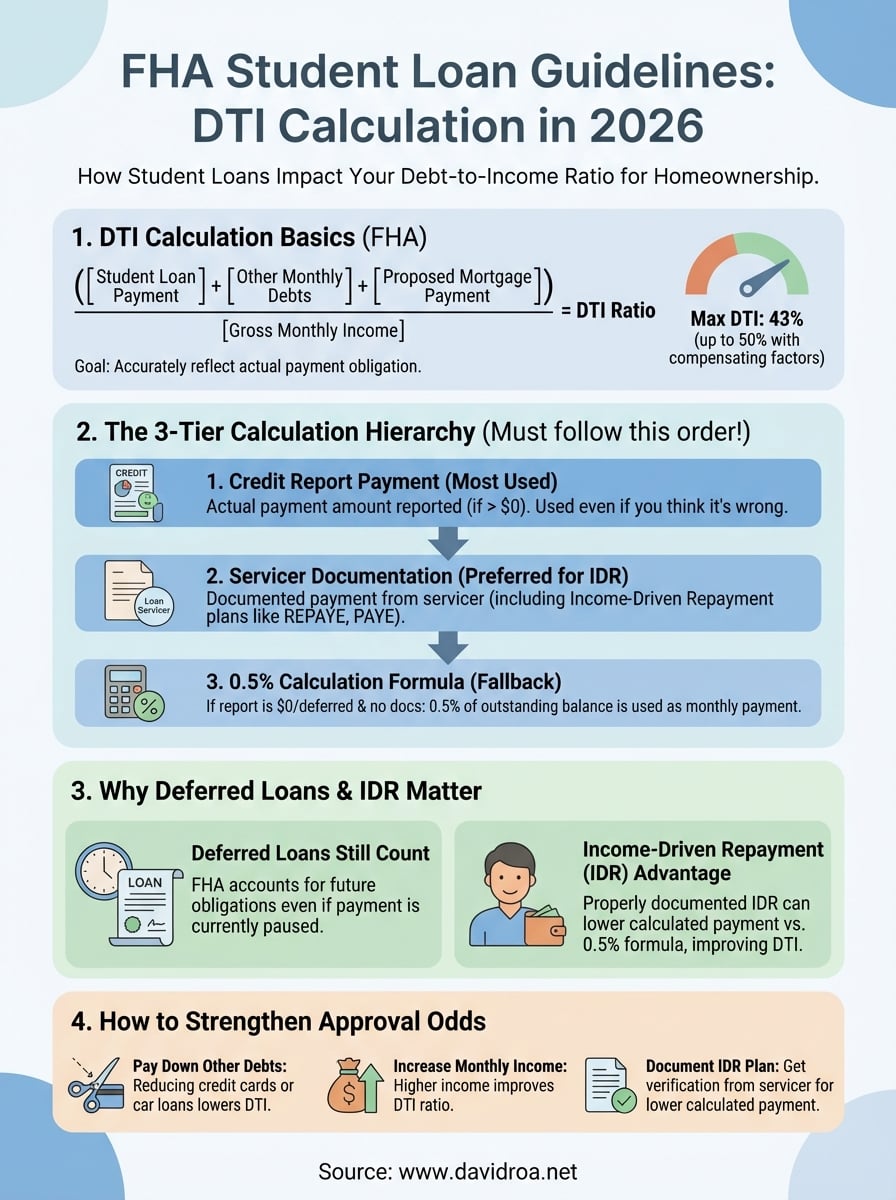
Under current rules, your lender must use the payment shown on your credit report whenever it's greater than zero. This payment appears on the tradeline for each loan and typically reflects what your servicer reports as your monthly obligation. If your credit report shows $250 per month, that's the figure your lender will use in your DTI calculation, not the full balance divided by some fixed number.
The current payment calculation formula
When your credit report shows a $0 monthly payment or no payment at all, FHA requires lenders to calculate using one of three methods. First, they can use 0.5% of your outstanding balance as a monthly payment. For example, if you owe $40,000 in student loans, your lender would calculate $200 per month ($40,000 × 0.005).

Second, your lender can accept documentation directly from your loan servicer showing your actual monthly payment amount. This letter must clearly state the payment and come from the entity servicing your loan. Third, if you're on an income-driven repayment plan, your lender can use the documented IDR payment amount even when your credit report shows $0, as long as you provide written verification from your servicer.
If your credit report shows a payment amount, that's the number your lender will use in your DTI, regardless of whether you think it's too high or outdated.
Special treatment for income-driven plans
Income-driven repayment plans receive favorable treatment under fha student loan guidelines because they're based on your actual ability to pay. When you're enrolled in an IDR plan like REPAYE, PAYE, IBR, or ICR, your lender can use the payment amount listed in your servicer's documentation instead of the 0.5% calculation or the credit report figure.
This often results in a lower DTI calculation than the standard formula would produce. For borrowers with high balances but low incomes, an IDR payment of $100 per month is far more favorable than the $500 monthly payment that 0.5% of a $100,000 balance would generate. You must provide a current payment letter from your servicer that shows your specific IDR plan and monthly payment amount to take advantage of this option.
Why student loans can raise your FHA DTI
Your DTI represents the percentage of your gross monthly income that goes toward debt payments, and student loans play a significant role in this calculation regardless of your current repayment status. FHA lenders add your calculated student loan payment to your other monthly obligations, such as credit cards, car loans, and the proposed mortgage payment, then divide that total by your gross monthly income to determine your DTI ratio.
The DTI calculation formula
FHA allows DTI ratios up to 43% for most borrowers and sometimes as high as 50% with compensating factors like strong reserves or excellent credit. Your student loan payment counts as part of the numerator in this calculation. For example, if you earn $5,000 per month and your total debts including the new mortgage payment equal $2,150, your DTI sits at 43% ($2,150 ÷ $5,000).
When your student loan adds $300 to that monthly debt load, you might exceed the maximum allowable DTI and face a denial. Under fha student loan guidelines, even a small calculated payment can push you over the threshold, especially when combined with high housing costs or other revolving debt.
Student loans affect your buying power dollar for dollar, which means every $100 in calculated monthly payment reduces the mortgage amount you can qualify for by approximately $20,000.
Why deferred loans still count
Deferment doesn't eliminate your obligation in the lender's eyes. FHA requires lenders to account for student loans even when no payment is currently due because the debt still exists and will eventually require repayment. Your credit report might show $0, but the outstanding balance tells lenders you'll face a future payment obligation that could impact your ability to sustain mortgage payments long-term.
This conservative approach protects both you and the lender from overextending your budget based on a temporary payment pause that won't last forever.
How FHA counts student loans in your DTI
FHA uses a three-tier hierarchy to determine which student loan payment figure appears in your DTI calculation. Your lender must follow this specific order, and they cannot simply choose whichever number produces the most favorable outcome. The process starts with your credit report payment, moves to servicer documentation if needed, and falls back to a formula only when no other option applies.
The three-tier counting method
Your lender first checks your credit report for a documented monthly payment. When your credit report shows any amount greater than $0, that figure becomes your DTI payment regardless of other factors. This applies even when you believe the amount is outdated or inaccurate, so you'll need to resolve credit report errors before applying for your mortgage.
If your credit report shows $0 or no payment, your lender moves to the second tier and accepts written documentation from your servicer. This letter must state your actual monthly payment amount and come directly from the company servicing your loans. Under fha student loan guidelines, this documentation method works for both standard repayment plans and income-driven plans.
When neither source provides a payment amount, your lender calculates 0.5% of your outstanding balance as your monthly payment. This formula applies to deferred loans, forbearance periods, or situations where your servicer cannot provide current payment information.
Your lender must use the credit report payment first, servicer documentation second, and the 0.5% calculation only as a last resort under FHA rules.
What your lender will request
You should expect your lender to pull your credit report during the application and review every student loan tradeline for payment amounts. If your report shows $0, your lender will ask for a payment letter from your servicer that includes your loan balance, monthly payment, and repayment plan type.
How to estimate your DTI with examples
Calculating your DTI before applying gives you a clear picture of where you stand and whether your student loans will prevent approval. You need three numbers to start: your gross monthly income, your total monthly debt payments including the proposed mortgage, and your calculated student loan payment under the rules we've covered. The formula is simple, but the student loan component requires careful attention to which calculation method applies to your situation.

Example with credit report payment
Suppose you earn $6,000 per month gross and your credit report shows a $400 monthly student loan payment. Your proposed FHA mortgage payment including taxes and insurance totals $1,200, you pay $300 for a car loan, and you carry $150 in minimum credit card payments. Your total monthly debt equals $2,050 ($1,200 + $400 + $300 + $150), which produces a DTI of 34.17% ($2,050 ÷ $6,000).
This DTI sits comfortably below the 43% threshold most FHA lenders require, giving you room for approval without compensating factors. Your lender would use that $400 figure directly from your credit report under fha student loan guidelines without requesting additional documentation.
When your credit report shows a payment amount, that number becomes your DTI calculation regardless of your actual servicer statement or payment plan.
Example with 0.5% calculation method
Now assume your credit report shows $0 for your student loan payment because your loans are in deferment, and you owe $50,000 total. Your lender calculates $250 per month ($50,000 × 0.005) as your payment obligation. Using the same income and other debts from above but substituting $250 for the student loan, your total monthly debt becomes $1,900, producing a 31.67% DTI ($1,900 ÷ $6,000).
This lower calculated payment improves your approval odds and buying power compared to the credit report scenario.
How to qualify with student loans on your file
Qualifying for an FHA loan with student debt requires strategic preparation rather than hoping your application slides through. You can take specific actions before applying that directly improve your approval odds by lowering your calculated DTI or strengthening your compensating factors. The key is understanding which aspects of your student loan situation you control and addressing them before your lender pulls your credit report and calculates your payment.
Lower your DTI before applying
Paying down other debts gives you more room in your DTI ratio for the student loan payment that FHA requires. Focus on eliminating or reducing credit card balances, car loans, and personal loans that appear on your credit report. Every $100 in monthly payments you eliminate increases your mortgage buying power by approximately $20,000, which can make the difference between approval and denial when your student loans push you close to the DTI limit.
Your second option is increasing your gross monthly income through raises, overtime, bonuses that meet FHA documentation requirements, or adding a qualified co-borrower to your application. Lenders can count income from multiple sources as long as you provide two years of history and evidence of continuance under fha student loan guidelines.
Reducing just $200 in monthly non-housing debt can drop your DTI by 3 to 4 percentage points, often enough to secure approval when student loans put you over the threshold.
Document your IDR plan properly
Enrollment in an income-driven repayment plan before you apply can dramatically lower your calculated payment compared to the 0.5% method. You need written verification from your servicer showing your current IDR payment amount and plan type, which your lender will use instead of the standard calculation. Request this documentation well before your mortgage application so you have time to resolve any servicer processing delays that might hold up your approval.
Next steps
Understanding fha student loan guidelines puts you ahead of most borrowers who walk into the mortgage process unprepared. You now know how lenders calculate your student loan payment for DTI purposes, which documentation you need, and what strategies work to improve your approval odds when education debt complicates your application.
Your next move is pulling your credit report directly to see what payment amounts appear on your student loan tradelines. Check whether your servicer reports $0 or an actual monthly figure, then calculate your estimated DTI using your gross monthly income and total debt obligations. This preparation gives you a clear starting point and helps you identify potential issues before you contact a lender and begin the formal application process.
If you're ready to explore your FHA loan options with a mortgage professional who understands complex student loan scenarios, reach out to discuss your specific situation. With over 25 years of lending experience and more than $150 million funded, I help borrowers structure their applications for approval even when student debt creates challenges that traditional lenders struggle to navigate.
