
What Is The National Real Estate Investors Association?
Real estate investing rewards those who build the right relationships and stay informed, and that's exactly why organizations like the National Real Estate Investors Association exist. Whether you're buying your first rental property or scaling a portfolio of fix-and-flips, having access to education, networking, and industry resources can be the difference between a good deal and a costly mistake.
At David Roa, we've spent over 25 years funding real estate investors through products like DSCR loans, hard money lending, and fix-and-flip financing, over $150 million funded and counting. That experience has shown us firsthand how investors who plug into strong networks tend to make smarter moves and close stronger deals. National REIA is one of the most established organizations offering that kind of support, yet many investors still don't fully understand what it does or how to take advantage of it.
This article breaks down what the National Real Estate Investors Association is, how its local chapters work, what you get as a member, and how to decide if joining is worth your time and money. If you're serious about building wealth through real estate, this is information worth having.
Why National REIA matters to investors and landlords
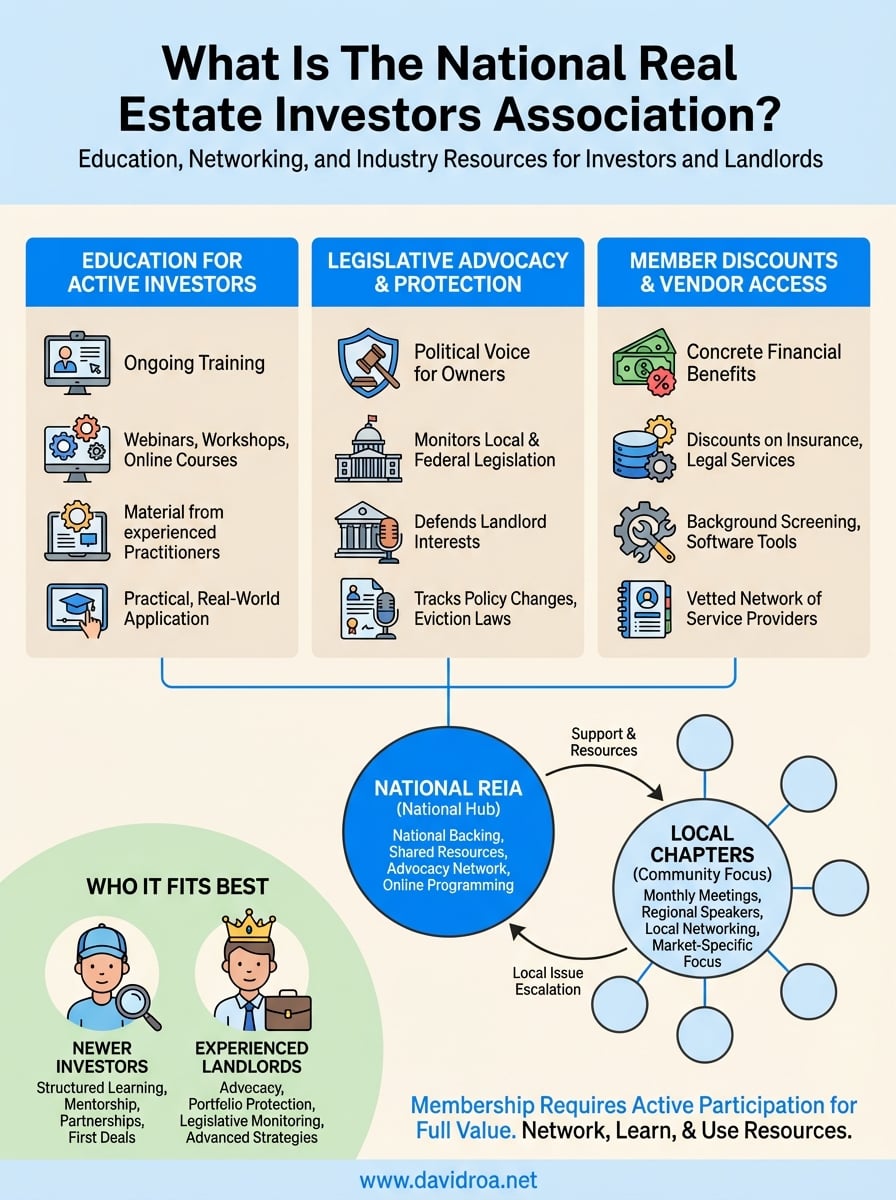
The National Real Estate Investors Association functions as an umbrella organization connecting more than 40,000 members across hundreds of local chapters throughout the United States. It was founded with a clear purpose: to give real estate investors, landlords, and property managers the tools, training, and advocacy they need to succeed in an industry that shifts constantly. For individual investors working without institutional backing, that kind of organized support carries real weight. Understanding why the organization exists helps you decide whether the resources it offers align with where you are in your investing journey.

Education built for active investors
Real estate investing is not a field where you learn everything once and coast indefinitely. Tax laws change, lending programs evolve, local regulations tighten, and market conditions shift from year to year. National REIA addresses this by making ongoing education a core part of what membership delivers. You get access to webinars, workshops, online courses, and live events designed specifically for people who are actively buying, managing, or selling properties rather than studying real estate from the sidelines.
What separates this education from generic online content is that the material comes from practitioners with direct experience. The instructors and speakers connected to National REIA's programs are typically investors, attorneys, CPAs, and lenders who work in the industry daily. That means the guidance you receive reflects how deals actually get structured and closed, not how they look in a classroom setting. For newer investors especially, that gap between theory and application is where most costly mistakes happen.
The most useful education in real estate investing comes from people who are still doing the work, not just teaching it.
Legislative advocacy that protects your investments
One of the most underrated benefits National REIA provides is political advocacy on behalf of landlords and investors. Local and federal legislation regularly introduces proposals that affect rental housing, eviction procedures, property tax assessments, and landlord-tenant law. Without organized representation, individual investors have almost no meaningful voice in those conversations.
National REIA actively monitors legislation at the state and federal level and takes positions that defend the interests of property owners. For landlords managing rental portfolios, this kind of advocacy can directly affect your bottom line. Policies that restrict rent increases, complicate evictions, or raise compliance costs hit small landlords harder than large institutions. Having an organization that tracks these changes and pushes back when needed is a practical benefit that most investors only recognize after a policy shift has already cost them money.
Member discounts and vendor access
Membership in National REIA comes with concrete financial benefits beyond education and advocacy. Discounts on insurance, legal services, background screening tools, and property management software are typically available through the organization's network of affiliated vendors. These savings add up quickly, particularly for investors managing multiple properties who pay for these services on a recurring basis.
You also gain access to a vetted network of service providers who understand the specific needs of real estate investors. Finding a contractor, title company, or property manager who has worked with investors before is genuinely easier when you have a directory of professionals connected through a national organization. That access matters most when you are moving quickly on a deal and need reliable people in place without spending weeks vetting cold contacts. Many members report that vendor access alone offsets the cost of membership within the first year of active use.
National REIA vs local REIAs and other investor groups
When you first start researching investor organizations, the terminology can get confusing fast. The National Real Estate Investors Association operates as the national-level body, but most of the day-to-day activity happens through local REIA chapters that are either affiliated with the national organization or operate independently. Understanding how these layers differ helps you make a smarter decision about where to invest your time and membership dues.
How local REIAs connect to the national organization
Local REIAs affiliated with National REIA carry the benefit of national backing combined with community-level focus. These chapters typically hold monthly meetings, bring in regional speakers, and build relationships among investors who are actively buying and selling in the same markets you work in. That local relevance is what makes chapter membership so practical. You can talk to someone who just closed a deal two zip codes away rather than swapping notes with an investor in a completely different state facing different market conditions, financing options, and local regulations.
The connection to the national organization gives affiliated chapters access to shared educational resources, vendor networks, and legislative support that independent local groups often cannot build on their own. If a proposed policy threatens landlords in your state, an affiliated chapter can escalate that issue through the national network rather than fighting it alone with limited reach and resources.
Affiliation with the national network gives local chapters leverage that independent groups simply cannot match when it matters most.
Where independent groups and other organizations fit
Not every real estate investor group connects to National REIA. Many cities have independent meetup groups, online communities, and niche investor associations that operate entirely outside the national structure. Some of these groups are excellent, particularly when they focus on a specific strategy like multifamily investing or short-term rentals where the conversation stays tight and relevant. Others are loosely organized and inconsistent, which makes it difficult to build reliable relationships over time.
The practical comparison is that independent groups offer flexibility while National REIA-affiliated chapters offer structure and accountability. If you are newer to investing, structure tends to serve you better because it exposes you to vetted educational content, credible professionals, and a consistent calendar of events you can plan around. Experienced investors often participate in both, treating them as tools for different purposes rather than competing options.
Other national organizations like the Urban Land Institute focus more on commercial real estate development and attract a different audience. National REIA stays focused on residential and investment property owners, which keeps the conversations and resources relevant to the specific challenges you are likely navigating.
What membership includes and who it fits best
The national real estate investors association structures membership to deliver value at multiple levels, from direct financial savings to long-term professional development. Before you commit your time and money, it helps to understand exactly what you're paying for and whether your current investing situation positions you to use those benefits fully.
The core benefits you get with membership
Membership typically gives you access to educational content, vendor discounts, and a network of fellow investors through both the national platform and your local chapter. On the education side, you can expect webinars covering topics like tax strategy, landlord-tenant law updates, creative financing, and deal analysis. These are not surface-level overviews. The content is built for people actively closing transactions who need practical, applicable information rather than introductory material.
The vendor discount network covers services you likely already pay for, including background screening, landlord insurance, legal document tools, and property management software. For investors managing even two or three rental properties, those recurring costs add up fast. Accessing pre-negotiated discounts through a membership you're already paying for can offset the annual fee within a few months of use.
Members who actively use the vendor network and attend local chapter events consistently report faster return on their membership investment than those who treat it as a passive resource.
Who gets the most value from joining
Newer investors benefit the most from the structured educational programming and local mentorship available through chapter meetings. If you're still learning how to evaluate deals, structure financing, or manage tenants, being in a room with experienced investors on a monthly basis accelerates your learning in ways that online content simply does not replicate. The relationships you build at those early meetings often lead to your first partnerships, referrals, and off-market deal opportunities.
Experienced investors and landlords managing larger portfolios find the most value in the advocacy work and legislative monitoring the organization provides. When you have significant capital deployed across multiple properties, changes in landlord-tenant law or eviction procedures carry real financial consequences. Having an organization actively tracking and responding to those threats is worth far more than the membership fee.
Investors who are unlikely to benefit are those who join but never attend local events or use the vendor resources. Membership here is not passive. The benefits require active participation, and if your schedule does not allow for regular engagement, you may want to start with a single local chapter meeting before committing to a full membership.
How to find a local chapter and join
Finding your nearest chapter takes less time than most investors expect. The national real estate investors association maintains a chapter directory on its official website where you can search by state or zip code and pull up contact information for active groups in your area. If a chapter exists near you, that directory is your fastest starting point. If your area does not have an affiliated chapter, the site also lists resources for starting one, which is worth knowing if you live in a smaller market with no current presence.

Using the National REIA website to locate chapters
Go directly to the National REIA website and navigate to the chapter finder tool. You enter your location or zip code, and the tool returns a list of nearby affiliated chapters with contact details and, in most cases, a link to the chapter's own website or social media page. From there, you can check upcoming meeting dates and get a feel for how active the group is before you commit to attending.
Many chapters also post their meeting schedules and event topics publicly, which lets you review what topics are being covered and decide if the current programming matches where you are in your investing journey. Looking at two or three upcoming meeting topics tells you more about the quality of a chapter than anything else. An active chapter with relevant, current programming is worth your time. A chapter that has not updated its calendar in months may not be.
Checking a chapter's public meeting history before you show up saves you the frustration of investing an evening in a group that does not match your goals.
What to expect from the sign-up process
Joining an affiliated chapter typically involves two separate steps: signing up at the national level and registering with your local chapter. The national membership gives you access to the broader network, discounts, and online educational content. The local chapter membership, which sometimes carries its own fee, is what gets you into monthly meetings, local events, and face-to-face networking with investors in your market.
Some chapters allow you to attend one meeting as a guest before you pay anything, which is a reasonable way to evaluate whether the group fits your goals before you commit. If your local chapter offers that option, take it. Showing up once as a visitor lets you talk to members directly, gauge the experience level in the room, and ask questions about how active the group stays between formal meetings.
What to expect at meetings, events, and networking
Walking into your first National Real Estate Investors Association chapter meeting without knowing what to expect can feel like showing up to a job interview without researching the company. Most chapters follow a consistent format that mixes structured presentations with open networking time, so understanding the general flow helps you prepare and get more out of the experience from your first visit.
How a typical chapter meeting runs
Most affiliated chapter meetings run 90 minutes to two hours and follow a predictable structure. The meeting usually opens with introductions or brief member updates, moves into a main presentation or panel discussion on a specific topic, and closes with open networking. Topics rotate monthly and often cover areas like landlord-tenant law, deal financing, tax strategy, or property management systems. The speaker is typically a local professional or experienced investor rather than a national figure, which keeps the content grounded in your specific market.
The networking portion at the end is where a significant amount of the real value lives. You will find a mix of newer investors looking for guidance and experienced operators open to partnerships or referrals. Conversations in those last 30 minutes regularly lead to introductions with lenders, contractors, attorneys, and off-market deal sources that you would spend months tracking down on your own. Bring business cards and be direct about what you are working on and what kind of connections would help you move forward.
The investors who build the strongest networks at chapter meetings are the ones who come with a clear idea of what they need and are willing to share what they know in return.
National events and online programming
Beyond monthly chapter meetings, the national organization hosts larger conferences and online events throughout the year. These national events pull in speakers from across the country and cover topics with broader scope, including legislative updates, economic outlooks, and advanced investing strategies. Attending even one national event gives you exposure to a wider range of investors and professionals than your local chapter can realistically provide.
Online programming through the national platform fills in the gaps between in-person events. Webinars run on a regular schedule and are often recorded for members who cannot attend live. This matters if your schedule makes consistent meeting attendance difficult. You can still absorb the educational content and stay current on industry changes without needing to be in the room every month.
Common questions and misconceptions
Even investors who have heard of the national real estate investors association often hold inaccurate assumptions about what it is and how it works. Clearing up the most common misunderstandings helps you approach membership with the right expectations and avoid walking away from a resource that could genuinely benefit your business.
Is National REIA only for experienced investors?
This is the most frequent misconception, and it consistently keeps newer investors from taking the first step. National REIA is designed to serve investors at every level, from people who have not yet closed their first deal to seasoned operators managing dozens of properties. The educational programming specifically accounts for this range, with introductory content sitting alongside more advanced material on topics like portfolio structuring, 1031 exchanges, and complex financing strategies.
Newer investors often get the most out of their first few chapter meetings simply by listening and asking direct questions. The format of most meetings creates natural opportunities for newer members to connect with experienced investors who are willing to share what worked and what did not. Waiting until you feel "ready" before joining is one of the more common ways investors delay their own progress.
The investors who grow fastest through these networks are almost always the ones who joined before they felt fully prepared.
Does membership guarantee deals or income?
Membership does not guarantee any financial outcome, and any chapter or vendor suggesting otherwise is misrepresenting what the organization offers. National REIA is a network and educational resource, not a lead generation service. What you do with the relationships and knowledge you gain through membership depends entirely on your own effort and decision-making.
Investors who join expecting a passive flow of deal opportunities without putting in consistent work typically feel disappointed. The real benefit is that membership compresses the learning curve and expands your network faster than working alone. Deals come from relationships you build over multiple meetings, not from signing up and waiting. Treat membership as infrastructure for your investing business, not as a shortcut to returns.
Can you participate without joining a local chapter?
Yes, but your experience will be significantly narrower. National-level membership gives you access to online content, webinars, and the vendor discount network, but it does not replace the local connections that chapter meetings provide. The investors who get the most value from the organization consistently combine national membership with active local chapter participation. If no chapter currently exists near you, the national organization provides guidance on forming one, which is worth considering if your market has an active investor community with no current hub.
Next steps
The national real estate investors association gives you a structured path to better education, stronger connections, and real protection for your investments as a landlord or property owner. Whether you are just starting out or managing an active portfolio, the combination of local chapter access and national resources closes gaps that most investors cannot fill on their own.
Start by searching the National REIA chapter directory for a group near you, then commit to attending one meeting before making any membership decisions. Talk to the people in the room, ask what the group has helped them accomplish, and measure that against where you want to be in the next 12 months.
Financing is where most real estate investors stall out, and the right lending partner makes a direct difference in how fast you can act on opportunities. If you are ready to move forward on your next deal, connect with David Roa to explore financing options built specifically for investors.
