Refinance My Home Loan: Steps, Rates, Costs, Break-Even Now
You're paying more than you need to on your mortgage, and you know it. Maybe rates have dropped since you closed, or maybe your credit score has improved and you're sitting on better terms you haven't claimed yet. Either way, the thought keeps circling back: "I need to refinance my home loan." But between rate quotes, closing costs, and lender fine print, figuring out whether a refinance actually saves you money, or just moves costs around, isn't always straightforward.
Here's what matters: a refinance only makes sense when the numbers work in your favor. That means understanding your break-even point, knowing what fees to expect, and choosing the right loan product for your situation, whether that's a conventional rate-and-term refi, an FHA Streamline, or a cash-out to tap your equity.
With over 25 years in mortgage lending and more than $150 million in funded loans, I've walked thousands of homeowners through this exact decision at David Roa. I've seen refinances save families hundreds per month, and I've talked people out of refinancing when the math didn't add up. This guide breaks down every step of the process, from checking your eligibility to calculating your true savings, so you can decide with confidence, not guesswork.
How refinancing works and when it makes sense
When you refinance your home loan, you replace your current mortgage with a new one. The new loan pays off your existing balance, and you start fresh with different terms, whether that's a lower interest rate, a shorter payoff period, or access to your home equity as cash. The lender underwrites the new loan based on your current financial profile, including your credit score, income, and home value, not the original terms you agreed to at closing.
The basic mechanics of a refinance
The process closely mirrors what you went through when you bought your home. You apply, the lender pulls your credit, orders an appraisal, and verifies your income and assets. Once approved, you sign new loan documents at closing, your old mortgage gets paid off, and you begin making payments on the new loan. Most refinances close in 30 to 45 days, though streamline programs like FHA Streamline can move faster because they allow reduced documentation and often skip the full appraisal requirement.
One detail many homeowners miss: your first payment on the new loan typically isn't due until 30 to 60 days after closing, depending on what day in the month you close. That gap can feel like breathing room in your budget, but you're not skipping a payment. Interest still accrues during that window, so factor it into your planning before you spend that money elsewhere.
A refinance doesn't erase your loan balance. It restructures it, so the math on total interest paid over the life of the loan matters just as much as your monthly savings.
When refinancing actually makes sense
Not every rate drop is a signal to act. The right time to refinance depends on your specific situation, not what you read in a headline. Several concrete indicators tell you the math is likely in your favor:
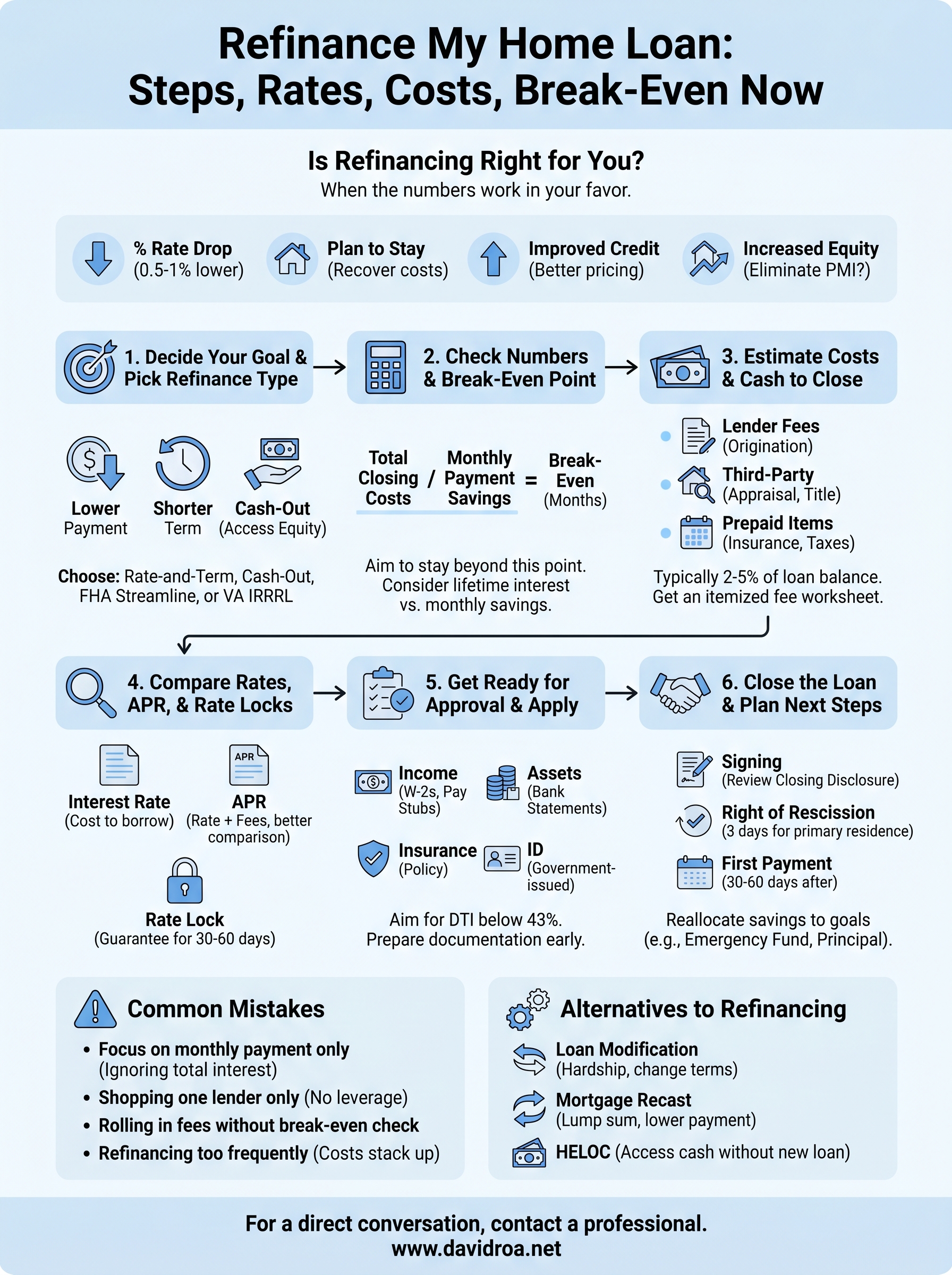
- Your current rate is at least 0.5% to 1% higher than what you qualify for today
- You plan to stay in the home long enough to recover closing costs through monthly savings
- Your credit score has improved significantly since you closed, unlocking better pricing
- Your home value has risen, giving you more equity and potentially eliminating private mortgage insurance (PMI)
- You need to adjust your loan term, such as moving from a 30-year to a 15-year to reduce total interest paid
- You want to switch from an adjustable-rate mortgage to a fixed rate before your adjustment period hits
If most of those conditions apply to your situation, a refinance conversation is worth pursuing seriously. If only one applies, say rates dipped slightly but your credit is weaker than it was at closing, the savings may not outweigh what you pay in fees. Refinancing for its own sake isn't the goal. The goal is a loan structure that improves your financial position in a concrete, measurable way. Everything in the steps ahead helps you figure out whether this refinance gets you there.
Step 1. Decide your goal and pick a refinance type
Before you contact a lender or pull a credit report, get clear on what you want this refinance to accomplish. Your goal determines which loan product fits, what documentation you need, and whether the cost to close is justified. Jumping into a refinance without a defined objective is the fastest way to end up with a loan that doesn't serve you.
The four main refinance types
Each refinance product solves a different problem. Matching your situation to the right loan type keeps you from paying for features you don't need.
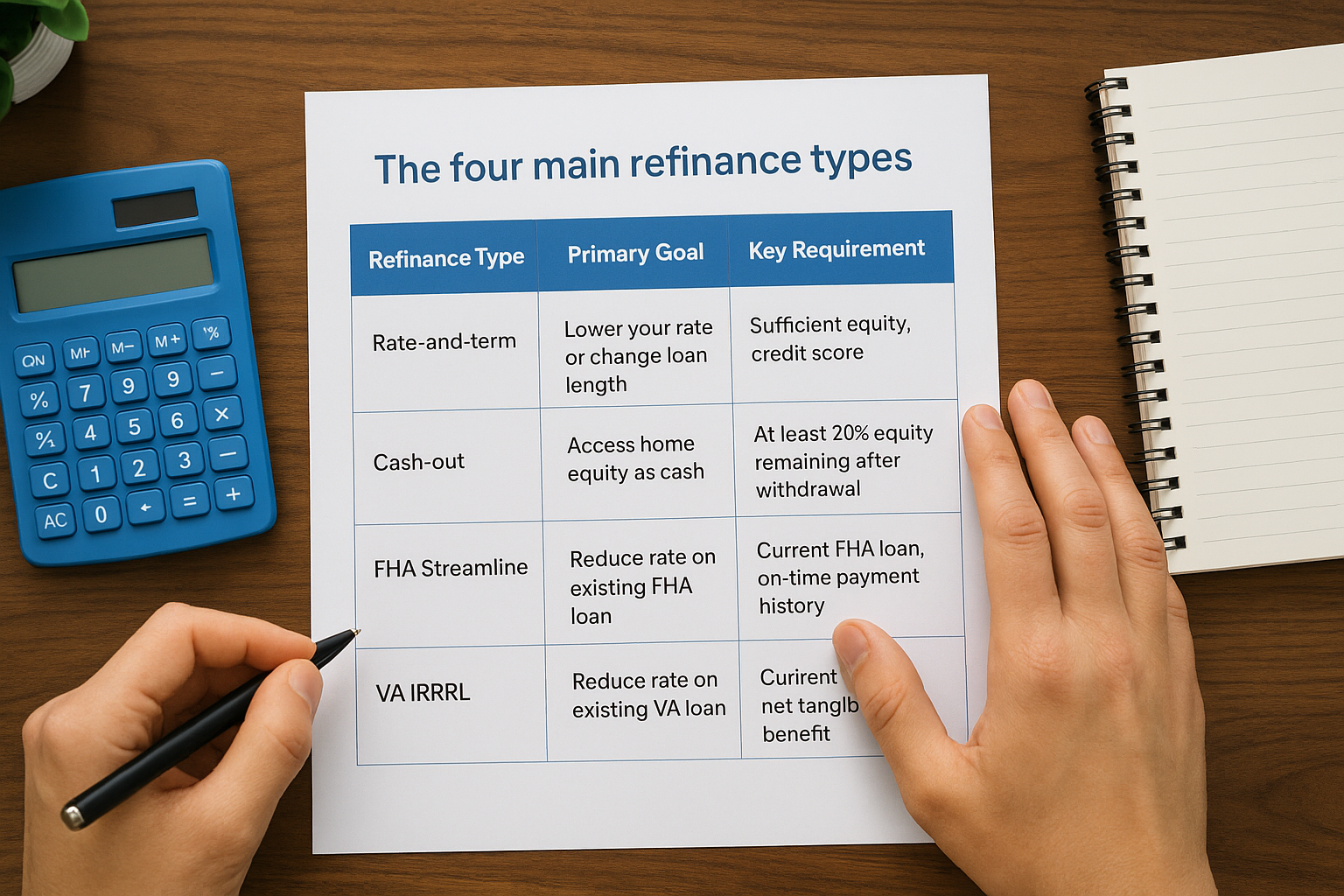
| Refinance Type | Primary Goal | Key Requirement |
|---|---|---|
| Rate-and-term | Lower your rate or change loan length | Sufficient equity, credit score |
| Cash-out | Access home equity as cash | At least 20% equity remaining after withdrawal |
| FHA Streamline | Reduce rate on existing FHA loan | Current FHA loan, on-time payment history |
| VA IRRRL | Reduce rate on existing VA loan | Current VA loan, net tangible benefit |
If you currently have an FHA loan and simply want a lower monthly payment, an FHA Streamline is often your fastest path. If you have a conventional loan and your home has gained value, a rate-and-term refinance is typically the cleaner option. A cash-out refinance works when you have a specific use for the funds, such as paying off high-interest debt or funding a renovation, but it increases your loan balance, so it requires a clear financial rationale.
Define your goal before you shop
Write down your specific outcome before you refinance my home loan process begins. Ask yourself: Do I want a lower monthly payment, a shorter loan term, or access to cash? Chasing all three at once usually means compromising on each.
Pick one primary goal, then evaluate every lender offer against that single benchmark. That clarity cuts through the noise faster than any rate comparison tool.
If your goal is reducing monthly cash outflow, prioritize rate. If you want to build equity faster, focus on term. Knowing your target in advance also protects you from being upsold into a product that looks attractive on paper but misaligns with where you're actually headed financially.
Step 2. Check your numbers and break-even point
Once you know your goal and loan type, the next move is running your actual numbers before you talk to any lender. Most homeowners skip this step and let the lender's loan estimate tell the whole story, which puts you at a disadvantage during negotiations. Two figures drive the refinance decision: your monthly payment savings and your break-even point. Get both on paper before you go any further.
Calculate your break-even point
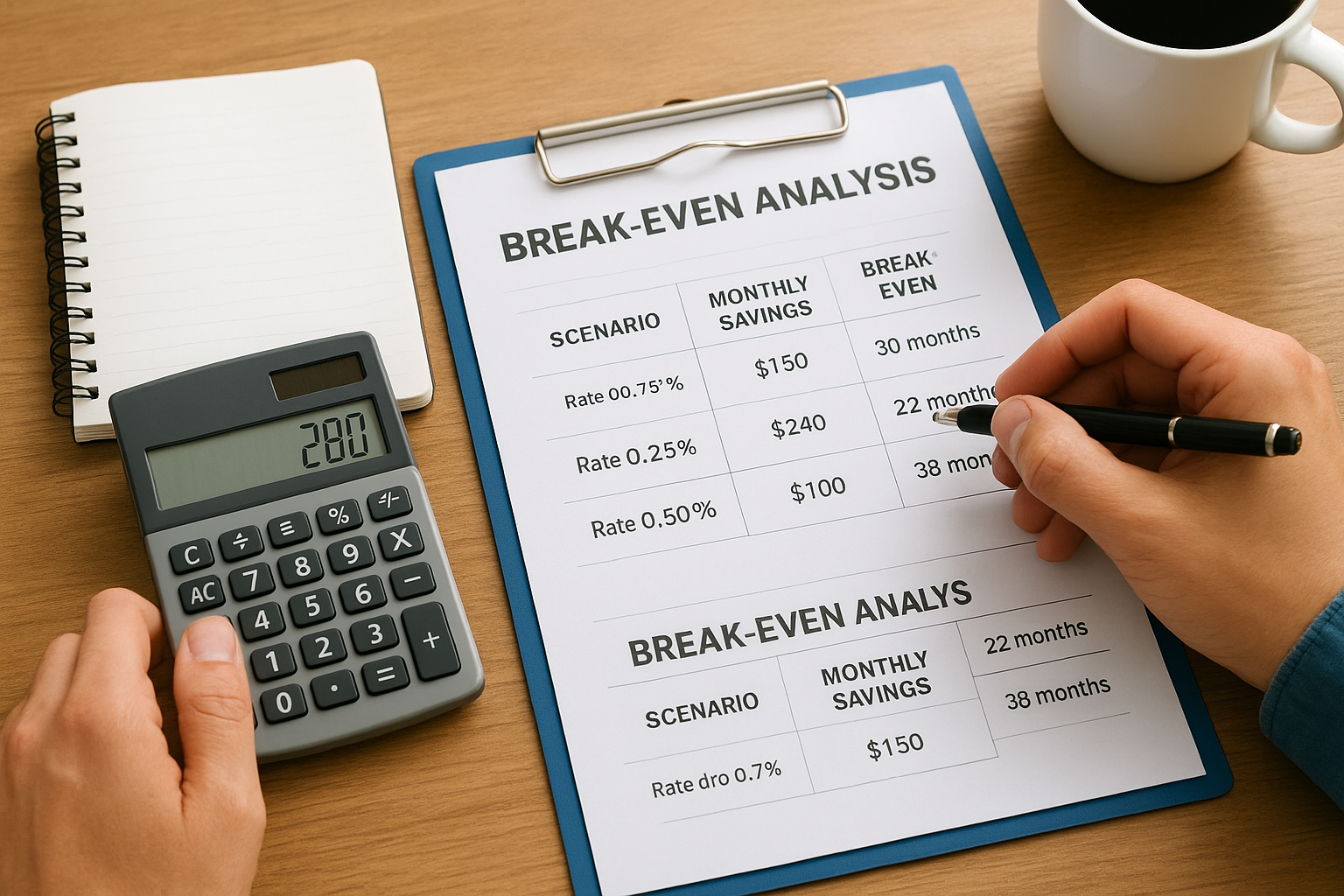
The break-even point is the number of months it takes for your monthly savings to recover the cost of closing. If you pay $4,800 in closing costs and lower your payment by $160 per month, your break-even is 30 months. You need to stay in the home beyond that point for the refinance to generate real financial benefit.
If you plan to sell or refinance again before you hit your break-even, you will lose money on this transaction regardless of how attractive the rate looks.
Use this formula, then verify it against the numbers your lender provides:
Break-Even (months) = Total Closing Costs / Monthly Payment Savings
Here's how that plays out across three common scenarios:
| Scenario | Closing Costs | Monthly Savings | Break-Even |
|---|---|---|---|
| Rate drop of 0.75% | $4,500 | $150 | 30 months |
| Rate drop of 1.25% | $5,200 | $240 | 22 months |
| Rate drop of 0.50% | $3,800 | $100 | 38 months |
Factor in your remaining loan term
When you refinance my home loan into a new 30-year term, your monthly payment often drops, but your total interest paid can increase significantly if you're already 8 to 10 years into your current mortgage. Run both the monthly savings number and the lifetime interest cost side by side before you commit.
Pull your current mortgage statement and note your remaining balance and the interest paid to date. Then compare that against the total repayment cost of the proposed new loan. A lower monthly payment that adds $25,000 in long-run interest is not a savings, it is a cost restructured to feel like one.
Step 3. Estimate costs, cash to close, and fees
Closing costs are the part of refinancing that surprises homeowners most, and they're also the part lenders are least likely to volunteer upfront. When you refinance my home loan, you're looking at fees that typically run between 2% and 5% of your loan balance. On a $300,000 loan, that means $6,000 to $15,000 in costs before you see a single dollar in savings. Know what's coming before you sit across from a lender.
What refinance closing costs typically include
Most fees fall into three buckets: lender fees, third-party fees, and prepaid items. Lender fees cover origination and underwriting. Third-party fees cover the appraisal, title search, title insurance, and settlement agent. Prepaid items include homeowner's insurance, property taxes, and prepaid interest that covers the days between closing and your first payment due date.
Here's a breakdown of what to expect in each category:
| Fee Category | Common Items | Typical Range |
|---|---|---|
| Lender fees | Origination, underwriting, processing | $1,000 to $3,000 |
| Third-party fees | Appraisal, title search, title insurance | $1,500 to $3,500 |
| Prepaid items | Insurance, taxes, prepaid interest | $1,000 to $3,000 |
| Recording fees | County and state filing | $50 to $250 |
Ask every lender for an itemized fee worksheet before you submit a full application. That single document tells you more about a lender's pricing than their advertised rate does.
Calculate your cash to close
Your cash to close is not the same as your total closing costs. If you roll fees into the loan balance or receive a lender credit in exchange for a slightly higher rate, your out-of-pocket number at the closing table changes. Use this simple template to map your real position:
Total Closing Costs:        $________
- Lender Credits:           $________
- Seller Concessions:       $________
+ Prepaid Items:            $________
= Estimated Cash to Close:  $________
Ask your loan officer for a Loan Estimate within three business days of application. That document is standardized by federal law and gives you a direct apples-to-apples comparison across every lender you're evaluating.
Step 4. Compare rates, APR, and rate locks
When you refinance my home loan, the advertised interest rate is rarely the full picture. Lenders lead with the rate because it looks attractive, but the rate alone doesn't tell you what the loan actually costs over time. Before you compare any two offers, you need to understand three numbers: the interest rate, the APR, and the rate lock terms.
Rate vs. APR: know the difference
The interest rate is what the lender charges you to borrow the money. The annual percentage rate (APR) includes that rate plus most of the fees tied to the loan, which gives you a more accurate cost comparison across lenders. A lender quoting 6.5% with high origination fees can end up more expensive than one quoting 6.75% with no points, and the APR exposes that difference immediately.

Here's how to read two competing loan offers side by side:
| Offer | Interest Rate | Lender Fees | APR | Monthly Payment |
|---|---|---|---|---|
| Lender A | 6.50% | $3,800 | 6.74% | $1,264 |
| Lender B | 6.75% | $0 | 6.79% | $1,297 |
| Lender C | 6.25% | $6,200 | 6.72% | $1,231 |
In this example, Lender C has the lowest rate but the highest fees, making it the right choice only if you stay in the home long enough for those fees to pay off. Lender B costs more monthly but saves you cash at closing. APR comparison surfaces these trade-offs instantly.
How to use rate locks
A rate lock guarantees your interest rate for a set period, typically 30, 45, or 60 days, while your loan moves through underwriting. If rates rise during that window, your locked rate holds. If rates fall, you generally stay at the locked rate unless your lender offers a float-down option.
Request your rate lock confirmation in writing and confirm what happens if your closing is delayed beyond the lock expiration, some lenders charge extension fees that can run $500 to $1,000 or more.
Ask your loan officer these three questions before you lock:
- How long is the lock period, and does it cover your expected closing date with a buffer?
- Does the lender offer a float-down option if rates drop after you lock?
- What is the cost to extend the lock if your closing runs long?
Step 5. Get ready for approval and apply
Once you've compared rates and locked your preferred offer, the work shifts to your side of the table. Lenders move faster when your documentation is complete and organized, so preparation here directly affects how quickly you close. A disorganized application slows underwriting, sometimes by weeks, and can trigger additional documentation requests that push you dangerously close to your rate lock expiration.
Gather Your Documents Before You Apply
Before you refinance my home loan officially, pull together every document the underwriter will need. Missing paperwork is the single most common reason loan processing stalls, and it's entirely preventable if you prepare in advance. Have these ready before you submit:
- Income verification: Last 2 years of W-2s, last 30 days of pay stubs, or 2 years of tax returns if self-employed
- Asset statements: Last 2 months of bank, retirement, and investment account statements
- Current mortgage statement: Shows your remaining balance and monthly payment
- Homeowners insurance: Current policy with your insurer's contact information
- Government-issued ID: Driver's license or passport
- Property tax statements: Most recent bill from your county
Self-employed borrowers should expect to provide a year-to-date profit and loss statement alongside full tax returns, since underwriters need confirmation that your income is current and consistent, not just historical.
How to Submit a Strong Application
Your credit profile and debt-to-income (DTI) ratio are the two numbers underwriters focus on most during a refinance review. Before you apply, pull your credit report at the federally authorized AnnualCreditReport.com and dispute any errors in writing. Even a five-point credit score improvement can shift your rate tier and meaningfully reduce your payment.
Calculate your DTI by dividing your total monthly debt payments, including the proposed new mortgage payment, by your gross monthly income. Keep that figure below 43% to stay within conventional loan guidelines. If your DTI runs tight, paying down a small revolving balance before applying can push you into a cleaner approval range without requiring a large payoff at closing.
Step 6. Close the loan and plan what happens next
When your loan clears underwriting and the lender issues a Clear to Close, you're in the final stretch of the process to refinance my home loan. At this point, your loan officer schedules a closing date, and the title or settlement company prepares your final documents. Review your Closing Disclosure carefully at least three business days before your signing appointment since federal law requires lenders to provide it within that window, and it locks in every fee you were quoted during processing.
What happens at the closing table
Closing on a refinance is typically shorter than a purchase closing because there's no seller involved and no transfer of ownership. You'll sign the new promissory note, deed of trust, and a set of federal disclosures. On a primary residence refinance, federal law gives you a three-business-day right of rescission, meaning you can cancel the loan after signing without penalty. Your funds don't disburse until that window closes.
Bring a government-issued ID and a certified or cashier's check for your cash-to-close amount. Personal checks are rarely accepted at the closing table.
Plan your first payment and next financial move
Once your loan funds, your old mortgage is paid off by the new lender and your account with the previous servicer closes. Confirm in writing that the payoff posted correctly, then watch for a letter from your new loan servicer confirming your first payment date and exact amount. That first payment is usually due 30 to 60 days after closing depending on when in the month you signed.
Use that window intentionally. If your monthly payment dropped by $200, redirect those savings toward a specific financial goal rather than letting them absorb into general spending. A simple allocation looks like this:
Monthly Savings:                $200
- Emergency Fund (50%):         $100
- Extra Principal Payment:      $ 60
- Short-Term Goal (25%):        $ 40
Treating your monthly savings as a dedicated line item rather than leftover cash turns a refinance from a one-time rate improvement into a sustained financial gain you'll feel for years.
Common mistakes and when not to refinance
Knowing when to refinance my home loan is only half the equation. Knowing when to stop is equally important, and it's where most homeowners leave money on the table. A refinance is a financial tool, not a default response to every rate movement, and using it at the wrong moment can set your financial position back by years.
Mistakes that cost homeowners money
The most expensive mistakes happen before you ever sign a document. Many homeowners focus only on the monthly payment and ignore the total interest cost across the life of the new loan. Resetting a 22-year-old mortgage back to a 30-year term can drop your payment by $180 per month while adding $40,000 or more in total interest. That's a loss disguised as a win.
Comparing only monthly payments across loan offers is the equivalent of comparing only the down payment on a car. It shows you one number while hiding the full cost.
Watch out for these specific errors when evaluating whether to move forward:
- Shopping one lender only: You have no baseline for comparison and no negotiating leverage
- Rolling in fees without calculating break-even: A no-cost refi sounds attractive until you realize the higher rate extends your break-even by years
- Refinancing too frequently: Closing costs stack up each time, and your equity drops every time you roll fees into the balance
- Ignoring your remaining term: Refinancing 5 years before payoff almost never improves your financial position
Clear signs this is not the right time
If your credit score has dropped significantly since your original closing, the rate you qualify for today may actually be higher than what you're currently paying after fees are factored in. Wait until your score recovers before starting an application, even if rates look favorable in the news.
You should also hold off if you plan to sell within 24 months. Most refinance transactions carry closing costs that require two or more years to recover through monthly savings. Moving before you hit that break-even point means you paid fees with no financial return.
Options besides refinancing
A full refinance is not the only lever you can pull when your current mortgage no longer fits your financial situation. Before you decide to refinance my home loan, it's worth reviewing the alternatives that may solve your specific problem with less cost, less paperwork, and no reset to your loan term.
Loan modification
A loan modification changes the terms of your existing mortgage directly with your current servicer, without replacing the loan entirely. This option is typically reserved for homeowners facing financial hardship, such as a job loss or medical expense that makes the current payment unmanageable. Because the modification happens within your existing loan, you avoid closing costs and the credit impact of a new application.
Contact your servicer's loss mitigation department in writing to request a modification review. They will ask for proof of hardship, recent bank statements, and income documentation, similar to a standard underwriting package.
Recast your mortgage
A mortgage recast lets you make a large lump-sum payment toward your principal balance, after which your lender re-amortizes the remaining balance at your existing interest rate. The result is a lower monthly payment without changing your rate or term and without triggering a new loan. Most conventional lenders allow recasts for a flat fee, typically between $150 and $500.
A recast works best when you have a windfall, like a bonus or inheritance, and your current interest rate is already competitive enough that a new loan would not improve it.
Home equity line of credit
If your goal is accessing cash rather than reducing your payment, a home equity line of credit (HELOC) lets you borrow against your available equity without replacing your first mortgage. You draw funds as needed, pay interest only on what you use, and keep your existing mortgage rate intact.
Use case comparison:
- Need cash for renovation:     HELOC or cash-out refi
- Payment too high, hardship:   Loan modification
- Have lump sum, want savings:  Mortgage recast
- Want lower rate + new term:   Traditional refinance
Each of these paths has a specific scenario where it outperforms a full refinance, so match the tool to your actual problem before you commit.
Next steps
You now have a complete framework to refinance my home loan decision from start to finish. Start with your break-even calculation, confirm your goal matches the right loan type, and gather your documentation before you contact a single lender. That order keeps you in control of the process rather than reacting to whatever a lender presents first.
From there, get at least three Loan Estimates and compare them on APR, not just rate. Review every fee line, confirm your lock period covers your closing date with buffer days built in, and treat your monthly savings as a dedicated financial tool once the new loan funds.
Every homeowner's situation is different, and the right structure for your loan depends on your specific numbers, timeline, and goals. If you want a direct conversation about what refinancing looks like for your situation, reach out to David Roa and get a clear answer from someone who has done this more than 150 million times over.
