12 Best Commercial Real Estate Lenders With Rates (2026)
Choosing the right lender can make or break a commercial property deal. Whether you're buying your first office building, refinancing a retail space, or scaling a rental portfolio, the best commercial real estate lenders offer more than just capital, they bring competitive rates, flexible terms, and the ability to close on time. But with dozens of banks, SBA lenders, and online platforms competing for your business, sorting through the options gets overwhelming fast.
Having spent over 25 years originating commercial and residential loans, and having funded more than $150 million in deals, I've worked alongside many of these lenders firsthand. At David Roa, we broker commercial financing through SBA programs, conventional banks, and private capital sources, so I've seen how each type of lender performs when it actually matters: at the closing table. That hands-on experience, combined with running my own businesses and investment properties, gives me a practical read on what borrowers should prioritize.
This guide breaks down 12 top commercial real estate lenders for 2026, including their current rates, loan types, and ideal borrower profiles. I've also included key details on eligibility requirements and loan structures so you can compare your options side by side. By the end, you'll have a clear picture of which lender fits your deal, and what to watch out for before you apply.
1. David Roa commercial lending
Working with a broker-lender who doubles as an active real estate investor and restaurant owner gives you a different caliber of guidance than most of the best commercial real estate lenders offer directly. At David Roa, the focus is on matching you to the right financing structure from a network of banks, SBA programs, and private capital sources, rather than pushing you into whatever product a single institution happens to carry.
Why borrowers choose David Roa
Most borrowers come here because they have a complex deal that traditional banks keep declining or dragging out. With over 25 years of originating loans and $150 million funded, the team understands how to package applications for lenders who can actually close them. That experience matters most when your timeline is tight or your financials don't fit a standard template.
If your last lender told you no, the issue is usually fit, not the deal itself.
Loan programs you can access through David
David Roa brokers commercial loans across SBA 7(a) and 504 programs, conventional bank financing, DSCR loans for investors, hard money, fix-and-flip lending, and mixed-use property financing. For business owners, equipment financing and working capital products are also on the table. This range means you compare real options rather than defaulting to whatever one bank happens to offer.
Typical rates, terms, and down payments to expect
Rates vary by program, but SBA 504 loans currently price between 6.5% and 7.5% for fixed-rate portions, while conventional CRE loans run from 7% to 9% depending on property type and borrower strength. DSCR and hard money products carry higher rates, typically 9% to 12%, but they close faster and require less personal income documentation. Down payments range from 10% on SBA 504 to 25% to 35% on investor-focused loans.
What you need to qualify
Qualification depends on the program, but most commercial loans require at least 2 years of business or investment history, a credit score above 650, and documentation showing the property or business generates sufficient cash flow. For ITIN borrowers, alternative documentation programs are available that traditional banks typically will not touch.
Pros and cons for owner-occupied and investors
The right structure depends on how you use the property. Owner-occupied buyers benefit from SBA programs with lower down payments and longer amortization periods, while investors gain from DSCR products that qualify based on property income rather than personal tax returns.
| Owner-Occupied | Investors | |
|---|---|---|
| Pro | SBA 504 at lower rates | DSCR loans bypass personal income docs |
| Con | More documentation required | Higher rates on asset-based loans |
How to get matched to the right lender fast
Start by bringing your property details, intended use, and financial overview to the first conversation. David Roa's process is built around understanding your deal structure before recommending a lender, which saves you from submitting multiple applications and collecting hard credit pulls across several banks.
2. Live Oak Bank
Live Oak Bank has built a national reputation as one of the best commercial real estate lenders focused specifically on SBA financing. Based in Wilmington, North Carolina, it consistently ranks among the top SBA 7(a) lenders in the country by loan volume, making it a strong choice if your purchase qualifies for government-backed programs.
Best for SBA-backed commercial property loans
If you run a small business and want to purchase owner-occupied commercial real estate, Live Oak Bank's specialization in SBA lending gives you a real edge. The bank focuses on specific industries including healthcare, veterinary, and hospitality, but has expanded its reach to cover a broader range of small business real estate needs.
Loan programs and property types
Live Oak Bank primarily offers SBA 7(a) and SBA 504 loans for owner-occupied properties. Eligible property types include medical offices, restaurants, hotels, and professional service buildings. Conventional CRE products are more limited compared to the big banks, so investors typically need to look elsewhere.
Typical rates, terms, and down payments to expect
SBA 7(a) loans through Live Oak currently carry rates between 6.5% and 9%, depending on loan size and term. Down payments typically start at 10%, and terms run up to 25 years on real estate.
SBA 504 loans are often the better fit when you need a lower fixed rate on a long-term property purchase.
What you need to qualify
You generally need at least 2 years in business, a credit score above 680, and proof that the property will be owner-occupied at 51% or more. Personal guarantees are required for owners holding more than 20%.
Pros and cons for small businesses
Live Oak's SBA focus means lower down payments and longer terms than conventional loans, but the product range is narrower, so mixed-use buyers or pure investors may need to look elsewhere.
What the application process looks like
The bank handles much of the process digitally, with dedicated SBA specialists assigned to your file. Expect 60 to 90 days from application to closing on most SBA deals, which is standard for government-backed loans.

3. U.S. Bank
U.S. Bank is one of the largest traditional lenders in the country and stands out among the best commercial real estate lenders because it offers both conventional CRE loans and SBA-backed programs under one roof. That combination makes it worth considering if you want to compare government-backed options against standard bank financing without jumping between institutions.
Best for conventional CRE plus SBA options
U.S. Bank works well for established businesses that want to evaluate SBA 7(a) or 504 loans against a conventional commercial mortgage with a single banking relationship. The bank has the scale and underwriting experience to handle both structures, which simplifies your decision-making before you commit to a product type.
Loan programs and property types
U.S. Bank offers conventional commercial real estate loans, SBA 7(a), and SBA 504 programs primarily for owner-occupied properties. Eligible types include office buildings, retail centers, industrial facilities, and mixed-use properties. Pure investment properties are evaluated on a case-by-case basis.
Typical rates, terms, and down payments to expect
Conventional CRE loans currently run between 7% and 9.5%, while SBA 504 fixed rates fall in the 6.5% to 7.5% range. Down payments start at 10% for SBA programs and reach 20% to 25% for conventional loans, with terms extending up to 25 years.
Locking in a fixed rate through SBA 504 can save you materially over a 20-year hold compared to a floating conventional loan.
What you need to qualify
U.S. Bank typically requires a credit score above 700, at least 2 years of operating history, and debt service coverage ratios of 1.25x or better. Two years of financial statements and tax returns are standard across both loan types.
Pros and cons for established businesses
| Pros | Cons | |
|---|---|---|
| Conventional CRE | Flexible structures, faster closing | Higher down payment |
| SBA options | Lower down payment, longer terms | Slower approval timeline |
What to ask a banker before you apply
Before submitting anything, ask your banker directly whether your property qualifies for SBA 504 versus conventional financing and what the total cost difference looks like over your hold period. You should also confirm prepayment penalty terms, since many U.S. Bank commercial loans carry step-down penalties that can significantly affect your exit costs.
4. Bank of America
Bank of America is one of the best commercial real estate lenders for borrowers who want to negotiate loan structure rather than accept a one-size-fits-all product. The bank's commercial lending team is experienced with both owner-occupied and investor properties, and its sheer size means it can handle deals across a wide range of loan sizes and property types.
Best for flexible structures like balloon vs amortized
Bank of America gives you real choices on how you repay your loan, including fully amortized structures and balloon payment options that lower monthly costs but require a lump-sum payoff at the end of the term. That flexibility makes it a strong fit if you want to match your loan structure to your business cash flow or your planned hold period on the property.
Loan programs and property types
The bank offers conventional commercial real estate mortgages, SBA 7(a) loans, and SBA 504 financing for eligible owner-occupied properties. Eligible property types include office space, retail, industrial, and multi-tenant buildings. Investment property financing is available but evaluated more selectively compared to owner-occupied deals.
Typical rates, terms, and down payments to expect
Conventional CRE rates currently run between 7% and 9.5%, while SBA 504 options bring fixed-rate portions into the 6.5% to 7.5% range. Down payments start at 10% for SBA loans and reach 20% to 25% on conventional financing.
Balloon structures can free up monthly cash flow, but you need a clear refinance or exit plan before the term ends.
What you need to qualify
Bank of America typically requires a credit score of 700 or higher, at least 2 years of business history, and DSCR above 1.25x. Full financial documentation including two years of tax returns is standard.
Pros and cons for relationship banking
| Pros | Cons | |
|---|---|---|
| Relationship banking | Rate discounts for existing clients | Slower decisions than online lenders |
| Loan flexibility | Balloon and amortized options available | Heavy documentation requirements |
Common fees and closing timelines to plan for
Bank of America charges origination fees typically between 0.5% and 1% of the loan amount, plus standard third-party costs for appraisals, title, and environmental reviews. Closing timelines run 60 to 90 days on most commercial deals, so build that window into your purchase contract before you submit your offer.
5. JPMorgan Chase
JPMorgan Chase consistently ranks among the best commercial real estate lenders for borrowers who bring substantial experience and deal size to the table. The bank's commercial real estate division operates at a scale that smaller institutions simply cannot match, which translates into access to larger loan amounts and more sophisticated underwriting for the right borrower profile.
Best for experienced sponsors and larger deals
JPMorgan Chase prioritizes borrowers with a documented track record in commercial real estate. If you have prior ownership history, strong net worth, and are pursuing a deal above $1 million, you are in the borrower profile this bank actively wants to serve.
Loan programs and property types
The bank offers conventional commercial mortgages, construction loans, and agency financing for multifamily properties. Eligible property types span office, retail, industrial, multifamily, and mixed-use. Owner-occupied and investment properties are both evaluated, giving you more flexibility than many SBA-focused lenders.
Typical rates, terms, and down payments to expect
Conventional CRE rates currently fall between 7% and 9.5%, with terms ranging from 5 to 25 years. Down payments typically start at 20% to 25% depending on property type and borrower strength.
Multifamily deals through agency programs often carry lower rates than conventional bank financing, so ask your banker to run both scenarios.
What you need to qualify
JPMorgan typically requires a credit score above 700, a DSCR of 1.25x or better, and two to three years of audited or CPA-prepared financials.
Pros and cons for owner-occupied and investment CRE
| Pros | Cons | |
|---|---|---|
| Owner-occupied | Strong loan size capacity | Heavy documentation burden |
| Investment CRE | Sophisticated underwriting | Less accessible for newer investors |
How to improve approval odds before you apply
Before submitting your application, organize two to three years of tax returns, rent rolls, and a clear property business plan. Borrowers who present a complete, well-documented package move through underwriting faster and encounter fewer requests for additional information.
6. PNC Bank
PNC Bank earns its place among the best commercial real estate lenders because of how it structures the lending relationship. Rather than treating every borrower as a single transaction, PNC's commercial banking teams are built to develop long-term connections with business clients, which often translates into better terms as your relationship with the bank grows.
Best for relationship-based CRE lending
PNC works best for established businesses that want a single banking partner across checking, business credit, and commercial lending. The bank's relationship model gives you access to bankers who understand your full financial picture, not just the loan you're submitting today.
Loan programs and property types
PNC offers conventional commercial real estate loans, SBA 7(a), and SBA 504 programs for owner-occupied properties. Eligible property types include office buildings, retail centers, industrial facilities, and multifamily properties. The bank also finances owner-occupied healthcare and professional office spaces.
Typical rates, terms, and down payments to expect
Conventional CRE loans through PNC currently run between 7% and 9.5%, while SBA 504 options bring fixed rates into the 6.5% to 7.5% range. Down payments start at 10% for SBA-backed deals and reach 20% to 25% for conventional financing, with terms up to 25 years.
Existing PNC banking clients sometimes receive rate concessions that new applicants do not, so ask your banker directly about relationship pricing before you lock anything in.
What you need to qualify
PNC typically requires a credit score above 680, at least 2 years of business history, and a DSCR of 1.25x or better. Two years of tax returns and financial statements are standard across all programs.
Pros and cons for multi-location businesses
| Pros | Cons | |
|---|---|---|
| Relationship banking | Streamlined access across multiple accounts | Slower than online lenders |
| Multi-location | Can consolidate financing across properties | Geographic footprint may limit coverage |
What to prepare for underwriting
Pull together two years of business tax returns, personal financial statements, and current rent rolls before your first meeting. PNC underwriters will also want a clear picture of your property's operating expenses and occupancy history, so having those numbers organized upfront shortens the review cycle significantly.
7. Wells Fargo
Wells Fargo operates one of the largest commercial lending divisions in the country, and its reach makes it one of the best commercial real estate lenders for borrowers who want a straightforward, conventional mortgage without layering in SBA complexity. The bank handles a high volume of standard purchase and refinance transactions, which keeps its underwriting process predictable for experienced borrowers.
Best for traditional commercial mortgages
Wells Fargo fits best when your deal is clean and well-documented, meaning stable occupancy, strong cash flow, and a borrower profile that does not require alternative documentation or SBA overlays. Borrowers who have worked through the commercial loan process before will find the bank's structure familiar and efficient.
Loan programs and property types
Wells Fargo offers conventional commercial real estate mortgages for office, retail, industrial, multifamily, and mixed-use properties. Both owner-occupied and investment property purchases are eligible, giving it more flexibility than lenders that restrict financing to owner-occupied deals only.
Typical rates, terms, and down payments to expect
Rates currently fall between 7% and 9.5% on conventional commercial mortgages, with terms ranging from 5 to 25 years. Down payments typically start at 20% to 25% depending on property type and your overall credit profile.
Locking in a longer amortization period can significantly reduce your monthly payment burden, even if the rate is slightly higher.
What you need to qualify
Wells Fargo generally requires a credit score above 700, a DSCR of 1.25x or better, and two years of business and personal tax returns.
Pros and cons for straightforward purchases and refis
| Pros | Cons | |
|---|---|---|
| Purchases | Strong loan capacity, wide property eligibility | Higher down payment than SBA options |
| Refinances | Predictable underwriting process | Less flexibility for complex borrower profiles |
Questions to ask about recourse and guarantees
Before you sign anything, ask your banker directly whether the loan is full recourse or limited recourse, since Wells Fargo's commercial products typically require personal guarantees for owners above 20% equity. You should also confirm the prepayment penalty schedule, as step-down structures can create real costs if you plan to sell or refinance within the first several years.
8. Lendio
Lendio operates as a lending marketplace rather than a direct lender, which sets it apart from most of the best commercial real estate lenders on this list. Instead of submitting separate applications to each bank, you fill out one form and Lendio matches you with lenders from its network of over 75 financing partners.
Best for comparing multiple lenders with one application
Borrowers who want to shop competing offers without triggering multiple hard credit pulls will find Lendio's model genuinely useful. The platform works especially well for small business owners who are not sure which loan type fits their deal and want to see real options before committing to one direction.
Loan programs you can compare
Lendio connects you to SBA 7(a) loans, conventional commercial mortgages, bridge loans, and equipment financing, depending on what its network partners offer at the time of your application. Property types and loan structures vary by matched lender, so your actual options depend on who Lendio pairs you with based on your profile.
Typical rates, terms, and down payments to expect
Rates across the marketplace currently range from 6.5% to 10% depending on loan type and lender. Down payments typically fall between 10% and 25%, with terms that vary widely from lender to lender.
Comparing multiple offers side by side is the clearest way to identify which lender gives you the best total cost over the life of your loan.
What you need to qualify
Most lenders in Lendio's network require a credit score of at least 650, at least 2 years in business, and documentation of revenue or property cash flow to support the loan request.
Pros and cons of a lending marketplace
| Pros | Cons | |
|---|---|---|
| Marketplace model | Multiple offers from one application | Lendio does not control underwriting |
| Speed | Faster initial matching than direct bank applications | Final terms depend on individual lenders |
How to evaluate offers side by side
When you receive matched offers, compare total loan cost, not just the interest rate. Factor in origination fees, prepayment penalties, and amortization period, since a lower rate with a short amortization can cost you more each month than a slightly higher rate spread over 25 years.

9. iBusiness Funding
iBusiness Funding positions itself as a faster alternative to traditional bank lending, making it one of the more accessible options among the best commercial real estate lenders for borrowers who cannot afford a 60 to 90 day approval window. The platform operates as a technology-driven lender that focuses on SBA loans delivered through a streamlined digital process.
Best for faster funding than many banks
iBusiness Funding targets small business owners who need SBA financing but want to avoid the slow timelines that come with large banks. Their digital-first approach cuts down processing time significantly, which helps when a seller has given you a firm closing deadline.
Loan programs and use cases
The platform primarily offers SBA 7(a) loans for owner-occupied commercial real estate, working capital, and business acquisition. Property types eligible for financing include office, retail, and professional service buildings. Pure investment properties are generally outside their lending scope.
Typical rates, terms, and down payments to expect
SBA 7(a) rates through iBusiness Funding currently run between 6.5% and 9%, with terms up to 25 years on real estate. Down payments typically start at 10%, consistent with standard SBA program requirements.
Faster approvals are only an advantage if the rate and terms still make financial sense for your deal, so compare total loan cost before you commit.
What you need to qualify
You generally need a credit score above 650, at least 2 years in business, and documentation showing the property will be owner-occupied at 51% or more. Tax returns and business financials are required.
Pros and cons for speed-focused borrowers
| Pros | Cons | |
|---|---|---|
| Speed | Faster approvals than traditional banks | Limited to SBA products |
| Access | Digital process reduces friction | Not suitable for investment properties |
When to choose this over SBA or bank CRE
Choose iBusiness Funding when you qualify for SBA financing but your timeline is too tight for a traditional bank's review process. If your deal involves an investment property or requires a conventional structure, a broker with access to multiple lenders will give you better options.
10. TAB Bank
TAB Bank is a Utah-based institution that has carved out a clear niche among the best commercial real estate lenders by focusing on borrowers who want bank-caliber underwriting without the rigid geographic restrictions that often come with regional banks. Its commercial real estate division handles larger loan sizes that many community banks simply won't touch.
Best for bank CRE with larger loan sizes
Borrowers who need conventional commercial financing above the thresholds most local banks cap out at will find TAB Bank worth a close look. If your deal exceeds what a smaller bank can fund and you want to avoid the complexity of CMBS or agency execution, TAB Bank offers a direct bank alternative with underwriting built for larger-balance conventional loans.
Loan programs and property types
The bank offers conventional commercial real estate loans across a range of property types including office, industrial, retail, and owner-occupied facilities. Pure investment properties are evaluated selectively, so confirm your property type qualifies before investing time in a full application.
Typical rates, terms, and down payments to expect
Conventional CRE rates through TAB Bank currently run between 7% and 9.5%, with loan terms from 5 to 20 years. Down payments typically fall in the 20% to 25% range, consistent with most bank-funded commercial mortgages.
Larger loan sizes sometimes come with better rate pricing, so ask your banker to run the numbers at different loan amounts before you finalize your structure.
What you need to qualify
TAB Bank generally requires a credit score above 700, at least 2 years of business history, and a DSCR of 1.25x or better. Full financial documentation including two years of tax returns is standard across all programs.
Pros and cons for strong-credit borrowers
| Pros | Cons | |
|---|---|---|
| Strong credit | Access to larger loan sizes | Higher credit bar than SBA lenders |
| Conventional structure | No SBA processing delays | Higher down payment required |
How to time the appraisal and closing steps
Order your commercial appraisal early in the process, since turnaround times on larger properties can run 3 to 6 weeks and directly control your closing date. Coordinate with TAB Bank's underwriting team to align the appraisal delivery date with the completion of your credit review so both pieces land on the same timeline and you avoid unnecessary delays at the finish line.
11. RCN Capital
RCN Capital is a direct private lender that focuses almost entirely on real estate investors rather than owner-occupants, which separates it from most of the best commercial real estate lenders on this list. If you are pursuing a value-add deal, a bridge loan, or a property that does not qualify for conventional bank financing, RCN's investor-centric underwriting makes it a realistic option where traditional banks typically stop returning calls.
Best for investor-focused CRE and bridge-style needs
RCN Capital targets experienced real estate investors who need short-term or transitional capital for properties that are not stabilized or cash-flowing at bank-qualifying levels yet. The lender works best when your exit strategy is clearly defined and your deal timeline matches a bridge or fix-and-hold structure.
Loan programs and property types
RCN Capital offers bridge loans, fix-and-flip financing, and long-term rental loans across single-family, multifamily, and mixed-use properties. Commercial property types eligible for financing include small multifamily buildings and transitional assets in need of renovation or repositioning.
Typical rates, terms, and down payments to expect
Rates through RCN Capital currently range from 9% to 12%, reflecting the short-term and higher-risk nature of the products. Terms typically run 12 to 24 months on bridge and fix-and-flip loans, with down payments starting at 20% to 25%.
Short-term financing only makes financial sense when your renovation timeline and exit costs are locked in before you close.
What you need to qualify
RCN Capital generally requires a minimum credit score of 620, documented real estate investment experience, and a property plan that supports the loan-to-value limits the lender imposes, typically 70% to 75% of after-repair value.
Pros and cons for value-add strategies
| Pros | Cons | |
|---|---|---|
| Value-add | Funds properties banks won't touch | Higher rates than conventional financing |
| Speed | Faster approvals than traditional lenders | Short terms require a solid exit plan |
Red flags to avoid in short-term financing
Watch for lenders who quote a rate without disclosing origination points and extension fees, since those costs can significantly raise your effective borrowing cost on a short-term loan. Before you sign, confirm the prepayment and extension terms in writing so you are not caught off guard if your renovation runs longer than projected.

12. Lima One Capital
Lima One Capital is a direct private lender built specifically for real estate investors, making it one of the more specialized options among the best commercial real estate lenders on this list. The company focuses on short-term and transitional capital across several investor-focused loan types, with a particular emphasis on speed and scalability for borrowers running active investment businesses.
Best for short-term investor loans and transitions
Lima One works best for experienced investors who need bridge financing, rental loans, or construction capital on a timeline that traditional banks cannot match. If you are transitioning a property from acquisition to stabilization, or pulling equity out of a finished flip to fund your next deal, Lima One's product lineup is designed around exactly those scenarios.
Loan programs and property types
Lima One offers fix-and-flip loans, bridge loans, rental portfolio loans, multifamily financing, and new construction loans. Eligible property types include single-family, small multifamily, and larger multifamily assets up to 50 units.
Typical rates, terms, and down payments to expect
Rates currently run between 9% and 12% depending on loan type, borrower experience, and property condition. Terms on short-term products run 12 to 24 months, while rental loans can extend to 30 years. Down payments typically start at 20%.
Rental portfolio loans at Lima One allow you to consolidate multiple properties under one facility, which simplifies your balance sheet as you scale.
What you need to qualify
Lima One generally requires a minimum credit score of 600, documented investment experience, and a property plan that fits within 70% to 75% of after-repair value on short-term products.
Pros and cons for rentals, bridge, and construction
| Pros | Cons | |
|---|---|---|
| Rentals | 30-year terms available | Higher rates than bank financing |
| Bridge and construction | Fast approvals, flexible criteria | Short terms demand a clear exit |
How to plan your exit strategy before you close
Before you sign your loan documents, map out your exit in writing and stress-test it against a timeline that runs 30 to 60 days longer than you expect. Lima One's short-term products carry extension fees and rate adjustments if you go past your original term, so having a refinance lender or buyer lined up before you close is not optional, it is part of your underwriting.
Next steps
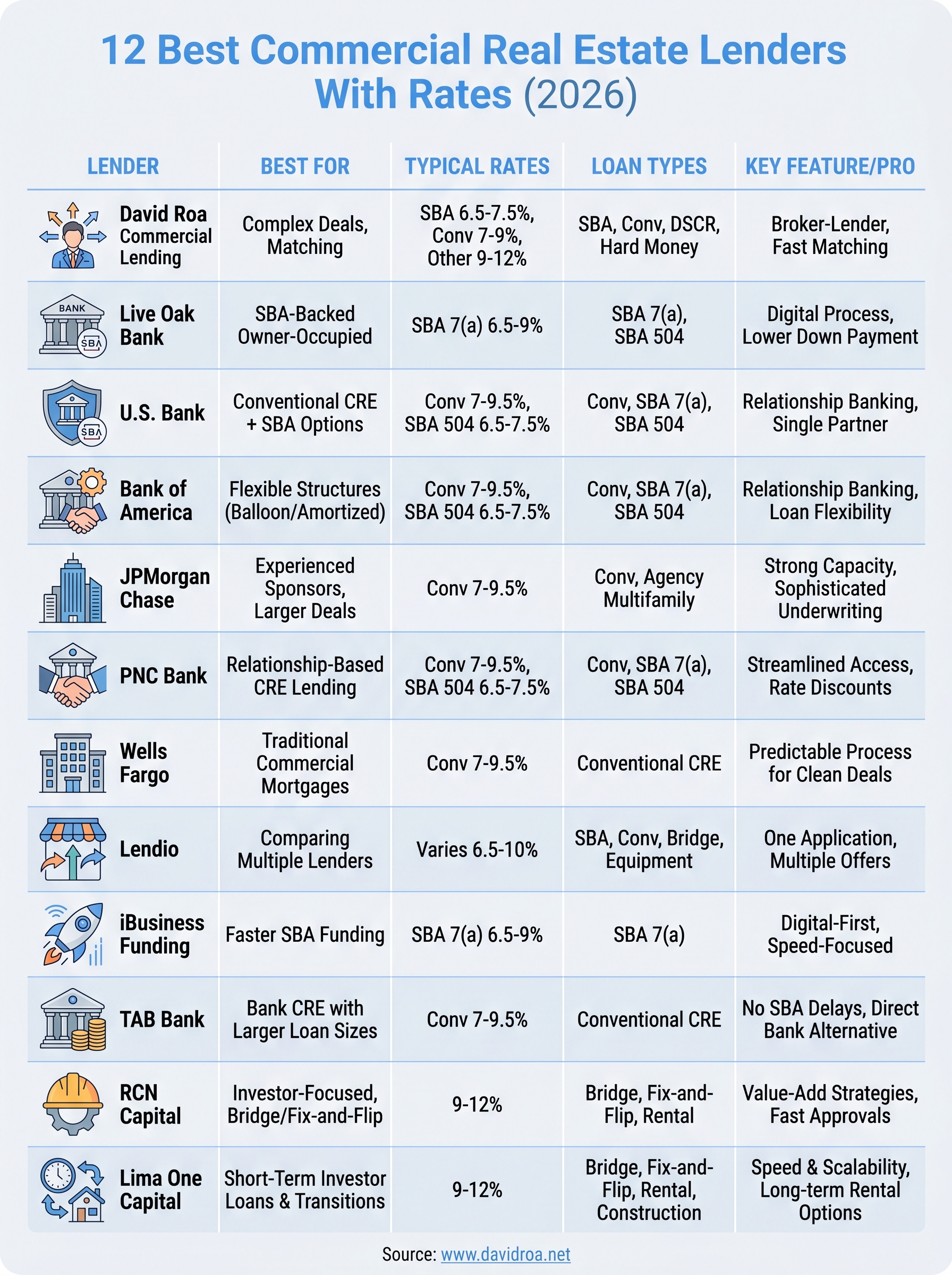
Finding the best commercial real estate lenders comes down to matching your deal structure, timeline, and borrower profile to the right financing source. You now have a clear comparison of 12 lenders across SBA programs, conventional bank financing, and private capital, so use that framework to narrow your shortlist before you spend time on applications.
Your next move is straightforward. If your deal is clean and your documentation is organized, go directly to the lender that fits your property type and loan size. If your situation involves alternative income documentation, an investment property, or a timeline that rules out traditional bank processing, working with a broker who has access to multiple programs will save you time and protect your credit from unnecessary hard pulls. Connect with David Roa today to walk through your deal and get matched to the right financing option without the guesswork.
