12 Bankrate Jumbo Mortgage Rates Benchmarks for 2026
Jumbo loans sit in a category of their own. They exceed the conforming loan limits set by the Federal Housing Finance Agency, which means lenders take on more risk, and borrowers face stricter qualification standards. If you're shopping for a high-value property, tracking Bankrate jumbo mortgage rates gives you a reliable baseline to compare what lenders are actually offering. But benchmarks alone don't tell the full story of what you'll qualify for or what you'll pay.
At David Roa, we've funded over $150 million in loans across residential, commercial, and investment deals over the past 25+ years. Jumbo mortgages are a core part of what we do, whether it's a primary residence purchase, a luxury property, or a high-value refinance. We work with borrowers directly to structure jumbo loans that fit their financial picture, including scenarios where traditional bank guidelines fall short, such as self-employed income, asset-based qualification, or ITIN applications.
This article breaks down 12 specific Bankrate jumbo mortgage rate benchmarks for 2026, covering national averages, fixed vs. adjustable rate trends, and the factors that push your rate higher or lower. We've organized these benchmarks so you can quickly see where rates stand right now and understand what's driving them. More importantly, you'll walk away knowing how to position yourself for the best possible rate when you're ready to move forward.
1. Benchmark a jumbo quote with David Roa
National averages like Bankrate jumbo mortgage rates give you a starting point, but your actual rate depends on the specific details of your financial profile and the lender you choose to work with. At David Roa, we treat the first rate conversation as a benchmark exercise, walking you through where rates stand today and where your numbers fit within that range.
What this benchmark measures
This benchmark compares the rate you can realistically qualify for against current national averages for jumbo loans. It factors in your credit score, loan-to-value ratio, loan size, and property type, all of which affect how lenders price jumbo risk. Jumbo loans don't follow the same secondary market rules as conforming loans, so each lender sets their own risk pricing, meaning the spread between the best and worst offers can be significant.
The gap between the best and worst jumbo offers from different lenders can exceed half a percentage point, which on a $1.5 million loan translates to thousands of dollars per year in interest.
What you should bring to the rate conversation
Walking into a rate discussion prepared shortens the process and gives you stronger leverage. You should have two years of tax returns or alternative income documentation ready, along with recent bank statements, a credit report you've reviewed in advance, and a clear number for your intended down payment. If you're self-employed, bring a year-to-date profit and loss statement because jumbo underwriting scrutinizes income documentation more closely than conforming loan guidelines do.
Your target property details matter too. Lenders price jumbo rates partly on loan-to-value ratios, so knowing your down payment percentage lets you have a more specific conversation about rate options from the start. Knowing your approximate purchase price and property type also helps us identify which loan products and pricing tiers apply to your scenario before you submit a full application.
How you compare offers the right way
Comparing jumbo offers requires looking beyond the headline rate. You need to examine the APR, total closing costs, lender fees, and whether the rate includes discount points. A lender who offers a lower rate but charges two points upfront may cost you more overall depending on how long you hold the loan.

Request a Loan Estimate from each lender you speak with. This is a standardized federal disclosure that itemizes fees and makes side-by-side comparison straightforward. When you work with David Roa, we walk through competing Loan Estimates with you directly, explaining where our offer differs and why. The goal is to make sure you're making a decision based on total cost and loan fit, not just the number on the rate sheet.
2. 30-year fixed jumbo purchase rate average
The 30-year fixed jumbo purchase rate is the most widely tracked number in the jumbo mortgage market. When you pull up Bankrate jumbo mortgage rates, this is typically the first figure you see, and it reflects what borrowers across the country are being offered on new home purchases above the conforming loan limit. Tracking this average weekly gives you a reliable reference point before you start approaching lenders.
What this benchmark measures
This benchmark captures the average interest rate offered on a 30-year fixed jumbo mortgage for a home purchase, based on lender surveys and submitted rate data across multiple financial institutions. It does not include fees or points, which is why the rate and the APR for the same loan will differ. The number reflects today's credit and economic conditions, including movements in the 10-year Treasury yield, which jumbo fixed rates tend to follow closely.
As of early 2026, 30-year fixed jumbo rates have generally tracked within 20 to 40 basis points of conforming rates, which is a tighter spread than historical norms and signals strong lender competition in the jumbo market.
When this benchmark matters most
This benchmark carries the most weight when you are buying a property that exceeds the 2026 conforming loan limit and you plan to hold the loan long-term. If you expect to stay in the home for more than seven years, the 30-year fixed structure protects you from rate resets and keeps your monthly payment predictable regardless of where rates move in the future. It also matters when you're comparing across lenders because a small rate difference on a large balance adds up fast.
How you use it to evaluate lender quotes
When a lender sends you a rate quote, compare the offered rate directly against the current national average for a 30-year fixed jumbo purchase. If their quote sits more than 20 to 30 basis points above the benchmark, push back and ask what's driving the difference. Factors like a lower credit score, a higher loan-to-value ratio, or the property type will explain part of the gap, but lender margin accounts for the rest, and that part is negotiable.
3. 30-year fixed jumbo purchase APR average
The Annual Percentage Rate (APR) for a 30-year fixed jumbo purchase tells you more than the interest rate alone. While the rate reflects what you pay on the loan balance each month, the APR folds in lender fees, origination charges, and certain closing costs to give you a fuller picture of what the loan actually costs over its life. Tracking the APR average alongside the interest rate on bankrate jumbo mortgage rates helps you identify whether a low rate comes with a high-fee structure underneath it.
What this benchmark measures
The 30-year fixed jumbo purchase APR average measures the all-in annualized cost of borrowing on a new jumbo purchase, expressed as a percentage. This number is always equal to or higher than the interest rate on the same loan because it absorbs costs that the rate alone does not capture. The APR benchmark gives you a standardized way to compare offers across lenders who may structure their fees very differently.
When two lenders quote the same interest rate but different APRs, the lender with the higher APR is charging more in fees, and that difference directly reduces the value of the lower rate.
What can move APR above the rate
Several factors push APR meaningfully above the stated rate. Origination fees and discount points are the most common drivers, since paying points to buy down your rate increases the fee load baked into the APR. Mortgage broker fees, underwriting charges, and private lender overlays on jumbo products can also widen the gap between rate and APR on larger loan balances where fee percentages translate into bigger dollar amounts.
How you compare APR apples to apples
To compare APR across lenders accurately, you need quotes built on the same loan amount, down payment, and loan term. Request a Loan Estimate from each lender and line up the APR figures directly. Differences above 15 to 20 basis points between lenders on comparable profiles usually point to fee structure differences, not just pricing, and that gap is worth negotiating before you commit to an application.
4. 15-year fixed jumbo purchase rate average
The 15-year fixed jumbo purchase rate consistently comes in lower than its 30-year counterpart when you check bankrate jumbo mortgage rates, and that difference reflects the reduced risk lenders take on with a shorter repayment window. Tracking this benchmark alongside the 30-year average lets you see exactly how much rate savings the shorter term buys you, and whether that savings justifies the higher monthly payment.

What this benchmark measures
This benchmark captures the average interest rate on a 15-year fixed jumbo mortgage for a purchase transaction, typically running 50 to 75 basis points below the 30-year fixed average. The lower rate exists because lenders recover their capital faster and carry less long-term interest rate risk over 15 years than they do over 30. This benchmark helps you quantify the rate benefit of the shorter term before you run payment calculations.
On a $1.2 million loan, a 60-basis-point rate reduction compared to the 30-year benchmark can save well over $200,000 in total interest, even though the monthly payment is substantially higher.
When a 15-year jumbo can make sense
A 15-year jumbo works best when your income is strong and stable and the higher monthly payment does not strain your cash flow. High-earning professionals, business owners with consistent revenue, and borrowers who want to eliminate the loan before retirement are the most common candidates for this structure. If your primary goal is building equity quickly on a high-value property, the 15-year fixed accelerates that process significantly.
How you check payment and interest tradeoffs
Start by calculating the monthly payment difference between the 15-year and 30-year options using current benchmark rates and your actual loan amount. Then calculate the total interest paid over each loan's life to see the full savings picture. Run both numbers against your monthly budget to confirm the higher payment leaves enough room for reserves, taxes, and insurance before you commit to the shorter term.
5. 15-year fixed jumbo purchase APR average
The 15-year fixed jumbo purchase APR layers total loan cost on top of the already-favorable rate you see on the shorter term. When you check bankrate jumbo mortgage rates for 15-year products, you'll typically notice that the APR sits closer to the stated rate than it does on a 30-year loan. That narrower gap reflects the shorter repayment window, which compresses how much lender fees contribute to the annualized cost calculation.
What this benchmark measures
This benchmark captures the all-in annualized borrowing cost for a 15-year fixed jumbo purchase, including interest, origination fees, and other lender charges spread across a compressed loan term. Because you repay the balance faster, fees carry slightly more weight in the APR calculation on a 15-year than on a 30-year loan with the same fee structure. Tracking this average tells you whether the low rate on the shorter term is clean or padded with upfront costs.
A lender who quotes a sharp 15-year rate but buries a 1-point origination fee in the closing costs can erode much of the monthly savings that drew you to the shorter term in the first place.
Fees that commonly show up in APR
Several charges regularly inflate APR beyond the stated rate on 15-year jumbo purchases. Origination fees and underwriting charges are the most frequent culprits, but appraisal fees on high-value properties, lender title insurance premiums, and prepaid interest at closing also factor into the APR on some lenders' disclosures. Jumbo products from portfolio lenders often carry proprietary processing fees that standard conforming loans don't include.
How you spot a low-rate high-fee offer
Request a Loan Estimate from each lender and compare the APR column directly against the interest rate column. A spread wider than 20 to 25 basis points between rate and APR on a 15-year jumbo signals a heavier fee structure. Ask the lender to itemize every charge contributing to that gap before you proceed.
6. 30-year fixed jumbo refinance rate average
The 30-year fixed jumbo refinance rate tracks what lenders charge borrowers who are replacing an existing jumbo loan with a new one, rather than buying a property for the first time. This number appears separately from purchase rates when you scan bankrate jumbo mortgage rates because refinance transactions carry different risk characteristics, and lenders price them accordingly. Knowing this benchmark before you contact a lender puts you in a stronger position to evaluate whether a refi makes financial sense right now.
What this benchmark measures
This benchmark captures the average interest rate offered on a 30-year fixed refinance for a loan that exceeds the conforming loan limit. Refinance rates on jumbo loans typically run 5 to 20 basis points higher than purchase rates for the same term because lenders view a refi borrower differently from a purchase borrower. The benchmark fluctuates alongside the 10-year Treasury yield and shifts based on broader credit conditions in the jumbo market.
When the refinance rate benchmark drops more than 75 basis points below the rate on your current jumbo loan, the math on a refi becomes worth modeling seriously.
When a refi benchmark helps you decide
The benchmark becomes most useful when you're sitting on a jumbo loan you originated in a higher-rate environment and current averages have moved meaningfully lower. Tracking the 30-year jumbo refi rate over several weeks shows you whether rates are trending down or stabilizing, which affects your timing. If you locked a jumbo rate in 2023 or early 2024 at a peak, even a modest drop in the benchmark relative to your current rate could generate meaningful monthly savings on a seven-figure balance.
How you estimate savings before you apply
Start by subtracting the current benchmark rate from your existing rate to get a rough spread. Multiply your outstanding loan balance by that spread, then divide by 12 to estimate monthly interest savings. From there, divide the estimated closing costs by the monthly savings to calculate your break-even timeline. If you plan to keep the loan beyond that break-even point, a refinance likely makes sense to pursue.
7. 30-year fixed jumbo refinance APR average
The 30-year fixed jumbo refinance APR gives you the same all-in cost picture on a refi that the purchase APR provides on a new buy. When you check bankrate jumbo mortgage rates for refinance products, comparing the APR column rather than just the rate column is the fastest way to identify which lender is actually offering the better deal once fees enter the equation.
What this benchmark measures
This benchmark captures the annualized total cost of a 30-year fixed jumbo refinance, folding lender fees, origination charges, and other applicable closing costs into a single percentage alongside the interest rate. Because refinance transactions carry their own fee structures separate from purchase loans, the APR spread above the stated rate can vary significantly across lenders and sometimes exceeds what you'd see on a comparable purchase transaction.
A refinance APR that runs more than 30 basis points above the stated rate on a jumbo loan usually signals a heavier closing cost load that deserves a line-by-line review.
Closing costs that drive refi APR
Several specific charges push jumbo refi APR above the interest rate. Title insurance and lender fees are the most consistent contributors, and on a high-balance loan, these costs translate into larger dollar amounts even when the percentage looks modest. Appraisal fees on luxury or non-standard properties can also run higher than on conforming loans, sometimes requiring two appraisals when the loan amount is especially large.
How you calculate a realistic break-even point
Your break-even point tells you how many months you need to hold the new loan before the monthly savings offset the closing costs you pay upfront. Divide your total out-of-pocket closing costs by your estimated monthly payment reduction to get that number. If you plan to sell or refinance again before reaching that month, the refi costs you money rather than saving it, and the APR comparison becomes less favorable regardless of how competitive the rate looks.
8. 15-year fixed jumbo refinance rate average
The 15-year fixed jumbo refinance rate is one of the most underused benchmarks in the data available when you check bankrate jumbo mortgage rates. Borrowers who originally took out a 30-year jumbo loan often overlook this option during a refinance because the higher monthly payment feels like an obstacle. But for the right financial profile, this rate benchmark opens a path to dramatically lower total interest costs on a high-value loan.
What this benchmark measures
This benchmark tracks the average interest rate offered on a 15-year fixed refinance for loan balances above the conforming limit. It consistently prices lower than the 30-year fixed refi average, typically by 50 to 75 basis points, reflecting the reduced duration risk lenders carry on a shorter payoff schedule. Tracking this figure separately from the 30-year benchmark lets you quantify exactly how much rate improvement you gain by compressing the term, before you run any payment calculations.
On a $1.5 million refinance balance, a 60-basis-point rate reduction compared to the 30-year refi average can eliminate six figures in total interest paid over the life of the loan.
When shorter-term refis work best
The 15-year refi structure fits borrowers who have meaningfully paid down their original jumbo loan and want to accelerate the remaining balance payoff. If you're 7 to 10 years into a 30-year jumbo and your income has grown since origination, refinancing into a 15-year at a lower rate can shorten your payoff timeline without dramatically increasing your payment relative to what you've already been paying.
How you stress-test the higher payment
Before committing to a 15-year refi, calculate the new monthly payment using your actual remaining balance and the current benchmark rate, then subtract your existing payment to find the true increase. Run that difference against your monthly cash reserves and recurring obligations to confirm you can absorb the higher obligation through periods of reduced income, unexpected expenses, or business slowdowns without risking the loan.
9. 15-year fixed jumbo refinance APR average
The 15-year fixed jumbo refinance APR adds the full cost picture to the already-favorable rate you see on this product. When you track bankrate jumbo mortgage rates for 15-year refi options, the APR typically sits closer to the interest rate than it does on a 30-year loan, but that gap can widen considerably depending on how individual lenders structure their fee schedules.
What this benchmark measures
This benchmark captures the annualized total borrowing cost of a 15-year fixed jumbo refinance, folding origination fees, lender charges, and applicable closing costs into a single percentage alongside the stated rate. Because the loan pays off faster, each dollar of fees contributes more to the APR than it would on a 30-year term. Comparing this benchmark across lenders tells you whether a competitive rate quote is genuinely clean or carrying a heavier fee load underneath it.
When two lenders quote identical 15-year refi rates but their APRs differ by more than 20 basis points, the fee structures are doing the work, not the rate.
Why refi APR can vary widely by lender
Jumbo refinance products often live inside a lender's portfolio rather than the secondary market, which gives individual institutions more flexibility to price fees however they choose. Some lenders offset lower rates with higher origination charges, while others offer flat-fee structures that compress the APR gap. The property type also matters on a refi because non-standard or high-value properties sometimes require additional appraisal work that feeds directly into the APR calculation.
How you decide between points and no points
Paying discount points upfront lowers your rate but raises your total closing costs, which pushes APR up in the short term while reducing the monthly payment long term. To evaluate whether points make sense, divide the cost of each point by the monthly savings it generates to find your break-even month. If you plan to hold the loan past that break-even, buying points on a 15-year jumbo refi usually works in your favor on a high-balance loan.
10. Jumbo vs conforming 30-year fixed rate gap
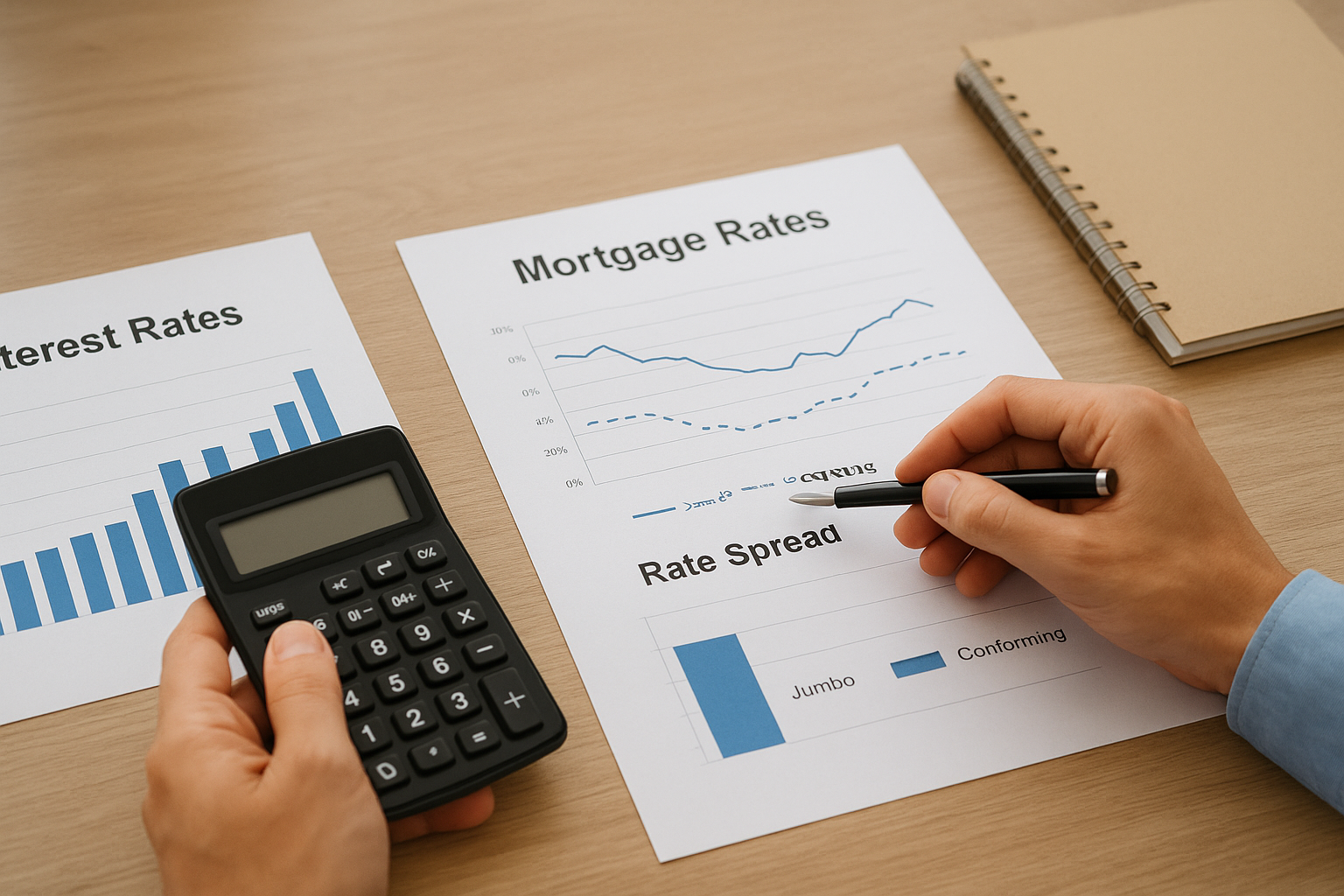
The spread between jumbo and conforming 30-year fixed rates is one of the most revealing numbers you can pull when reviewing bankrate jumbo mortgage rates. It tells you whether the broader lending market currently favors jumbo borrowers or penalizes them, and that context shapes every negotiation you have with a lender.
What this benchmark measures
This benchmark tracks the difference in basis points between the national average 30-year fixed jumbo rate and the national average 30-year fixed conforming rate at any given point in time. Historically, jumbo loans priced higher than conforming loans because they couldn't be sold to Fannie Mae or Freddie Mac, leaving lenders to hold that risk on their own books. The gap has ranged from nearly zero to over 100 basis points depending on credit market conditions and lender appetite for portfolio loans.
Why jumbo does not always price higher
When large banks and portfolio lenders compete aggressively for high-net-worth borrowers, they sometimes price jumbo loans at or below conforming rates to win that business. This happened noticeably between 2020 and 2022, when excess liquidity in the banking system pushed lenders to offer jumbo products at unusually tight spreads. In 2026, the gap has normalized, but lender competition in the jumbo segment still keeps the spread narrower than the historical average, which works in your favor as a borrower.
When the jumbo-to-conforming spread compresses below 20 basis points, it signals strong lender competition that you can use as direct leverage in rate negotiations.
How you use the gap to negotiate
Check the current spread before you contact any lender. If the jumbo rate benchmark sits within 25 basis points of the conforming average, use that fact directly in your conversation and ask the lender to explain any quote that prices significantly wider. Lenders who understand you've done your research tend to sharpen their offers, and on a seven-figure loan balance, even a 10-basis-point improvement generates thousands of dollars in annual savings.
11. ARM vs jumbo fixed starting rate benchmarks
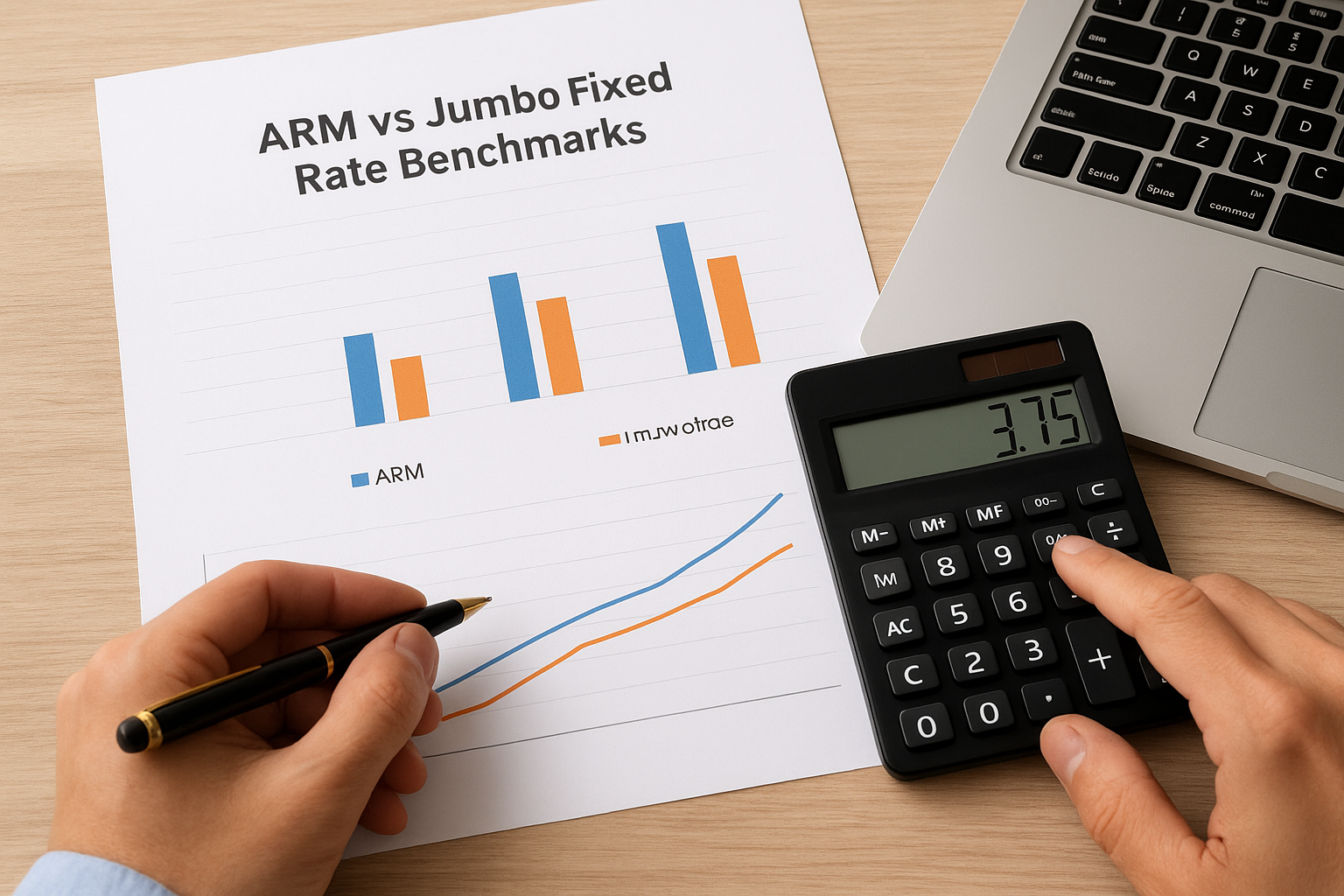
The starting rate gap between an adjustable-rate mortgage and a fixed jumbo loan appears prominently when you review bankrate jumbo mortgage rates across product types. On most days, the 5/1 or 7/1 ARM benchmark opens lower than the 30-year fixed average by 50 to 100 basis points, and that spread is what draws high-balance borrowers toward the adjustable option in the first place.
What this benchmark measures
This benchmark compares the average starting rate on jumbo ARM products against the 30-year fixed jumbo average, revealing how much rate savings the initial fixed period buys you before the loan adjusts. The ARM starting rate reflects the index the loan is tied to, typically the Secured Overnight Financing Rate (SOFR), plus a lender margin, and it only holds for the initial fixed window before resetting annually based on market conditions.
When the ARM-to-fixed starting rate gap exceeds 75 basis points on a jumbo loan, the first-year savings alone on a $1.5 million balance can exceed $11,000.
When an ARM benchmark applies to your plan
You should consider the ARM benchmark seriously when your hold timeline is shorter than the initial fixed period of the product you're evaluating. A 7/1 ARM makes sense if you expect to sell, refinance, or pay off the loan within seven years. Business owners and investors who rotate assets frequently, or high earners expecting a significant income event that will allow early payoff, are the profiles where this starting rate benchmark carries real weight.
How you evaluate reset risk and exit options
Start by identifying the rate caps on any ARM you consider: the periodic cap controls how much the rate can move at each adjustment, and the lifetime cap limits total movement over the loan's life. Then model your worst-case adjusted payment using the lifetime cap rate against your current balance to confirm you could absorb it. If that payment would strain your cash flow, the lower starting rate is not worth the exposure, and the fixed benchmark becomes the safer anchor.
12. 2026 jumbo threshold and approval benchmarks
Before you can use bankrate jumbo mortgage rates as a meaningful reference, you need to know exactly which loan amounts qualify as jumbo in the first place. The threshold shifts annually based on home price data, and crossing the conforming limit triggers a completely different set of underwriting standards than what applies to conventional loans.
What this benchmark measures
This benchmark identifies the dollar amount at which a loan becomes jumbo under 2026 guidelines, and it pairs that threshold with the standard approval targets lenders use to qualify borrowers for non-conforming loan balances. Understanding where the line sits keeps you from assuming a jumbo rate applies to your loan when it doesn't, or missing out on a conforming product that carries lower qualification hurdles.
Borrowers who land within $50,000 of the conforming limit often have a choice between structuring a conforming loan with a second lien and taking a jumbo, and the rate difference between those two paths is worth calculating before you commit.
The 2026 conforming loan limit numbers to know
For 2026, the baseline conforming loan limit is $806,500 for a single-unit property in most U.S. markets. High-cost areas, including parts of California, New York, and the Chicago metro corridor, carry higher limits that FHFA adjusts county by county. Any loan amount above your county's applicable limit requires jumbo pricing and underwriting, which is why confirming your specific county limit before you apply is a necessary first step.
Common jumbo underwriting targets to prepare for
Jumbo lenders hold borrowers to stricter qualification standards than conforming guidelines require. Most portfolio lenders look for a credit score of 720 or higher, a debt-to-income ratio below 43 percent, and cash reserves of 12 months or more after closing. Loan-to-value requirements typically cap between 80 and 90 percent depending on loan size, meaning larger balances generally require a bigger down payment to reach approval.
Your next step
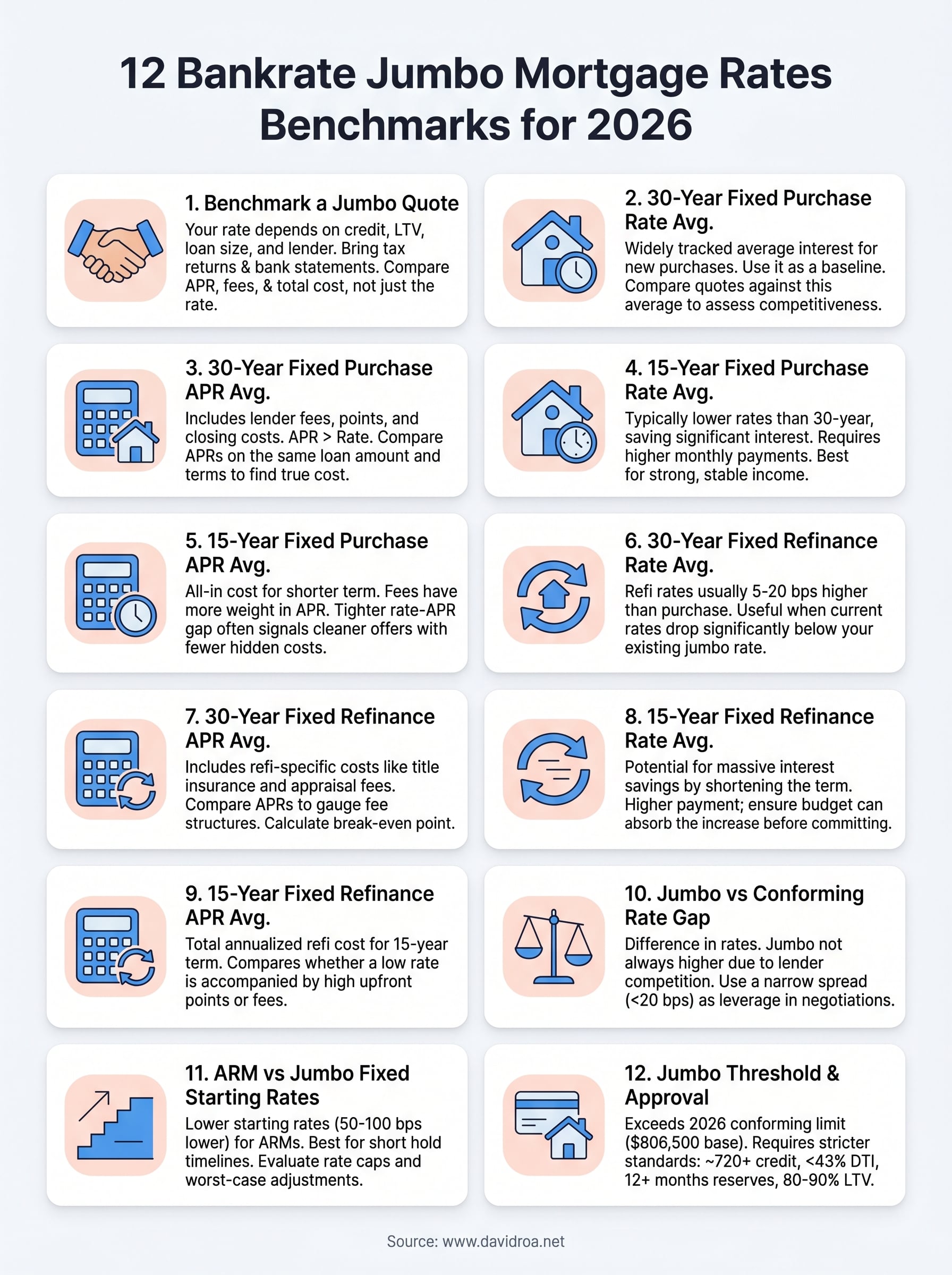
You now have 12 specific benchmarks to work with when you review bankrate jumbo mortgage rates and start comparing what lenders put in front of you. Each benchmark gives you a reference point, but a reference point only becomes useful when you apply it to your actual loan scenario, your income documentation, your credit profile, and your property details.
David Roa has funded over $150 million in loans across residential, commercial, and investment transactions, including complex jumbo deals that standard bank guidelines turned away. Whether you're purchasing a high-value home, refinancing an existing jumbo balance, or working through a non-traditional income situation, the process starts with a direct conversation about your numbers. Bring the benchmarks from this article with you and use them to ask sharper questions. Start your jumbo loan conversation with David Roa today and get a rate comparison built around your specific profile.
