Bankrate VA Loan Rates: Current APRs, Fees, And Next Steps
If you've been searching for Bankrate VA loan rates to get a read on where interest rates and APRs stand right now, you're doing exactly what a smart borrower should do. Comparing published rate data from trusted sources like Bankrate gives you a baseline, a starting point to measure every lender offer against. But here's the thing most veterans and active-duty service members discover quickly: the rate you see on a comparison site and the rate you actually qualify for can be two very different numbers.
VA loans remain one of the strongest mortgage products available, offering zero down payment requirements and no private mortgage insurance. Those benefits translate into real savings over the life of a loan, which is why understanding not just the interest rate but also the APR, lender fees, and VA funding fee matters so much. A rate that looks low on paper can cost you more at closing if the fee structure isn't transparent from the start.
With over 25 years in mortgage lending and more than $150 million funded, I've helped veterans across the country, and especially here in the Chicago metro area, navigate exactly this kind of decision. At David Roa, we work directly with borrowers to match them with VA loan options that reflect their actual financial picture, not just an average posted online. Our approach is hands-on: we walk you through the numbers, explain what drives your specific rate, and make sure you're comparing apples to apples before you commit. Whether you're a first-time VA buyer or building a real estate portfolio, the goal is the same, get you the best deal with full clarity on what you're signing.
This article breaks down current Bankrate VA loan rate data, explains what those APRs and fees actually mean for your monthly payment, and gives you a clear path forward for locking in a rate that works. We'll cover how VA rates are set, what influences them, and the concrete steps to take once you've done your research.
What Bankrate VA loan rates show
When you pull up Bankrate VA loan rates, you see a table of lenders listed side by side with their current interest rates, APRs, monthly payment estimates, and points. The data refreshes regularly, pulling in offers from participating lenders who pay to appear on the platform. That last detail matters: Bankrate earns revenue from lenders who advertise there, which doesn't make the data useless, but it does mean the list is not exhaustive. Plenty of strong VA lenders, including smaller regional lenders and mortgage brokers, won't appear on that table at all.
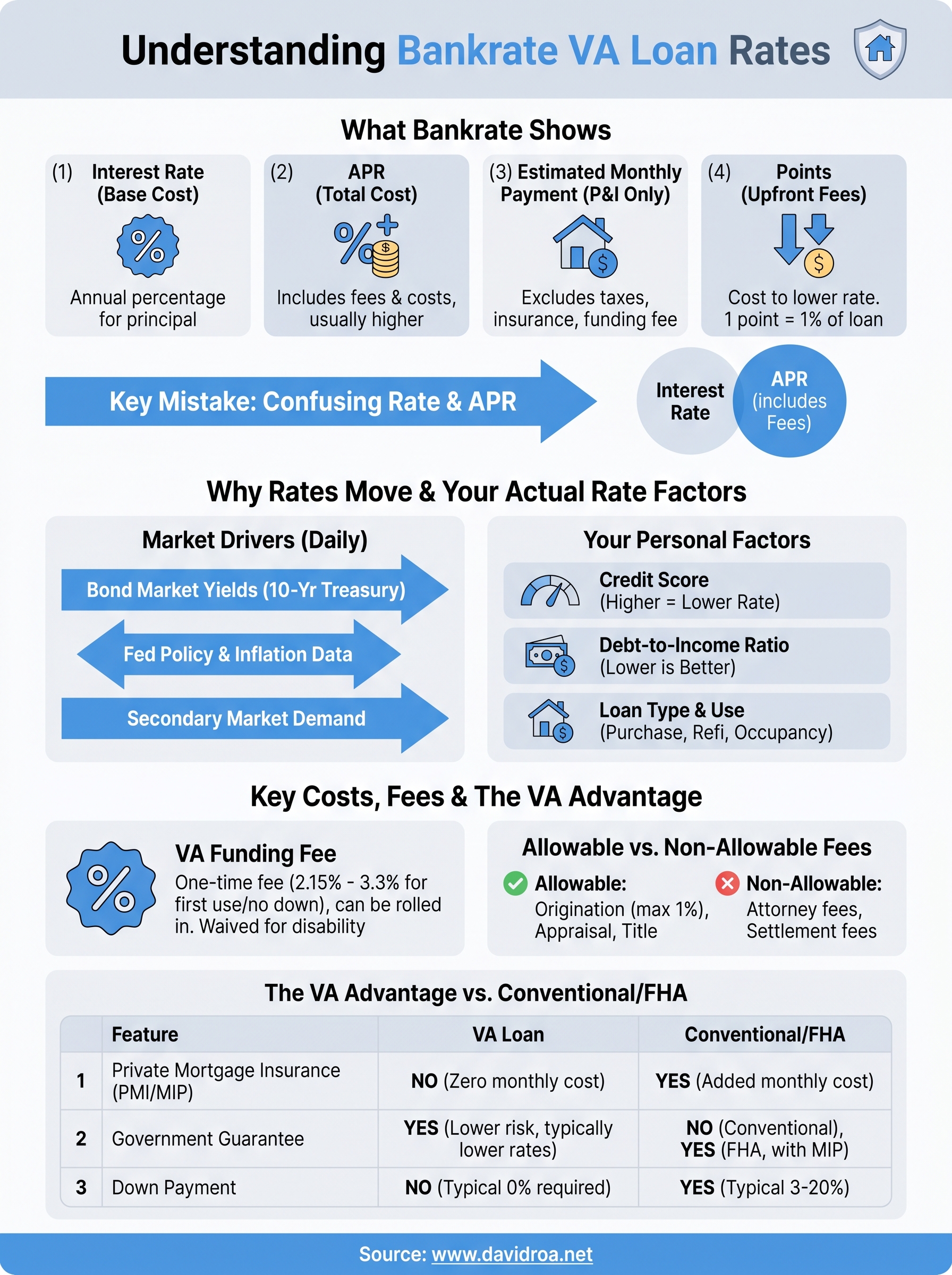
The table typically shows a 30-year fixed VA loan as the default comparison, though you can filter for 15-year fixed or adjustable-rate options. Each row gives you a snapshot: the lender name, the advertised interest rate, the APR, the estimated monthly payment, and sometimes the number of points required to secure that rate. These four data points together tell a meaningful story, but only if you know how to read them correctly.
The interest rate and the APR are not the same number, and confusing them is one of the most common mistakes borrowers make when comparing VA loan offers.
The difference between rate and APR
The interest rate is the base cost of borrowing the loan principal, expressed as a percentage. The APR, or annual percentage rate, folds in additional costs like lender origination fees, discount points, and certain closing costs, then spreads them across the full loan term. Because of this structure, the APR is almost always higher than the interest rate. When two lenders show the same interest rate but different APRs, the one with the higher APR is charging more in fees somewhere in the transaction.
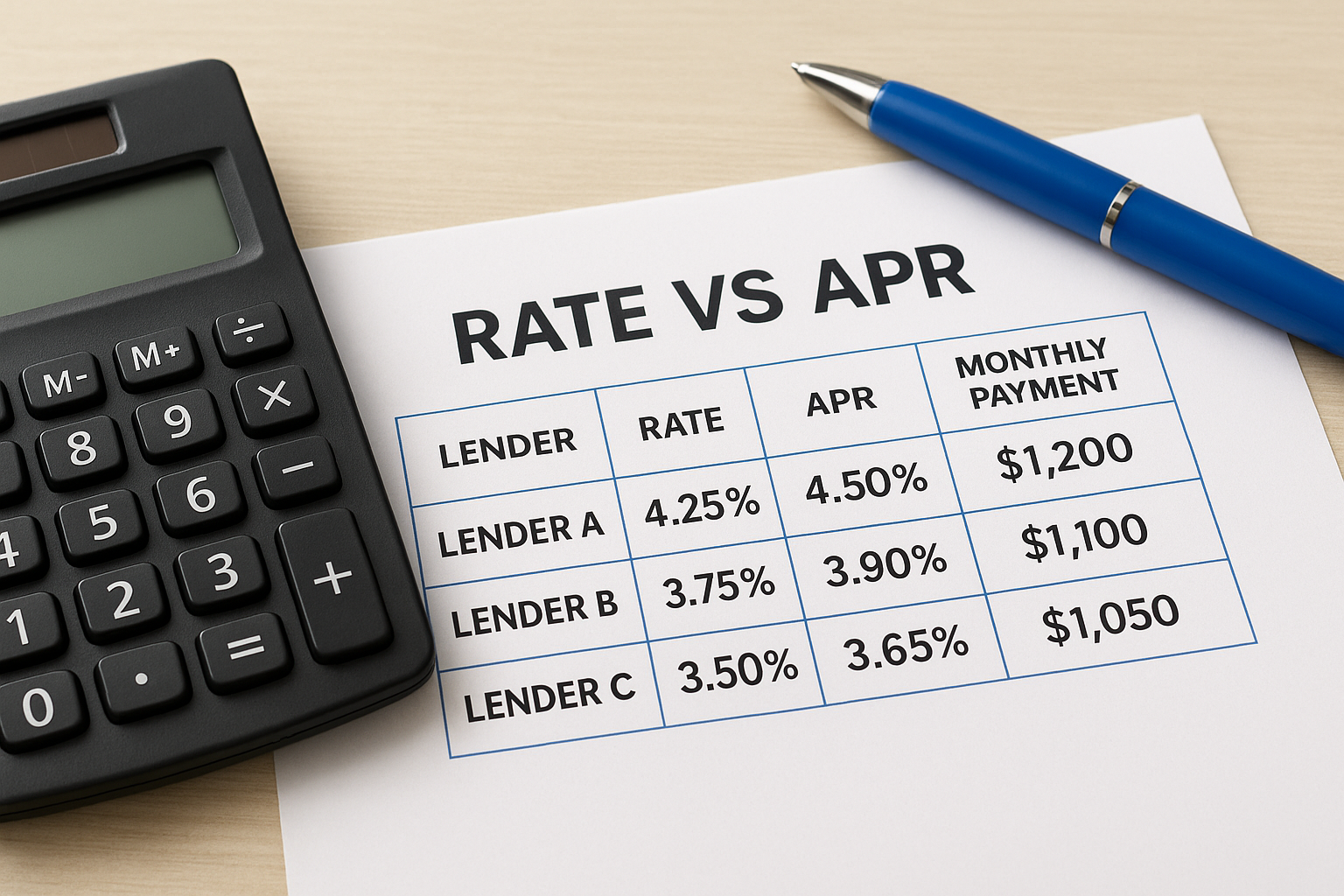
For VA loans specifically, the APR calculation gets more complex because the VA funding fee is a significant upfront cost that varies based on your service history and whether you've used your VA entitlement before. Some lenders roll the funding fee into the loan balance, which affects the APR differently than if you paid it at closing. You'll look at the funding fee in more detail later in this article, but keep that variable in mind every time you scan a rate table.
What the monthly payment estimate leaves out
Bankrate's estimated monthly payment figures typically reflect principal and interest only. They do not include property taxes, homeowners insurance, or the VA funding fee if you choose to finance it into the loan balance. For a cleaner comparison between lenders, you need to request a full Loan Estimate from any lender you're seriously considering, because that document legally requires every lender to disclose all costs in a standardized format under federal law.
The monthly payment shown on the table also assumes you're putting zero down, which is the most common VA loan scenario. If you plan to make even a modest down payment, the actual monthly payment drops and your funding fee percentage changes as well. Bankrate's comparison table won't automatically show you those personalized scenarios, which is why the published numbers work best as a directional reference point rather than a final figure you should build a budget around.
Why VA rates and APRs move week to week
When you check bankrate VA loan rates on Monday and return on Friday, the numbers may look different. That shift isn't random. Mortgage rates, including VA rates, respond to economic data, bond markets, and monetary policy decisions on a near-daily basis. Understanding what drives those changes helps you decide whether to lock a rate now or wait, and that timing decision can be worth thousands of dollars over the life of your loan.
The bond market sets the floor
Mortgage lenders price VA loans by watching the yield on 10-year U.S. Treasury bonds. When investors move money into bonds, yields fall and mortgage rates tend to follow. When investors pull money out of bonds and into stocks or other assets, yields rise and mortgage rates climb with them. This relationship isn't perfect, but it's consistent enough that experienced loan officers watch the bond market every morning before quoting rates.
A strong jobs report or higher-than-expected inflation data can push rates up within hours, which is why locking a rate after good news breaks is often the smarter move than waiting.
Federal Reserve decisions also play a significant role. When the Fed raises its benchmark rate to control inflation, borrowing costs across the entire economy tighten. Lenders pass that increased cost along to borrowers through higher interest rates on new mortgage originations, including VA loans. The Fed doesn't set mortgage rates directly, but its signals move markets fast.
Why VA rates track but don't mirror conventional rates
VA-backed loans carry a government guarantee, which makes them lower risk for lenders compared to conventional loans with no backing. That reduced risk is a core reason VA rates typically run below conventional rates for comparable loan sizes and borrower profiles. However, lenders still adjust their VA pricing based on their own operational costs, current loan volume, and secondary market conditions for VA mortgage-backed securities.
Because lenders sell most closed loans on the secondary market, the price investors pay for VA loan bundles directly influences what rate a lender can profitably offer you today. When secondary market demand for VA loans is strong, lenders can offer more competitive rates. When demand softens, rates edge higher regardless of what the Fed does.
How to read rate, APR, points, and payment
When you scan bankrate VA loan rates, four columns define every offer: the interest rate, the APR, the points, and the estimated monthly payment. Each number tells you something different, and reading all four together gives you a far more accurate picture than looking at any one column in isolation. Borrowers who focus only on the lowest advertised interest rate often end up paying more over time because they miss what the other three columns are signaling about the true cost of that loan.
Points and what they cost you
Discount points are upfront fees paid directly to the lender in exchange for a lower interest rate. One point equals one percent of the loan amount. So on a $350,000 VA loan, one point costs $3,500 at closing. Lenders sometimes advertise a very competitive rate tied to one or two points, which makes the rate look attractive on the comparison table while the real cost sits buried in that points column.

Before you get excited about a low rate, check the points column first, because a rate that requires two points to lock in might cost you more upfront than a slightly higher rate with zero points.
Your break-even calculation matters here. Divide the upfront cost of the points by the monthly savings the lower rate produces. If paying $3,500 in points saves you $40 per month, you need 87 months, more than seven years, to break even. If you plan to sell or refinance before that point, paying for the rate reduction loses you money.
How to calculate your true monthly payment
The monthly payment figure shown on the comparison table covers principal and interest only, which means it understates what you'll actually send to your servicer each month. Your real payment includes property taxes, homeowners insurance, and possibly the VA funding fee if you finance it into the loan balance.
To get an accurate number, add your estimated annual tax and insurance costs, divide by 12, and add that total to the principal and interest figure. Once you've done that math across multiple lender offers, the differences between them become much clearer and far more useful for making an actual decision.
What determines the VA rate you actually qualify for
The rate you see when browsing bankrate VA loan rates reflects an average across multiple borrower profiles. Your actual rate depends on several factors that lenders evaluate individually before issuing a formal quote. Understanding what drives your personal rate puts you in a stronger position to negotiate and to take targeted steps to improve your terms before you apply.
Your credit score carries the most weight
VA loans don't require a minimum credit score set by the Department of Veterans Affairs itself, but every lender sets its own floor, and that floor typically sits between 580 and 640 depending on the lender. Beyond just meeting the minimum, your score directly influences the rate you receive. Lenders use risk-based pricing, which means borrowers with scores above 740 generally qualify for the most competitive rates, while scores in the 620 to 680 range can push the rate noticeably higher.
Pulling your credit report before you apply gives you time to correct errors or pay down balances, both of which can move your score up and your rate down.
Your debt-to-income ratio matters more than most borrowers expect
Lenders calculate your debt-to-income ratio by dividing your total monthly debt payments by your gross monthly income. VA guidelines allow a DTI up to 41 percent as a general benchmark, though lenders can go higher with compensating factors. A lower DTI signals financial stability to the lender and supports approval at a better rate, especially when paired with a strong credit profile.
Reducing an existing car payment or credit card balance before you apply can shift your DTI meaningfully. Even a few percentage points of improvement on that ratio can change which rate tier you fall into with certain lenders.
Loan type and occupancy affect pricing
The property you're financing and how you plan to use it also factor into your rate. Primary residences receive the best pricing from VA lenders. Residual income requirements, loan size relative to the county conforming limit, and whether you're purchasing or refinancing all feed into the final rate a lender offers you specifically. Getting clear on these details before you start comparing lenders saves you from chasing a rate you don't actually qualify for.
How to compare offers on Bankrate without mistakes
Browsing bankrate VA loan rates gives you a useful starting point, but the comparison process breaks down fast if you're not evaluating each offer on identical terms. Lenders on the platform set their own assumptions about loan amount, credit score, and points when displaying rates, which means the numbers in one row may not reflect the same scenario as the numbers in the next. A disciplined comparison process filters out noise and shows you which offer is genuinely better.
Use the same loan parameters for every lender
Consistency is what makes a rate comparison meaningful. When you adjust the filters on Bankrate, use your actual loan amount, your estimated credit score range, and a consistent down payment figure across every lender you evaluate. Switching those inputs between lenders distorts the results and makes it harder to identify a clear winner.
Pay close attention to the points column on every row. A lender showing a low rate alongside one or two points is offering a different product than a lender showing a slightly higher rate with zero points required. Treat those as two separate offers and calculate which one costs less over your expected time in the home.
If you plan to sell or refinance within five years, a zero-point loan nearly always wins over a discounted rate you paid upfront to secure.
Request a Loan Estimate before trusting any quote
The Loan Estimate is the document that standardizes comparison across lenders. Federal law requires every lender to issue one within three business days of receiving your application, and it lists every cost in a uniform format. The advertised rate on Bankrate is a marketing figure; the Loan Estimate is a legally binding disclosure that reflects your actual scenario.
Once you have Loan Estimates from two or three lenders, line up the total closing costs on Page 2 of each document side by side. This step catches fees that don't appear in any rate table: origination charges, underwriting fees, and third-party service costs. Two lenders quoting identical rates on Bankrate can look very different once you compare their full Loan Estimates, and that difference often runs into hundreds or thousands of dollars at closing.
VA fees and rules to factor into the real cost
The rate you find when reviewing bankrate VA loan rates is only one piece of your total cost equation. VA loans come with a specific fee structure and a set of rules that directly affect what you pay at closing and over time. Skipping this layer of research is one of the fastest ways to get surprised on settlement day.
The VA funding fee
The VA funding fee is a one-time cost charged by the Department of Veterans Affairs on nearly every VA loan. It exists to sustain the program so future veterans can access the same benefit. The fee is calculated as a percentage of your loan amount, and it varies based on three factors: your type of military service, whether this is your first VA loan or a subsequent use, and how much you put down.
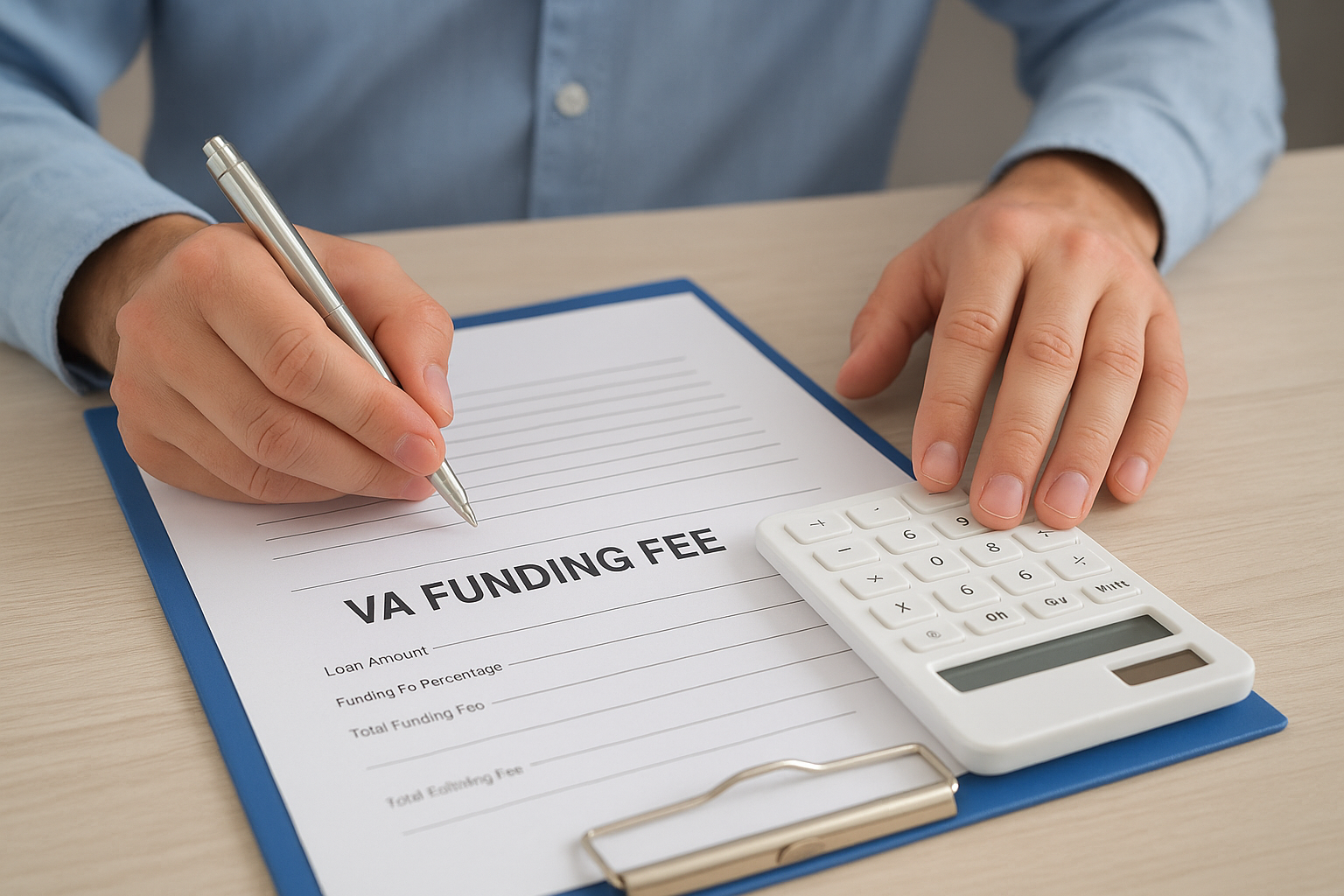
For a first-time VA buyer putting zero down, the funding fee currently sits at 2.15 percent of the loan amount for most borrowers, which adds $7,525 to the cost of a $350,000 loan.
For subsequent use with no down payment, that percentage rises to 3.3 percent, making it even more critical to factor in before comparing rates across lenders. You can pay the fee upfront at closing or roll it into your loan balance, but rolling it in increases your principal and raises your monthly payment slightly. Veterans with a service-connected disability rating of 10 percent or higher are exempt from the funding fee entirely, so confirm your status before you apply.
Allowable and non-allowable fees
VA rules limit what lenders can charge borrowers, which protects you from certain costs that conventional loan borrowers typically absorb. Lenders cannot charge you for attorney fees, settlement fees, or document preparation fees on a VA loan. These are classified as non-allowable fees under VA guidelines.
That said, lenders can still charge an origination fee of up to one percent of the loan amount, plus allowable third-party costs like the appraisal, title insurance, and recording fees. Your Loan Estimate will break these out clearly. Comparing that document across multiple lenders after you've reviewed the rate table gives you the full picture of what each offer actually costs you from start to close.
VA vs conventional and FHA rates and tradeoffs
When you check bankrate VA loan rates alongside conventional and FHA options on the same platform, VA rates consistently come in lower for qualified borrowers. That advantage stems directly from the government guarantee behind every VA loan, which reduces the lender's risk exposure and allows them to price the product more competitively than they could on an uninsured conventional loan.
How VA rates stack up against conventional loans
Conventional loans have no government backing, which means lenders absorb more risk on every deal. That risk gets priced into the rate, particularly for borrowers with credit scores below 740 or loan-to-value ratios above 80 percent. Borrowers who put less than 20 percent down on a conventional loan also pay private mortgage insurance, which typically adds 0.5 to 1.5 percent of the loan amount annually to the cost of carrying the loan.
VA loans eliminate both of those disadvantages. You pay no private mortgage insurance regardless of your down payment, and the rate itself usually sits 0.25 to 0.50 percentage points below a comparable conventional rate. Over a 30-year term on a $400,000 loan, that spread compounds into a significant dollar difference in total interest paid.
FHA vs VA: the real cost comparison
FHA loans serve borrowers who don't have VA eligibility, offering low down payment requirements and flexible credit standards similar to VA. However, FHA loans carry two mortgage insurance charges: an upfront premium of 1.75 percent of the loan amount and an annual premium that typically runs between 0.55 and 1.05 percent of the outstanding balance, depending on your loan term and down payment size. That annual premium stays on the loan for its entire life if you put less than 10 percent down.
If you have VA eligibility and you're comparing it against FHA, run the total cost calculation over your expected time in the home, because the absence of ongoing mortgage insurance on a VA loan frequently outweighs the one-time funding fee.
FHA rates generally run close to VA rates, but the mortgage insurance layer makes the effective cost of an FHA loan higher for most borrowers who qualify for both programs. For any veteran or active-duty service member who qualifies, VA financing typically wins that comparison on total cost from close to payoff.
Your next steps
Reviewing bankrate VA loan rates gives you a solid benchmark, but a published rate table can only take you so far. Your actual rate depends on your credit score, your debt-to-income ratio, your funding fee status, and which lenders you choose to engage with directly. The gap between the average rate you see online and the rate you personally qualify for is exactly where working with an experienced loan officer pays off.
Start by pulling your credit report, calculating your DTI, and confirming whether your service history qualifies you for a funding fee exemption. Then request Loan Estimates from at least two or three lenders so you can compare total costs, not just interest rates. Once you've done that groundwork, you'll be in a far stronger position to negotiate.
Connect with a VA loan specialist at David Roa to get a personalized rate quote based on your actual financial profile.
