What Is Mortgage Refinancing? How It Works, Costs, Benefits
If you're asking what is mortgage refinancing, you're likely sitting on an existing home loan and wondering whether there's a better deal available. The short answer: refinancing replaces your current mortgage with a new one, ideally on terms that save you money or better match your financial goals. But the full picture involves closing costs, timing, and trade-offs that deserve a closer look before you sign anything.
Refinancing can lower your monthly payment, shorten your loan term, eliminate mortgage insurance, or give you access to your home's equity as cash. It can also cost you thousands upfront and reset your amortization clock. Whether it makes sense depends entirely on your situation, your current rate, how long you plan to stay in the home, and what you're trying to accomplish. There's no universal right answer, which is exactly why the details matter.
At David Roa, we've helped borrowers navigate refinancing decisions across every scenario, from conventional rate-and-term refis to FHA Streamlines and cash-out loans for real estate investors. With over $150 million funded and 25-plus years in lending, we bring firsthand experience to a decision that can reshape your finances for decades. This guide breaks down how mortgage refinancing works, what it costs, and when it actually pays off.
Why homeowners refinance
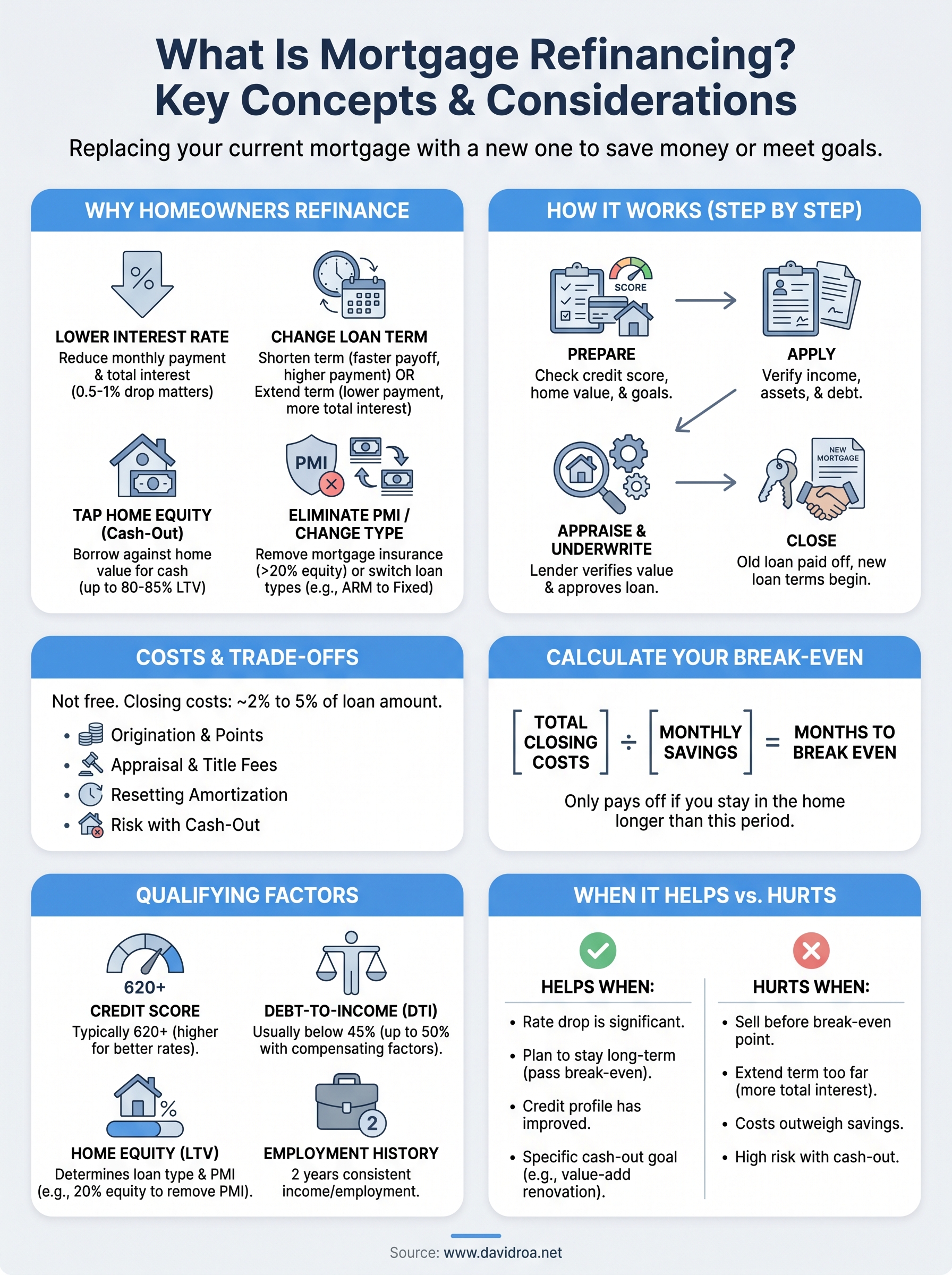
The reasons behind a refinance decision are as varied as the borrowers who pursue them. Most homeowners refinance to reduce costs, but some do it to restructure debt, access equity, or shift from one loan product to another entirely. Understanding your specific reason matters because it shapes which loan product makes sense, how long you need to stay in the home to break even, and whether refinancing is actually worth doing right now. Knowing what you want to accomplish answers a lot of what is mortgage refinancing actually solving in your situation.
Lower your interest rate
Dropping your interest rate is the most common reason homeowners refinance, and the math is straightforward. A rate reduction of even 0.5% to 1% can translate to hundreds of dollars saved each month on a mid-sized loan balance. On a $350,000 loan, moving from a 7.5% rate to a 6.5% rate cuts roughly $230 from your monthly payment and saves over $82,000 in total interest across a 30-year term.
A lower rate only delivers real savings if you stay in the home long enough to recover the closing costs you paid to get there.
Rate-driven refinances work best when market rates have dropped significantly since you originally closed, or when your credit profile has improved enough that you now qualify for terms you couldn't access before.
Change your loan term
Some homeowners refinance not to lower their payment but to pay off the home faster. Shortening from a 30-year to a 15-year loan raises your monthly payment but dramatically reduces the total interest you pay over the life of the loan. Other borrowers do the opposite: they extend their term to reduce monthly cash pressure, accepting more total interest in exchange for breathing room today.
Your financial goals determine which direction makes sense. If you're approaching retirement and want to be mortgage-free, shortening the term often wins on long-term cost. If you're managing tight cash flow from a business or investment property expenses, extending the term might be the practical move in the short run.
Tap into home equity
A cash-out refinance lets you borrow against the equity you've built in your home. You replace your existing loan with a larger one and receive the difference in cash. Homeowners use this for home renovations, debt consolidation, and even funding a down payment on an investment property. Real estate investors in particular use cash-out refinancing to pull equity from one property and redeploy that capital into the next deal.

The key constraint here is your loan-to-value ratio (LTV). Most conventional lenders require you to maintain at least 20% equity after the cash-out, meaning you can't pull every dollar out of the home. FHA and VA programs have their own rules around this, which your lender will walk you through based on your specific loan type.
Eliminate mortgage insurance or change loan type
If you originally put down less than 20% on a conventional loan, you're paying private mortgage insurance (PMI) every month. Once your home's value rises or your balance drops enough, refinancing into a new conventional loan can eliminate that cost entirely, even if your rate barely changes. The savings from dropping PMI sometimes make the refi worth it on their own without needing a significant rate improvement.
Switching loan types is another legitimate reason to refinance. Some borrowers start with an FHA loan because it was the only option available at the time, then move to a conventional loan once their equity and credit improve. Others shift from an adjustable-rate mortgage to a fixed-rate loan to lock in stability before rates move higher.
How mortgage refinancing works step by step
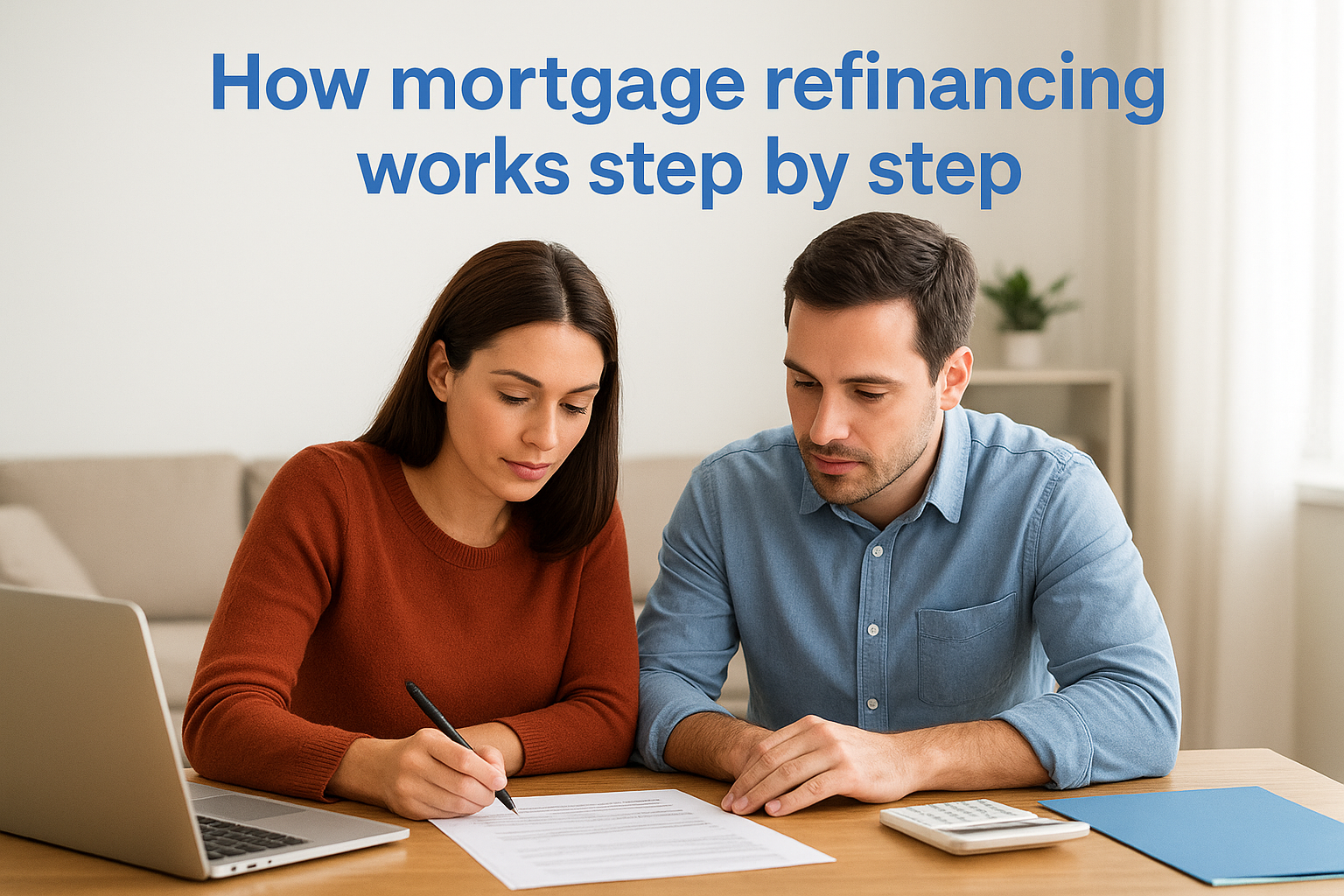
Once you understand what is mortgage refinancing at a conceptual level, the actual process follows a familiar path if you've bought a home before. You're essentially applying for a brand new mortgage, and the lender will evaluate your finances, order an appraisal, and underwrite the loan before closing. The key difference is that instead of receiving funds to purchase a property, the new loan pays off your existing mortgage balance, and your monthly payments shift to the new terms from that point forward.
Check your numbers before you apply
Before you contact any lender, spend time pulling your financial picture together. Your credit score, current loan balance, and estimated home value are the three numbers that shape what terms you'll qualify for and whether refinancing makes financial sense at all. Pull your credit report, request a payoff statement from your current servicer, and get a rough sense of your home's current market value using recent comparable sales in your area.
Running these numbers before applying saves you from taking a hard credit inquiry on a refi that won't pencil out.
Setting a clear goal, whether that's lowering your rate, shortening your term, or pulling out cash, also helps you shop lenders more effectively because you know exactly what loan product you're comparing across quotes.
Apply, get your home appraised, and close
Once you submit your application, the lender will verify your income, employment, assets, and debt obligations through standard documentation: pay stubs, tax returns, bank statements, and your current mortgage statement. Most conventional refinances require a formal home appraisal to confirm the property's current value, which directly affects your loan-to-value ratio and the rates you can access.
Underwriting typically takes two to four weeks, though streamline programs through FHA or VA can move faster because they waive certain documentation and appraisal requirements for eligible borrowers. Once the underwriter clears the file, you'll receive a closing disclosure with the final loan terms, sign the documents, and wait through a three-business-day rescission period before the loan funds. After that, your old mortgage balance is paid off and your new payment schedule begins with the replacement loan.
Refinance options and loan types
Not every refinance looks the same. The loan type you choose determines the documentation required, the equity rules that apply, and whether you walk away with a lower payment, a shorter term, or cash in hand. Understanding what is mortgage refinancing across different product types helps you pick the right tool for your specific goal rather than defaulting to whatever a lender first presents.
Rate-and-term refinance
A rate-and-term refinance is the most straightforward option available. You replace your existing mortgage with a new one that carries a different interest rate, a different repayment term, or both, without meaningfully changing the loan balance. This is the right move when rates have dropped significantly or when your credit profile has improved enough since closing to qualify for better terms.
If your only goal is a lower payment or a faster payoff, a rate-and-term refi accomplishes that without the added risk of borrowing against your home's equity.
Conventional, FHA, and VA loans all offer rate-and-term options, but the rules around loan-to-value ratios and mortgage insurance vary by program. Your lender will match you to the product that fits your current loan type and equity position.
Cash-out refinance
A cash-out refinance lets you borrow more than your current balance and receive the difference as a lump sum at closing. Borrowers use this for home improvements, paying down high-interest debt, or funding a down payment on an investment property. Most conventional lenders cap your new loan at 80% of the home's appraised value, so the amount you can pull out depends directly on how much equity you've built.
FHA cash-out refinances allow up to 85% LTV, while VA cash-out programs can go higher for eligible veterans. Each program carries its own mortgage insurance and funding fee structure, which affects the true cost of the cash you receive.
Streamline refinance programs
FHA Streamline and VA Interest Rate Reduction Refinance Loan (IRRRL) programs exist specifically to make refinancing faster and cheaper for borrowers who already hold those loan types. Documentation requirements are reduced, and many borrowers qualify without a full appraisal. The core limitation is that you must already carry an FHA or VA loan to access these programs, and you cannot take cash out through a standard streamline refinance. For borrowers who qualify, the reduced friction and lower upfront costs make streamline programs worth exploring first.
Costs, break-even, and the real math
Refinancing is not free, and understanding the full cost structure is where many borrowers stumble. When people ask what is mortgage refinancing, they often focus on the rate drop but overlook the upfront expenses that determine whether the lower payment actually translates into real savings. Closing costs on a refinance typically run between 2% and 5% of the loan amount, which means a $300,000 refinance can cost you $6,000 to $15,000 before you see a single dollar of monthly savings.
What you'll pay at closing
Your closing costs on a refinance cover several distinct fees, and knowing where the money goes helps you compare lender quotes accurately. Origination fees, discount points, appraisal fees, title insurance, and government recording fees are the most common line items you'll see on your loan estimate. Some lenders offer a no-closing-cost refinance, but they typically roll those costs into the loan balance or offset them with a higher rate, so you pay either way.
A no-closing-cost refinance is not free; it just changes when and how you pay.
Here are the most common refinance costs to expect:
- Origination fee: 0.5% to 1% of the loan amount
- Appraisal: $400 to $700 depending on property type and location
- Title search and insurance: $500 to $1,500
- Recording fees: $50 to $500 depending on your county
- Prepaid interest and escrow setup: varies based on your closing date
How to calculate your break-even point
Your break-even point is the number of months it takes for your cumulative monthly savings to equal what you paid in closing costs. The calculation itself is straightforward: divide your total closing costs by your monthly payment reduction. If you paid $6,000 to close and your payment dropped by $200 per month, you break even in 30 months, or two and a half years.
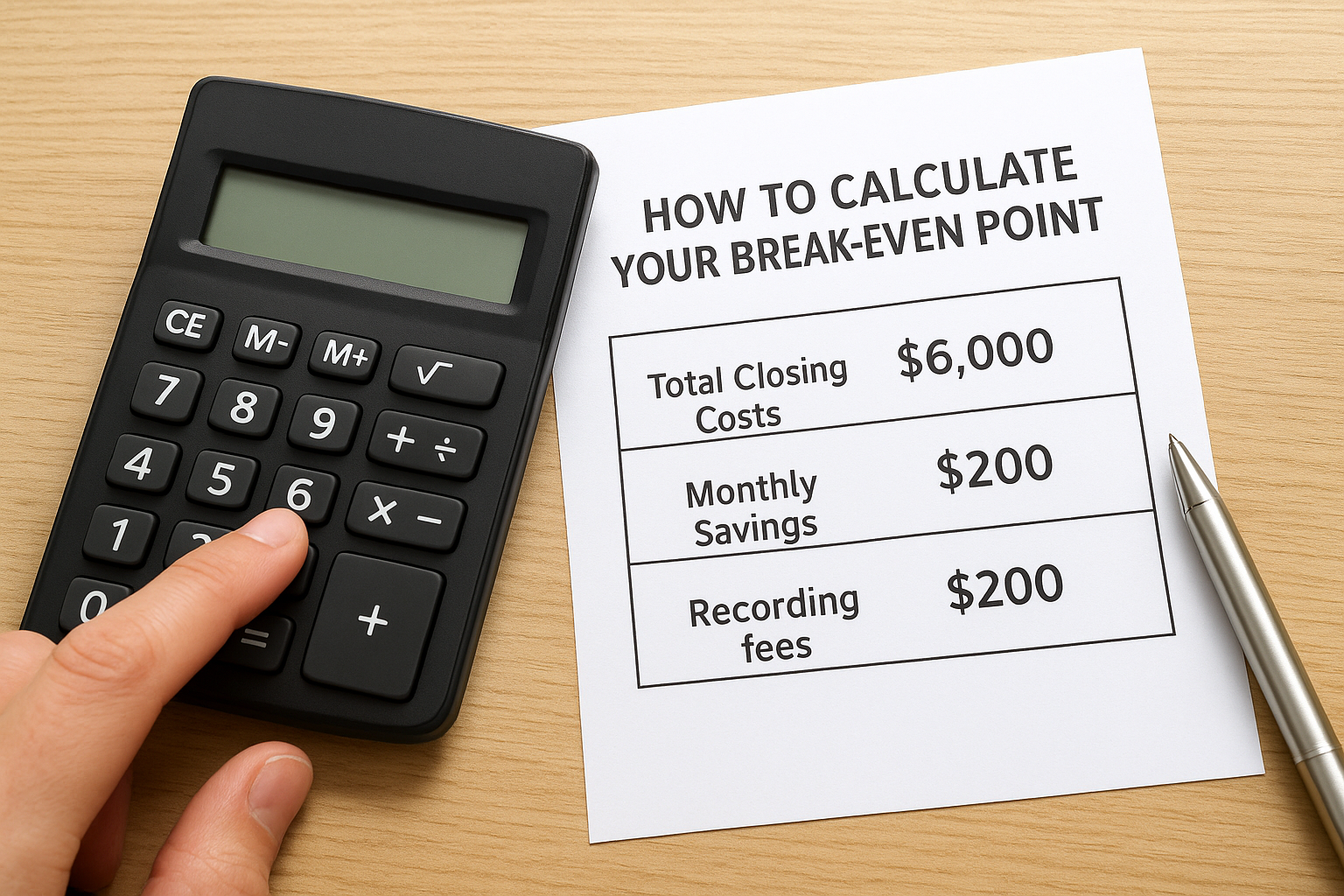
This number only matters in context. If you plan to sell or refinance again before you hit that break-even point, the refi costs you money on net. The longer you stay in the home after crossing the break-even threshold, the more the refinance pays off. Run this math before you apply, not after you've already locked a rate.
Who qualifies and what lenders look for
Whether you qualify to refinance depends on the same core factors lenders evaluated when you first applied for your mortgage. Credit score, debt-to-income ratio, home equity, and employment history all influence your eligibility and the rate you'll receive. Understanding what is mortgage refinancing from the lender's perspective helps you prepare your application with a realistic picture of where you stand before you submit anything.
Credit score and debt-to-income ratio
Your credit score is the single fastest variable lenders check because it signals how reliably you manage debt. Most conventional refinances require a minimum score of 620, though you'll need a score closer to 740 or above to access the most competitive rates. FHA refinances allow scores as low as 580, which gives borrowers with imperfect credit a viable path to better terms.
Improving your score by even 20 to 40 points before applying can move you into a lower rate tier and save you more than the delay costs you.
Your debt-to-income ratio (DTI) measures how much of your gross monthly income goes toward debt payments, including the proposed new mortgage payment. Most conventional lenders cap this at 45%, though some programs allow up to 50% with compensating factors like significant cash reserves. You calculate it by dividing your total monthly debt obligations by your gross monthly income. If your DTI is too high, paying down a credit card or auto loan before applying can bring it into an acceptable range.
Home equity and loan-to-value ratio
Your loan-to-value ratio (LTV) determines which refinance options are available to you and how much equity you can access in a cash-out scenario. Most conventional lenders require at least 20% equity to avoid paying PMI on the new loan, which translates to an LTV of 80% or lower. If your home has appreciated significantly since you purchased it, you may have more equity than you realize, and a current appraisal will confirm the number.
Lenders also look at your employment and income stability to confirm you can support the new loan payment. Two years of consistent employment history in the same field is the standard benchmark. Self-employed borrowers typically need to provide two years of tax returns, which is where having an experienced lender who understands non-traditional income documentation makes the process significantly smoother.
When refinancing helps and when it hurts
The answer to what is mortgage refinancing ultimately depends on whether the math and timing work in your favor. Refinancing can be a powerful financial tool or an expensive mistake, and the difference usually comes down to a few specific factors: how long you plan to stay in the home, where rates sit relative to your current loan, and what you're actually trying to accomplish. No single rule applies to every borrower, which is why evaluating your situation against concrete scenarios matters more than following general advice.
When refinancing makes clear sense
Refinancing works in your favor when your current rate is noticeably higher than what you'd qualify for today and you plan to stay in the home long enough to recover the closing costs. A borrower who locked in a rate during a high-rate environment and can now drop by a full percentage point or more stands to gain real savings over time. Eliminating PMI through a refinance is another scenario where the numbers often work cleanly, especially when your home has appreciated enough to cross the 20% equity threshold without requiring a large rate improvement to justify the costs.
Refinancing also makes sense when your financial profile has improved significantly since you first closed, because better credit and lower debt open access to loan products and rates you couldn't reach before.
Investors and homeowners with large equity positions often benefit from cash-out refinancing when they have a specific, high-return use for the funds. Pulling equity to fund a renovation that adds measurable value to the property, or using it as a down payment on an income-producing asset, can make the borrowing cost worthwhile compared to the return on that capital.
When refinancing works against you
Refinancing hurts when you pay thousands in closing costs and then sell or move before reaching your break-even point. A borrower who closes a refinance with $8,000 in costs and sells 18 months later has simply spent money for no net benefit. Short timelines and refinancing rarely produce a positive outcome.
Extending your loan term to lower the monthly payment can also cost you significantly in the long run. Resetting a 30-year clock when you're already 10 years into your original loan means paying interest for 40 total years instead of 30, and that extra decade of payments adds up fast.
Next steps
Now that you understand what is mortgage refinancing, from how it works to what it costs and when it pays off, the next move is to run the actual numbers against your current loan. Pull your credit score, get a payoff statement from your servicer, and estimate your home's current value. Those three data points tell you quickly whether refinancing is worth pursuing right now or worth revisiting later.
Every borrower's situation is different. Your rate, your timeline, your equity position, and your goals all shape whether a rate-and-term refi, a cash-out loan, or a streamline program is the right fit. Getting an experienced lender to review your full picture costs you nothing and saves you from making a decision based on incomplete information.
If you're ready to see what terms you'd actually qualify for today, connect with David Roa for a straightforward conversation about your options with no pressure attached.
